
Two questions people often ask
How do I know if a yard drainage contractor actually understands my problem?
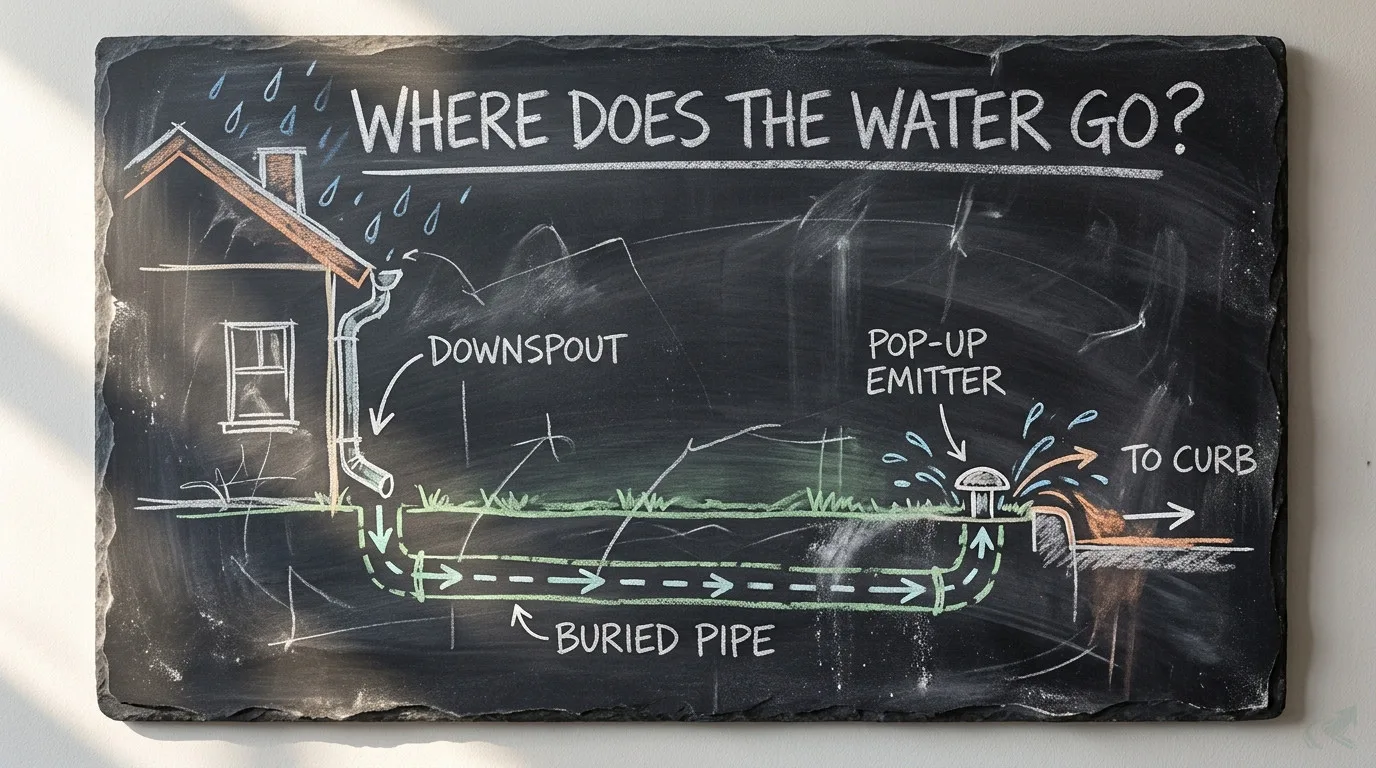
Ask where the French drain pipe daylights -- where the pipe physically exits the property and discharges water. A contractor who can't answer specifically ('to the swale at the rear property line' or 'to the street curb via a buried pop-up emitter') hasn't designed a drainage system. They've proposed a trench.
Is every standing water problem in NC solvable with a French drain?
No -- and the ones that aren't are expensive mistakes. A high clay-water table problem needs a different solution than a surface-grade problem. A contractor who proposes the same solution for both has diagnosed neither.
Both contractors Karen talked to said “French drain.” Both were confident. Both quoted different prices — one at $6,200, one at $14,800. When she asked each of them “where does the water actually go?” the first said “into the ground.” The second said “it drains away.” Neither of those is a drainage plan. That’s two contractors who haven’t thought about where the water goes.
This page gives Karen — and any NC homeowner sitting on two identical-sounding proposals — the questions that reveal whether a contractor diagnosed the yard or just quoted their standard solution.
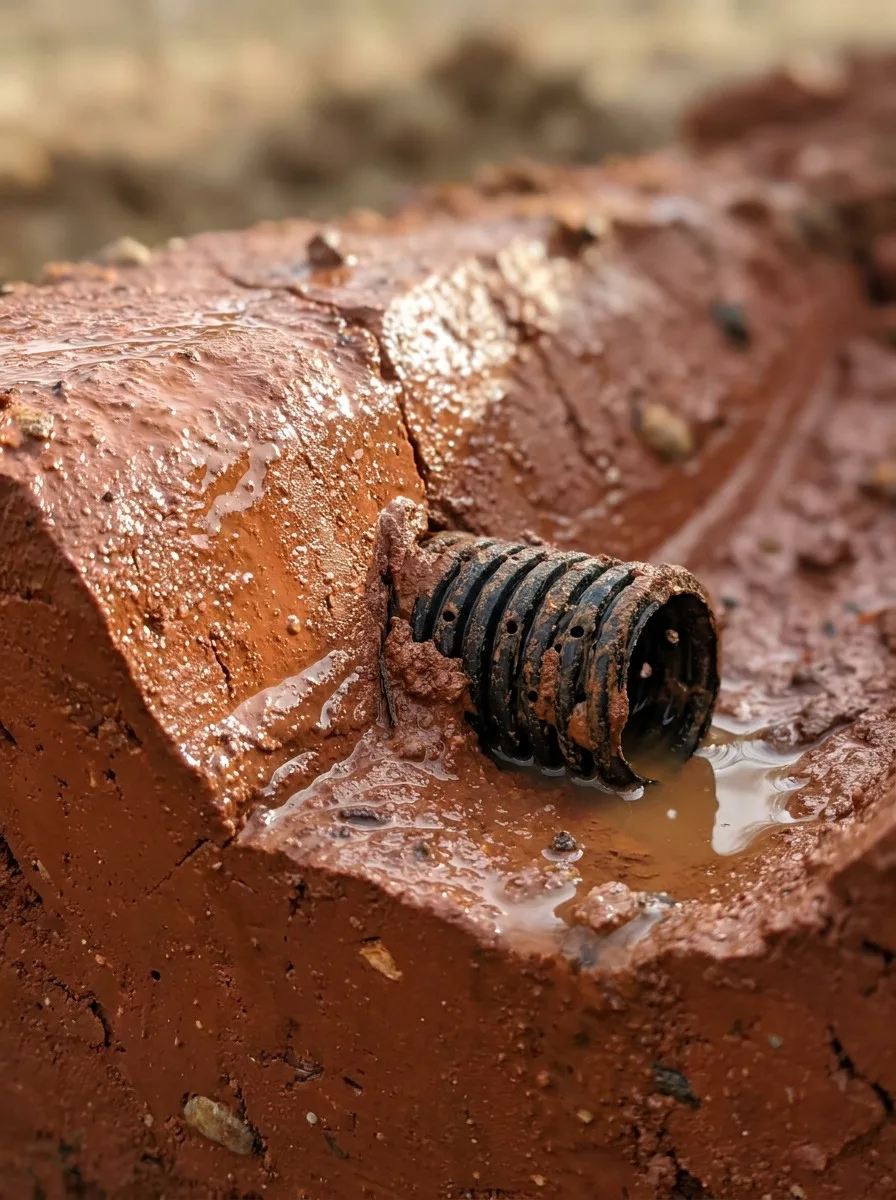
Diagnosis-First vs Default-French-Drain — The Difference
A diagnosis-first contractor identifies the source of the standing water before proposing a solution. A default-French-drain contractor proposes a French drain for every standing-water problem, regardless of cause.
The two approaches look similar in the proposal stage. Both show up, walk the yard, and quote a French drain. The difference is in the questions asked before the proposal.
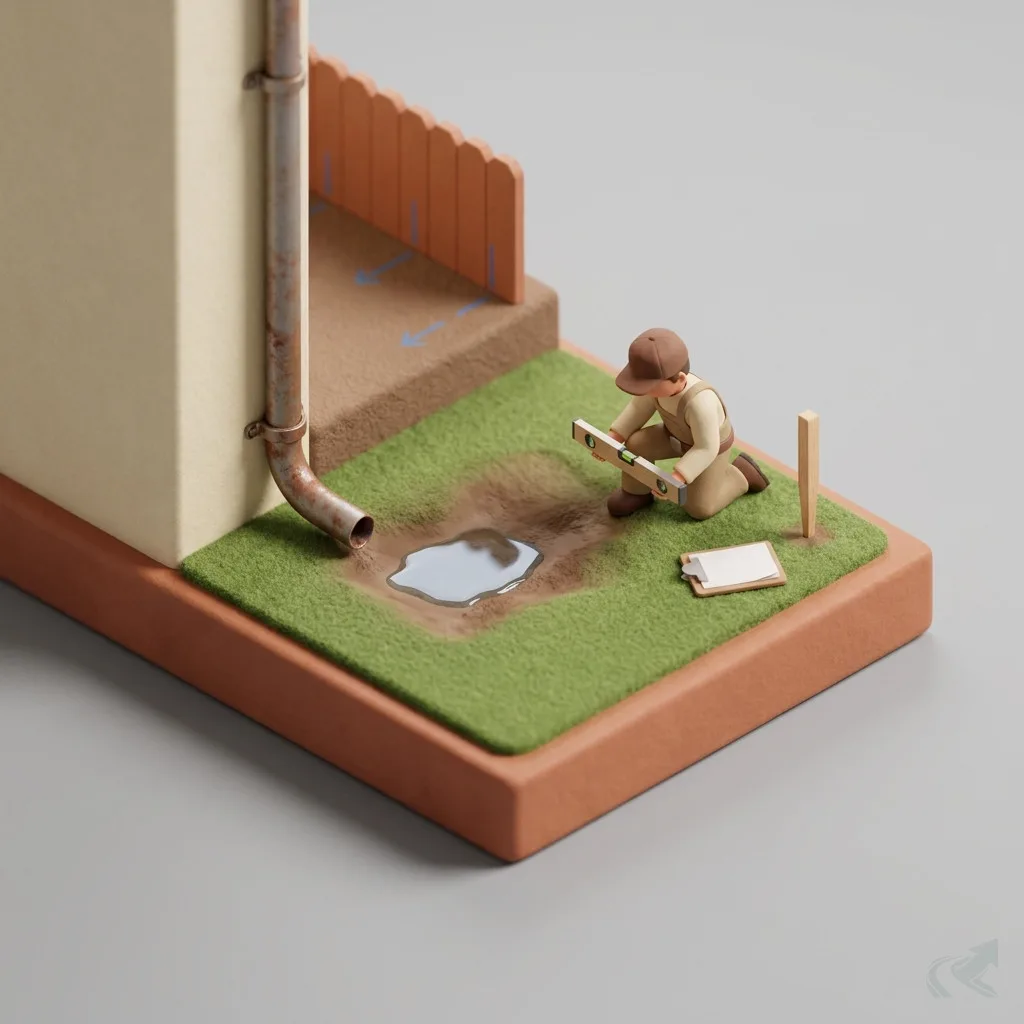
Diagnosis-first: The contractor asks where the water originates — high water table, surface runoff from an uphill neighboring lot, settled grade creating a low spot, improper downspout routing, or some combination. They measure slope. They ask where the water needs to exit the property. Then they propose a system that addresses the actual problem.
Default French drain: The contractor sees standing water and quotes a French drain. They may be correct — but they’re correct by accident, not by analysis. The problems surface when the French drain addresses the wrong problem.
A high-water-table yard doesn’t drain better with a surface-level perforated pipe buried in Piedmont clay. A surface-runoff problem from an uphill neighbor requires routing water off the property entirely — not installing a drain that fills with clay-saturated water and saturates the surrounding soil.
There are yards that need a French drain. There are yards that need regrading. There are yards that need both. A contractor who only knows one of those fixes is offering their hammer to every problem — which is why the first question when you hire a grading contractor in NC should be about diagnosis, not price.
A diagnosis-first contractor vs a default-French-drain contractor
Comparison. Diagnosis first: Asks where the water originates before quoting; Measures slope and identifies the exit point; Screens for high water table, uphill runoff, downspouts; Proposes the system that fits the actual problem. Solution first: Sees standing water, quotes a French drain; Marks the trench without measuring anything; Right only by accident, not by analysis; Drain fills with clay-saturated water and fails.
- Asks where the water originates before quoting
- Measures slope and identifies the exit point
- Screens for high water table, uphill runoff, downspouts
- Proposes the system that fits the actual problem
- Sees standing water, quotes a French drain
- Marks the trench without measuring anything
- Right only by accident, not by analysis
- Drain fills with clay-saturated water and fails
A contractor who only knows one fix is offering the same hammer to every drainage problem.
The Daylight Question — The Fastest Diagnostic
Ask “where does the pipe daylight?” — where the French drain pipe physically exits the property and discharges water. A contractor who can’t answer that specifically hasn’t designed a drainage system.
“Daylight” is the technical term for the exit point of a French drain pipe. The pipe must terminate somewhere outside the saturated zone and discharge water off the property or into a designed collection point. Without a daylight point, the water moves from one spot in the yard to another spot in the yard.
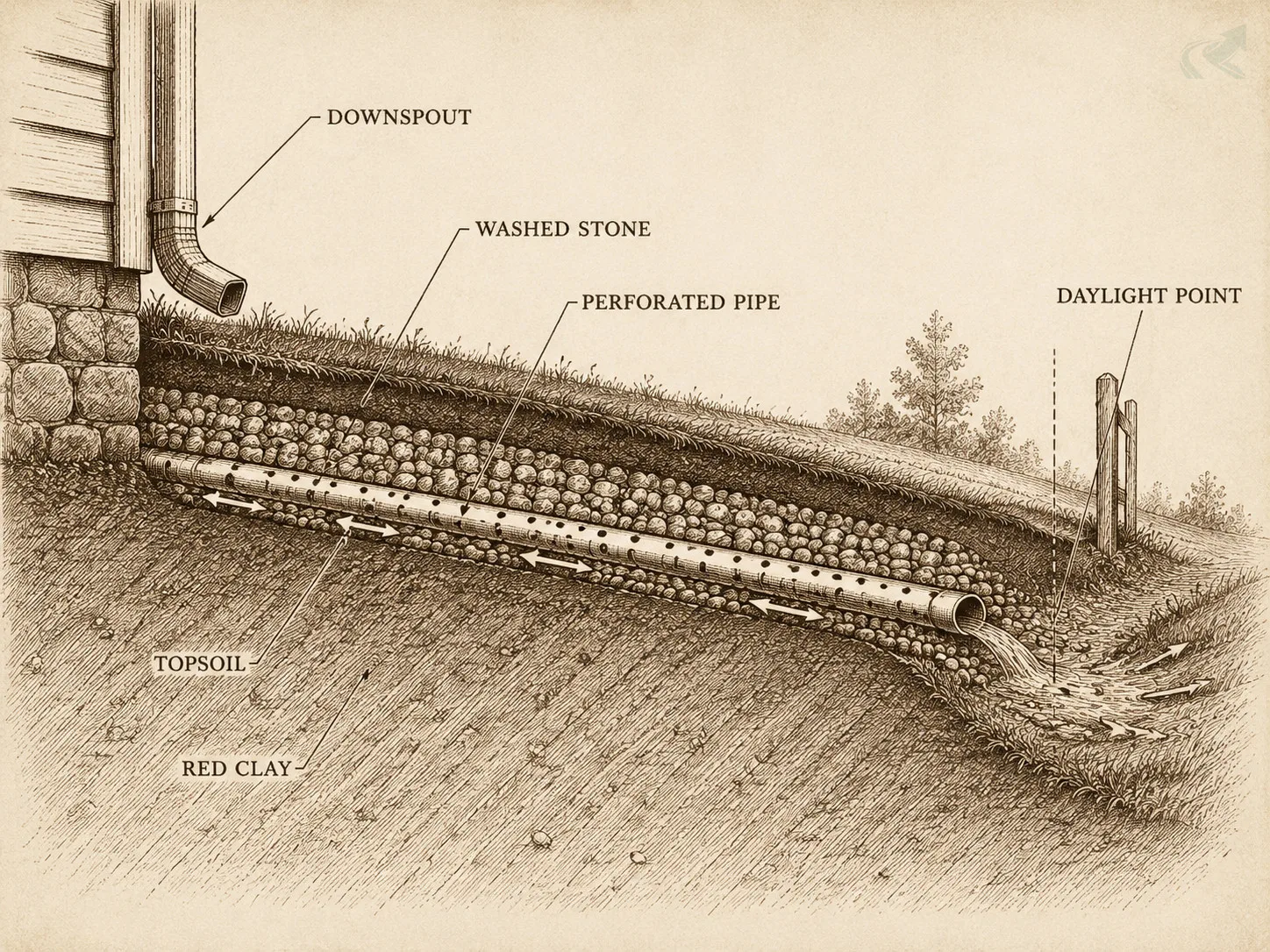
Acceptable daylight locations in North Carolina:
- The street curb, via a buried pipe running to a pop-up emitter at the curb line
- A drainage swale at the rear or side property boundary
- A recorded drainage easement on the property
- The downhill side of the property where grade naturally provides a free-discharge slope
What “into the ground” means: The contractor has no daylight plan. Water will saturate the soil around the pipe, and within two or three rain cycles, the area adjacent to the French drain trench becomes the new standing-water problem.
The question is direct: “Where does this pipe exit the property and discharge?”
A contractor who points to a specific location — “we tie into the drainage swale at your rear property line, here” — is working from a design. A contractor who says “it drains away” is not, and vague answers about water discharge are among the clearest red flags in NC grading quotes.
Three Questions That Reveal a Contractor’s Diagnosis Quality
Three questions separate contractors who diagnosed the yard from those who quoted their standard solution.
Ask these before accepting any yard drainage proposal. The answers — not the price — reveal whether the contractor understood the problem.
Question 1: “What do you think is causing the standing water?”
- Specific answer (good): High water table in this area of the lot; surface runoff from the adjacent uphill property; the grade has settled toward the foundation; the downspout discharges six feet from the house with nowhere to go.
- Generic answer (concern): “Clay. Your soil is just clay.” — Technically accurate for most of North Carolina. Not diagnostic. Clay explains why water doesn’t drain fast; it doesn’t explain why it pools where it does.
Question 2: “Where does the pipe daylight?”
- Specific answer (good): “We run the pipe to the rear swale at your property line” or “we tie into a pop-up emitter at the street curb.”
- Vague answer (concern): “It drains away” or “into the ground.” No named exit point means no drainage design.
Question 3: “What happens to my yard if it rains two inches in 24 hours?”
- Specific answer (good): Describes the flow path — where water enters the system, how it moves through the pipe, where it exits the property.
- Vague answer (concern): “Should handle it.” No description of flow path means no drainage system was actually designed.
Copy these three questions before your next contractor visit. The answers will tell you more than the quote.
When a French Drain Is the Right Answer — and When It Isn’t
A French drain is appropriate when excess subsurface water is the problem and a viable daylight point exists. It is the wrong fix — or insufficient on its own — when the problem is surface runoff with no subsurface component.
French drain is appropriate for:
- Subsurface water table that is consistently high — soil that stays wet at 6 to 12 inches below grade even days after rain, a sign the clay profile is holding a perched water layer
- Water entering from uphill that needs to be intercepted before reaching the yard (a curtain drain — a French drain for NC red clay installed perpendicular to the slope at the uphill edge of the yard — is the correct variant here)
- Foundation footing collecting water from a perched layer in the Piedmont clay profile, producing basement moisture or crawl-space water — a problem that overlaps with foundation drainage NC and usually needs more than a French drain alone
French drain is not appropriate (or not sufficient) for:
- Standing water from surface runoff with no subsurface component — the fix here is regrading to establish positive drainage (grade sloping away from the low spot) and compaction to prevent future settling
- Downspout discharge creating localized ponding — the fix is a downspout extension with a buried rigid pipe and pop-up emitter at grade, not a French drain
- Yard grading that slopes toward the foundation — a French drain won’t fix a positive-drainage problem; regrading and compaction address the slope itself
A note for NC homeowners who have watched French drain tutorials: Much of that content originates from regions with sandy or loamy soil where subsurface drainage is the primary mechanism. North Carolina Piedmont clay doesn’t behave the same way. A French drain that works reliably in sandy Florida soil can fail in NC red clay within one season. The advice isn’t wrong in its home context — it needs translation, not dismissal, for French drains in NC red clay.
For a broader look at standing water yard drainage solutions NC, including approaches beyond French drains, the drainage QN covers the full range of methods.
What a Legitimate Yard Drainage Quote Includes
A legitimate yard drainage quote names the problem, the system, the daylight point, and the material specifications.
If a quote doesn’t include these elements, ask for them before signing. A contractor unwilling to specify these items in writing is a contractor who hasn’t designed the system.
Line-item checklist for a yard drainage proposal:
- Problem statement — what the contractor diagnosed as the cause of standing water
- System type — French drain, curtain drain, swale, regrading, downspout extension, or a combination
- Daylight location — the specific exit point, named and locatable on the property
- Pipe specification — diameter and material (corrugated flex pipe vs. smooth-wall rigid pipe; rigid smooth-wall handles more flow and is less prone to root intrusion)
- Aggregate specification — the stone type and size surrounding the perforated pipe (washed stone, not crusher run)
- Installation depth — how deep the pipe will be set
See itemized yard drainage quote for the full breakdown of what each line item reveals about the contractor’s proposal quality.
Common Mistakes When Hiring a Yard Drainage Contractor
Accepting “it drains away” as a daylight plan. No specific exit point means no drainage design. This is the single most common setup for a failed French drain in NC — the contractor installs a perforated pipe in clay soil with nowhere for the water to go, and the area next to the trench becomes the new standing-water problem.
Assuming two identical proposals confirm the diagnosis. Two French drain quotes may mean two contractors with the same default solution, not independent confirmation that a French drain is correct. The daylight question and the diagnosis question reveal whether either contractor actually worked the problem.
Choosing by price without understanding scope. A $6,000 quote and an $18,000 quote for “yard drainage” may be for entirely different systems solving different problems — or the same system quoted at very different margins. The three diagnostic questions give a basis for comparing proposals on substance, not just price.