
Two questions homeowners ask before calling anyone
Do I need new gravel, or do I need regrading -- or both?
Both, in order. Regrade first to re-establish the crown. Compact the base. Add gravel top-up after the geometry is correct. Adding gravel without regrading first puts new material in the same divots and channels the old gravel already fled.
What kind of gravel should go on a North Carolina driveway?
ABC (Aggregate Base Course) for the base layer -- its fines lock under compaction against Piedmont clay. CABC or #67 as a surface wearing course if specified. Never #57 washed stone or screenings as a surface -- both migrate under traffic in NC clay conditions.
Your gravel driveway has ruts, channels, and bare clay showing where the gravel migrated to the low side. One contractor quoted you “3 loads of , spread and grade, $800.” Another quoted “regrade first, then material, $2,200.” You don’t know which is right.
The answer depends on whether the base is still intact and whether the crown geometry can be re-established with existing material. If the base has soft spots or the crown is flat, regrading is not optional — it comes before anything else. This page gives you the diagnostic to figure out which scope you’re actually buying.
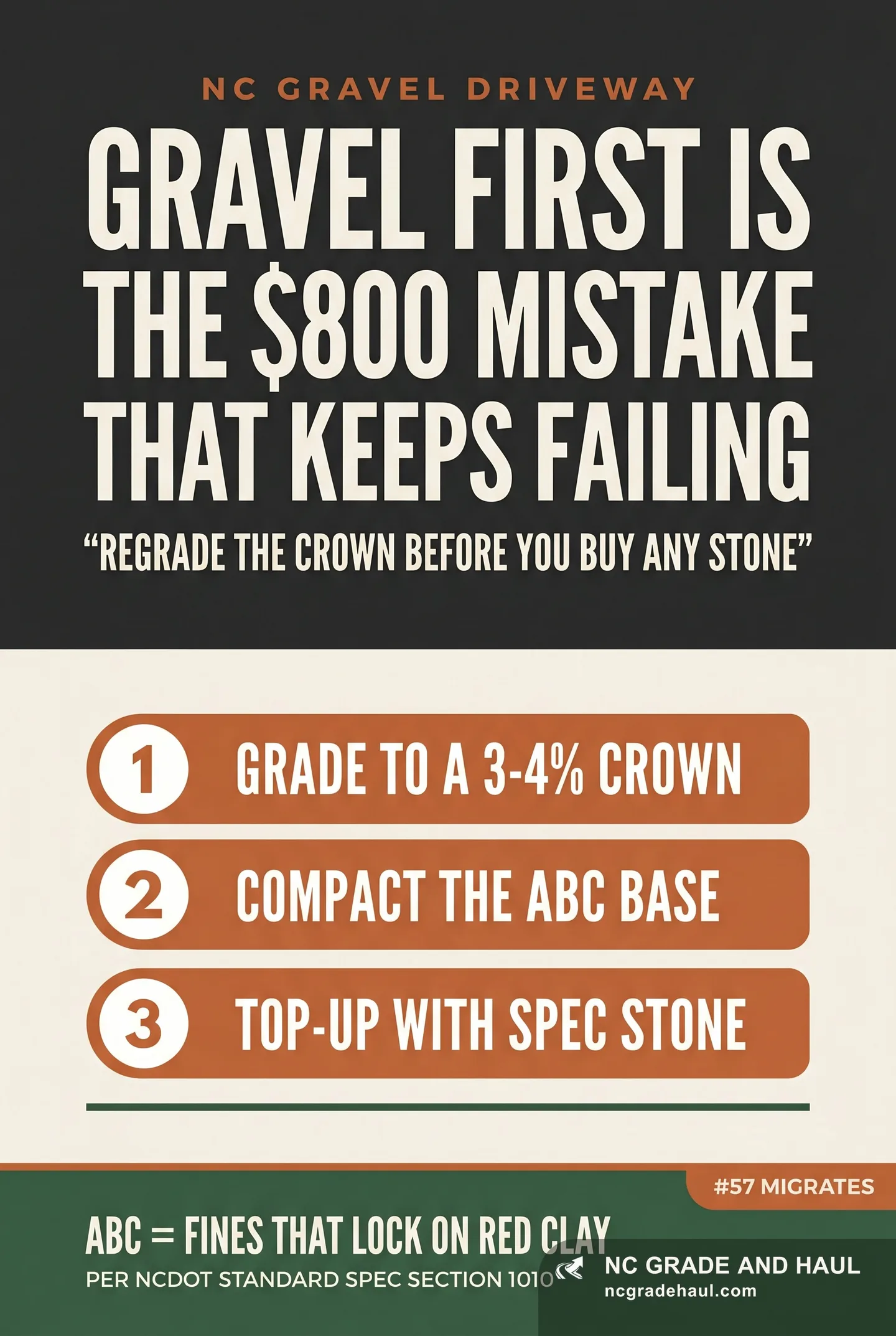
Regrade vs Top-Up — How to Decide
If the base is intact and the crown is mostly preserved, a top-up may be enough. If the base has soft spots, the crown is flat, or ruts cut through to subgrade, regrading comes first.
Walk this four-step check before you call anyone. It takes ten minutes and it tells you what category your driveway is in.
- Walk the driveway after rain. Any spot that feels soft or springs underfoot is a base issue. That means regrade required before top-up — no exceptions.
- Check the crown from one end. Stand at one end and look down the centerline. Is the middle of the drive higher than the edges? If it looks flat or concave, the crown is gone. Regrade required.
- Where is the gravel right now? If gravel has piled into the ditch on one side and the center shows bare clay, the crown was lost and the gravel followed the water. Top-up alone will not fix this. The geometry has to be re-established first.
- How deep are the ruts? Ruts under 2 inches that do not expose subgrade: top-up may restore passability. Ruts over 2 inches exposing clay: regrading required.
The honest answer for most degraded North Carolina gravel driveways: regrading plus a partial top-up is usually the right scope. A pure gravel-only top-up without regrading is rarely the right call — it works only for very mild cosmetic degradation on a base that is still tight and crowned.
The Gravel Driveway Grading Sequence
Crown first, compact second, top-up third. This sequence is not optional — doing it out of order produces a surface that fails faster than the one you started with.
Here is what each step looks like on site:
- Clear debris. Remove organic material, mud, and anything that is not driveway base from the surface. Spreading gravel over organic material creates a soft, unstable layer that ruts immediately under traffic.
- Grade to crown. The operator uses a motor grader or box blade to pull material toward the centerline, shaping a 3-4% crown from center to edges — why gravel driveways need a crown is covered in detail at the crowning spoke. This step often uses existing material — you may not need new gravel yet.
- Compact the base. A padfoot or drum roller makes passes over the freshly graded base. If subgrade soft spots were suspected during the diagnostic walk, proof-roll with a loaded truck before committing to the top-up phase.
- Observe through one rain event if time allows. Watching where water goes after the first rain confirms whether the crown is shedding correctly. This is the cheapest quality check available.
- Top-up with specified material. for the base layer; #67 stone or for the surface wearing course if specified. Material is spread by tail-gating delivery or by blade from a stockpile. See driveway gravel replenishment hauling for ordering logistics and load sizing.
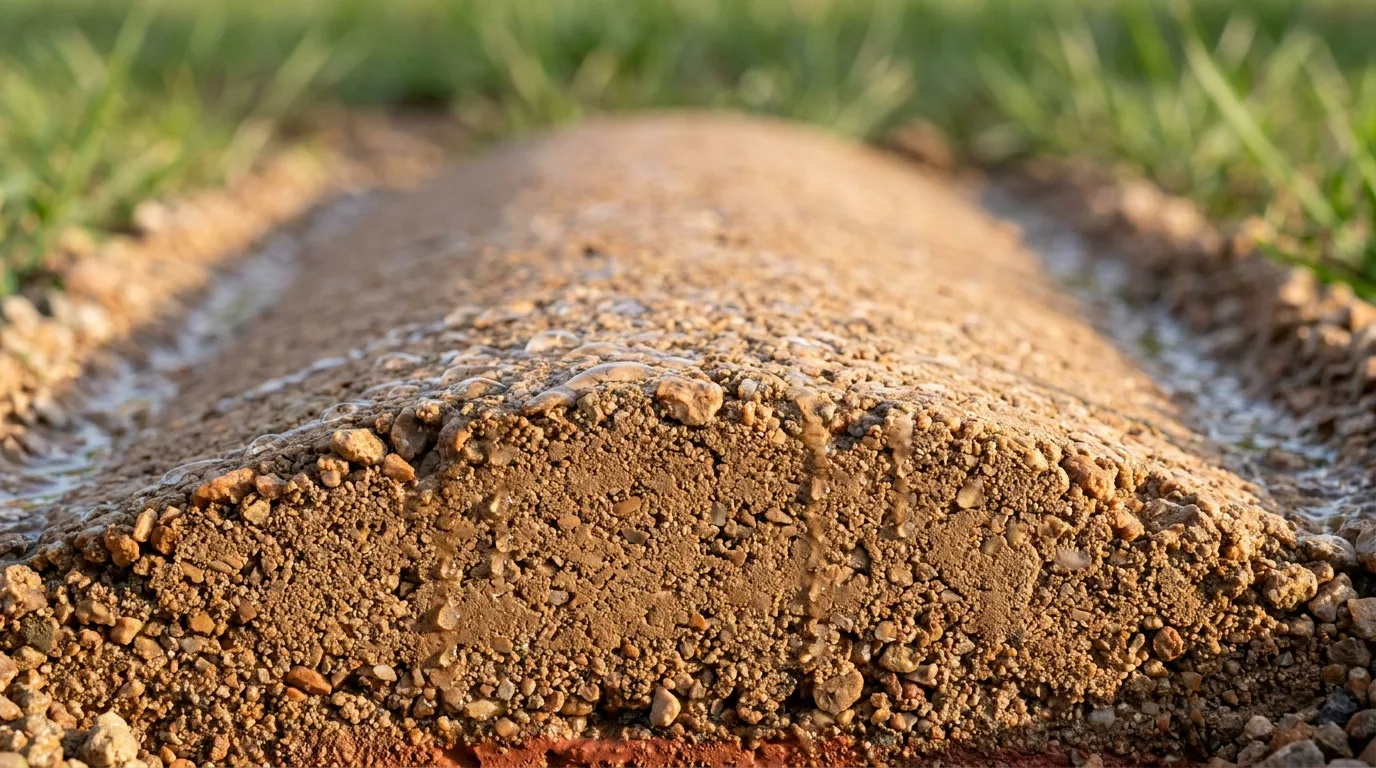
North Carolina standard for gravel driveways is base plus CABC or #67 surface. Avoid screenings-only and #57 washed stone as surface materials — both migrate under traffic on Piedmont clay.
ABC vs #67 — Which Gravel for Which Layer
ABC is the base layer material. #67 is the drainage layer when specified. CABC is the surface wearing course. Using #57 or screenings as a surface fails in NC clay conditions.
Understanding the layers keeps you from accepting a vague “gravel and grade” quote that substitutes cheaper material without you knowing:
- ABC (Aggregate Base Course): mixed gradation from 1.5 inch down to fines. The fines lock particles together under compaction. The NC driveway standard aggregate — applied after regrading; requires compaction. One cubic yard weighs roughly 1.35-1.5 tons depending on moisture.
- CABC (Crusher Run): often used interchangeably with ABC depending on how a specific NC quarry names its products. Same general gradation, same function. Gradation varies more pit-to-pit than ABC — confirm the spec with the quarry before ordering.
- #67 stone: 3/4 inch washed stone. Specified as a drainage layer under ABC when the subgrade is very wet. Not a surface material — it migrates under vehicle traffic.
- #57 stone: slightly larger washed stone. Same migration problem as #67 when used as a surface. A common mistake on NC driveways. If a contractor proposes #57 as the surface wearing course, that is the wrong material for Piedmont clay.
The Piedmont red clay note: clay subgrade is impermeable — water does not move vertically through it. ABC’s fines give it bearing capacity on clay because the fines pack against the clay surface rather than depending on percolation.
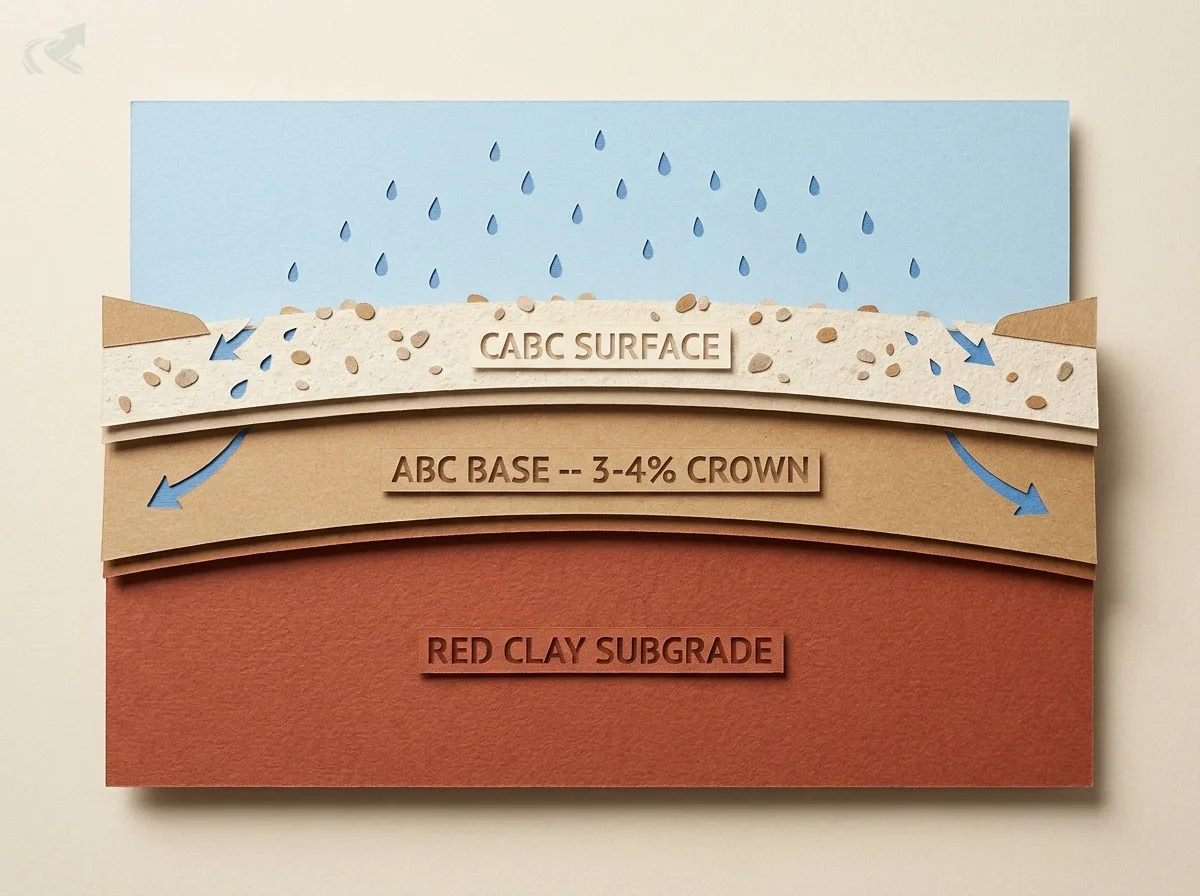
Gravel driveway layers: the right stack vs the wrong stone
Comparison. Right material: ABC base compacted over the red clay subgrade; CABC or #67 surface wearing course on top; Proper crown arc sheds water off both edges. Wrong stone: #57 washed stone or screenings spread straight on clay; No fines to lock under compaction -- nothing binds; Gravel migrates to the low edge, clay shows in the wheel tracks.
- ABC base compacted over the red clay subgrade
- CABC or #67 surface wearing course on top
- Proper crown arc sheds water off both edges
- #57 washed stone or screenings spread straight on clay
- No fines to lock under compaction -- nothing binds
- Gravel migrates to the low edge, clay shows in the wheel tracks
ABC's fines pack against impermeable clay and give it bearing -- washed stone with no fines migrates under traffic.
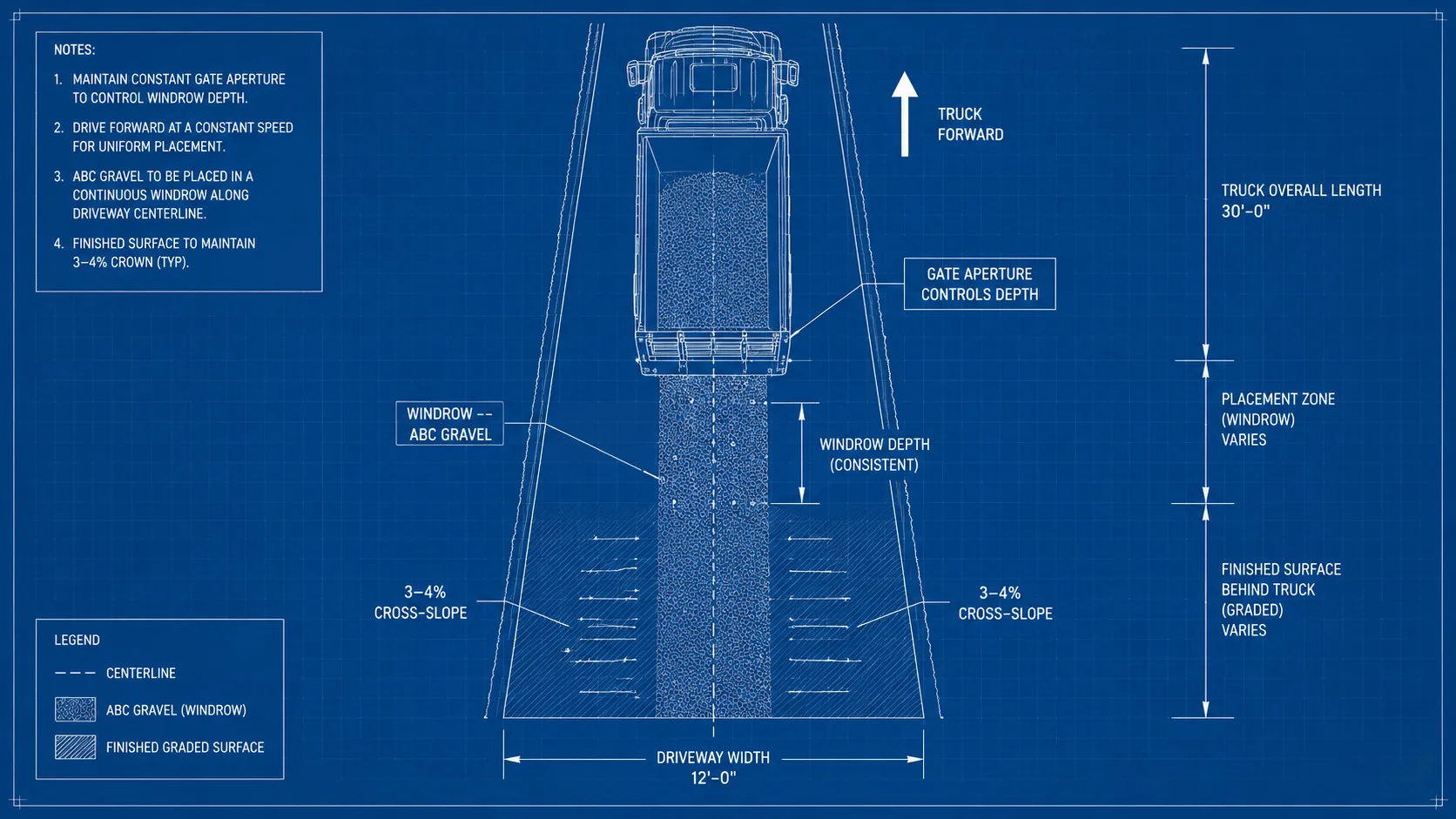
Tail-Gating — How Gravel Gets Spread Properly
Tail-gating means the dump truck releases material slowly as it drives forward — giving the operator a consistent windrow to blade out. It is the professional method for gravel distribution on a driveway.
A contractor who “just dumps it and blades it out” is working from a stockpile. That works, but it means more material movement and a less uniform starting surface for the crown cut.
- Tail-gating requires coordination between the truck operator and the grading operator. Truck speed and gate aperture control the windrow depth — a skilled operator can match the windrow to the blade pass width.
- Uniform windrow depth gives the grading operator a consistent surface to work with when cutting crown. An uneven stockpile dump creates excess in some areas and deficit in others.
- The DIY alternative is stockpile delivery plus blade distribution. More material movement required, but achievable on shorter driveways.
For a deeper look at how tail-gating gravel from a dump truck works in practice, see the tail-gating spoke.
When New Gravel Is Not the Answer
If your driveway keeps losing gravel to the same low spots after every regrade and top-up, the problem is a drainage issue at the edge — not a gravel quantity issue.
Adding more gravel to a drainage problem is like filling a leaky bucket. Signs that drainage is the real underlying problem:
- Gravel migrates to the same ditch or low side after every storm, regardless of how much material you add
- The centerline is chronically lower than the edges — water flowing to center instead of away from it (reversed crown)
- Standing water at the same low point after every rain
These are crown and drainage problems. Gravel alone does not fix them. See how driveway grading works in NC for the full crown diagnostic, and the compaction spoke for gravel driveway compaction NC to understand what proof-rolling confirms.
Common Mistakes on NC Gravel Driveways
The two most expensive gravel driveway mistakes: adding material before regrading, and specifying the wrong stone.
Adding gravel to a driveway without regrading first is like painting over peeling paint — it temporarily covers the problem but does not fix it. The crown and compaction come first. New gravel spread on a flat or reversed crown just migrates to the same low spots the old gravel already found.
The wrong material mistake: substituting #57 washed stone or screenings for ABC on a Piedmont clay subgrade. Neither material locks under compaction the way ABC does. The surface stays loose, ruts under traffic, and pushes to the edges. A quote that says “gravel and grade” without naming the material type is not a real quote.
Before You Order Gravel
A contractor who quotes you “X loads, spread and grade” without specifying crown percentage, compaction method, and material type has not given you a real quote. Before you agree to any scope, get it itemized:
- Material: ABC base, CABC or #67 surface — named by spec, not just “gravel”
- Regrading: separate line item from material delivery
- Compaction: what equipment, how many passes
- Top-up: specified separately from regrading labor
These are three distinct services. You need to know which ones you are paying for. A NC grading contractor near me search on NC Grade and Haul returns contractors with license status and public record references — so you can check before you call.
For more on how driveway grading works in NC and a look at grading a gravel driveway wet vs dry, see the driveway grading hub. For ABC gravel for gravel driveways specs by quarry, see the material spoke. For gravel delivery for driveway top-up logistics, see the hauling spoke.