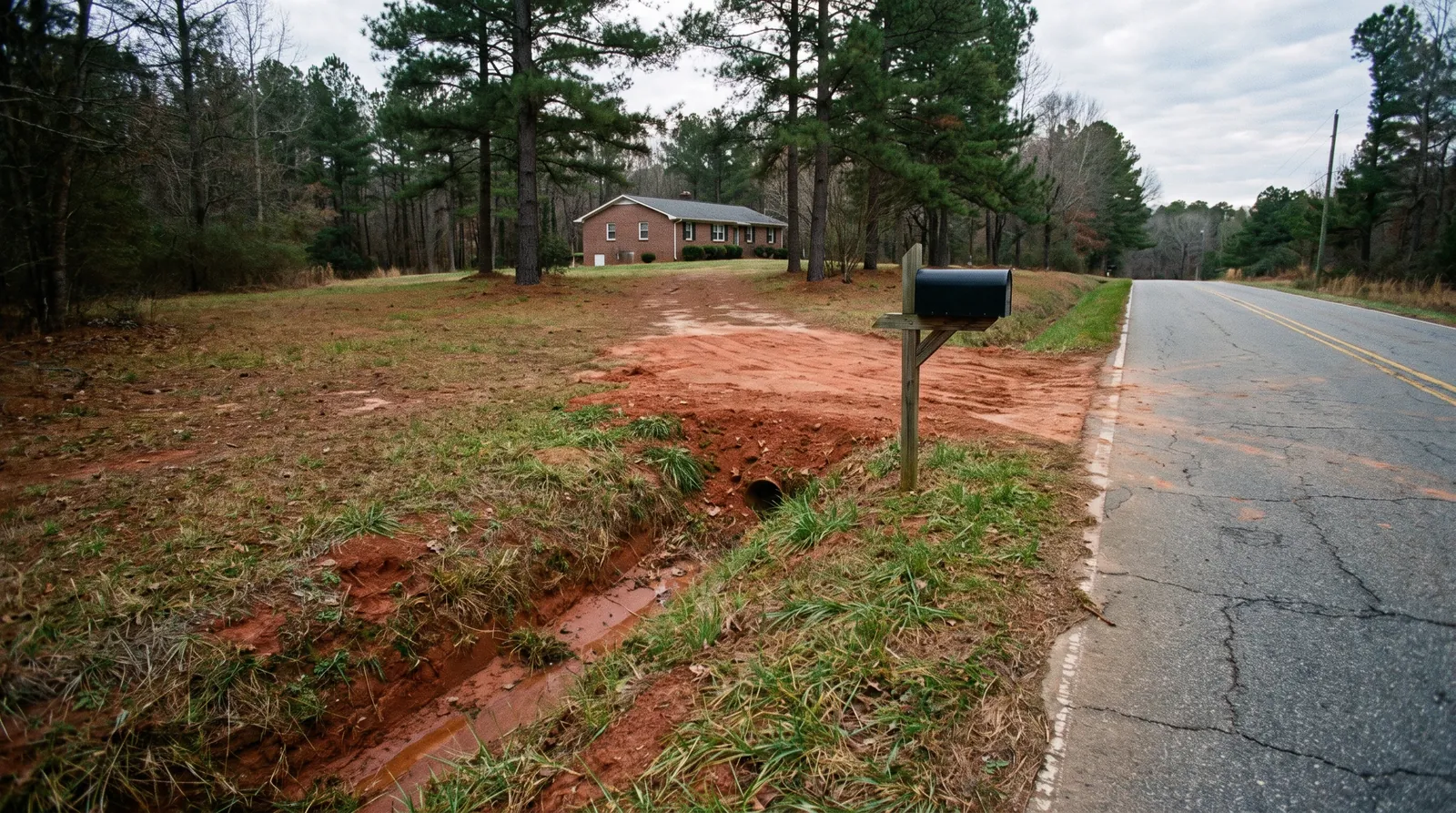
A driveway looks like the most private thing on a property. It is yours from the garage to the mailbox. Then it reaches the road, and somebody else’s rules start.
That somebody is usually one of three: the state, a city or town, or nobody (a private road). Which one decides the permit, the pipe, and who you call first. This page sorts that out. We’re a directory of site-work contractors, checked against public records. We don’t build driveways or issue permits.
Whose Road Is It?
If you wanted to hang a heavy shelf in a rented apartment, would you ask the shelf store, or the landlord?
A driveway onto a road is the same question. Start with who owns the road, before the word “permit.” NCDOT’s own road-ownership page says the department maintains about 80 percent of public roads in the state. Roads with an Interstate, U.S., N.C. or secondary route (SR) number are state-owned. Federal roads, private roads and municipal streets are not.
A road that looks like a county road, or a neighborhood street, can still be a state road. A missing number settles nothing. NCDOT publishes a web map, the Public Street Information Database (HB620), where you click a road and see who owns or maintains it. If the map leaves you unsure, NCDOT lists an email for road-inventory questions on that same page.
In an r/asheville thread, one commenter said neighbors on their street had been trying to get a straight answer, in writing, about who was responsible for clogged storm drains on a street the state maintains. The state said it was on the residents. Another commenter said a city crew cleaned the first ten feet of their storm drain and said the rest wasn’t the city’s. Then somebody asked the question underneath it: how do people even find out who maintains a road? The answer in the thread was the NCDOT map. (That thread was about drains, not driveways, but the confusion is the same one.)
Before you call anyone about a driveway permit
1. Look up the road -- Use NCDOT's HB620 map. State, city or town, or private decides everything after this. 2. Call the right office -- State road: the NCDOT District Engineer for your county. City or town street: the city or town. 3. Ask the two questions -- Is a permit needed for this driveway? What pipe size and length will you set for the ditch? 4. Write down the answer -- Name, date and what was said. Then tell your contractor.
-
Look up the road
Use NCDOT's HB620 map. State, city or town, or private decides everything after this.
-
Call the right office
State road: the NCDOT District Engineer for your county. City or town street: the city or town.
-
Ask the two questions
Is a permit needed for this driveway? What pipe size and length will you set for the ditch?
-
Write down the answer
Name, date and what was said. Then tell your contractor.
The order matters. The pipe and the permit both follow from whose road it is.
Do You Need a Permit?
The state rule is short, and it does not say what most people have heard. North Carolina’s rule on driveways in the highway right of way (19A 02B .0601) says anyone who wants to build a driveway connection in the right of way of a state road must get a permit first. Then it adds that driveway connections to residences “are normally excluded from this requirement.”
“Normally” is doing work. NCDOT may include a residence where the connection involves a public safety hazard, where it falls at a highway construction project, or where drainage installation costs are excessive or the drainage complications are obvious.
NCDOT’s Policy on Street and Driveway Access says the same thing in plain English: permits will normally not be required for a single residence. The very next sentence encourages the owner to contact the District Engineer anyway, to find out about safety and design issues, to coordinate with any road project, and to arrange for the driveway pipe.
Not everything is “normally excluded.” The policy sorts permits into commercial, residential subdivision (which names homebuilder spec houses, apartment complexes and mobile home parks), and a few other classes. A driveway for a house being built to sell, or for a business, is a different conversation than a family’s own driveway. And if you build where a permit is required and skip it, the rule says the driveway can be removed, or access denied, until a permit is executed.
One caution about age. NCDOT’s published policy manual is dated July 2003, and its own current FAQ and permit user guide still point to it, as does the driveway pipe rule, readopted in 2019. The two rules quoted here are the current text on the state’s rules site. NCDOT’s FAQ also words it more broadly: anyone who plans to develop property, or alter an existing access, must get a driveway permit. Confirm with your District Engineer’s office, because they are the ones who decide.
Call the District Engineer First
For a state road, the permit and the pipe both run through one office: the District Engineer’s office for your county. NCDOT splits the state into 14 divisions, each with district offices. The division map page links a PDF listing every division and district office, and it is updated by NCDOT, so we don’t copy phone numbers here.
What to ask, in order:
- Is this a state-maintained road? (If you checked the map, say so.)
- Does a driveway at this spot need a permit? Say whether it’s a new driveway, a widened one, or a move.
- What size and length of pipe will you set for the ditch? Who installs it?
- Is there anything about this spot, like sight distance, a nearby road project, or a drainage problem, that will matter?
NCDOT’s own FAQ says to contact the local city or county authority that controls land use as well, and to contact the District Engineer’s office early.
The Pipe in the Ditch
Most roads in North Carolina have a drainage ditch along the edge. A driveway has to cross it. NCDOT’s policy says that where a driveway crosses a highway ditch, an approved pipe size has to go in the ditch, and under no circumstances will existing ditches be filled without adequate alternate provisions for drainage. The driveway may not cause water to flow across the highway pavement, pond on the shoulder or in the ditch, or erode within the right of way.
For a single-family home on a state road, the rule (19A NCAC 02D .0421) works like this:
- You buy the pipe and deliver it to the installation site. NCDOT is then responsible for the installation and its cost, if the ditch opening is needed for drainage and the other conditions are met.
- The District Engineer sets the size. The pipe is limited to a minimum of 15 inches and a maximum of 48 inches inside diameter unless NCDOT directs otherwise. The policy says the pipe must be adequate for the anticipated flow in the ditch.
- The minimum length is 20 feet, with more where the earth side slopes need it. The pipe is not to be lengthened just to get rid of the typical side ditch.
- Over 48 inches, it’s on you. The policy says the owner furnishes and installs the pipe at their own expense.
- The pipe becomes NCDOT’s. Pipes and culverts properly installed on the right of way under a permit become the property of NCDOT, and NCDOT maintains drainage through them. For single-family homes, the policy says NCDOT will provide new pipe to replace damaged pipe.
The conditions in the rule matter. Among them: the property can’t already have adequate access, the entrance can’t present a safety hazard such as poor sight distance, and the benefit is limited to farm entrances and to property owned by the person living on it or proposing to live on it. The rule says this “does not include property being developed for sale.” Commercial property, which the rule defines to include property being developed for sale, falls under a separate part of the rule with its own application and payment: the owner still furnishes the pipe, and either pays NCDOT $10 per linear foot to install it or has a private contractor install it under NCDOT inspection, with a $50 inspection payment.
If environmental permits are required for the pipe, the policy puts getting them on the owner, who must also furnish and properly install the pipe.
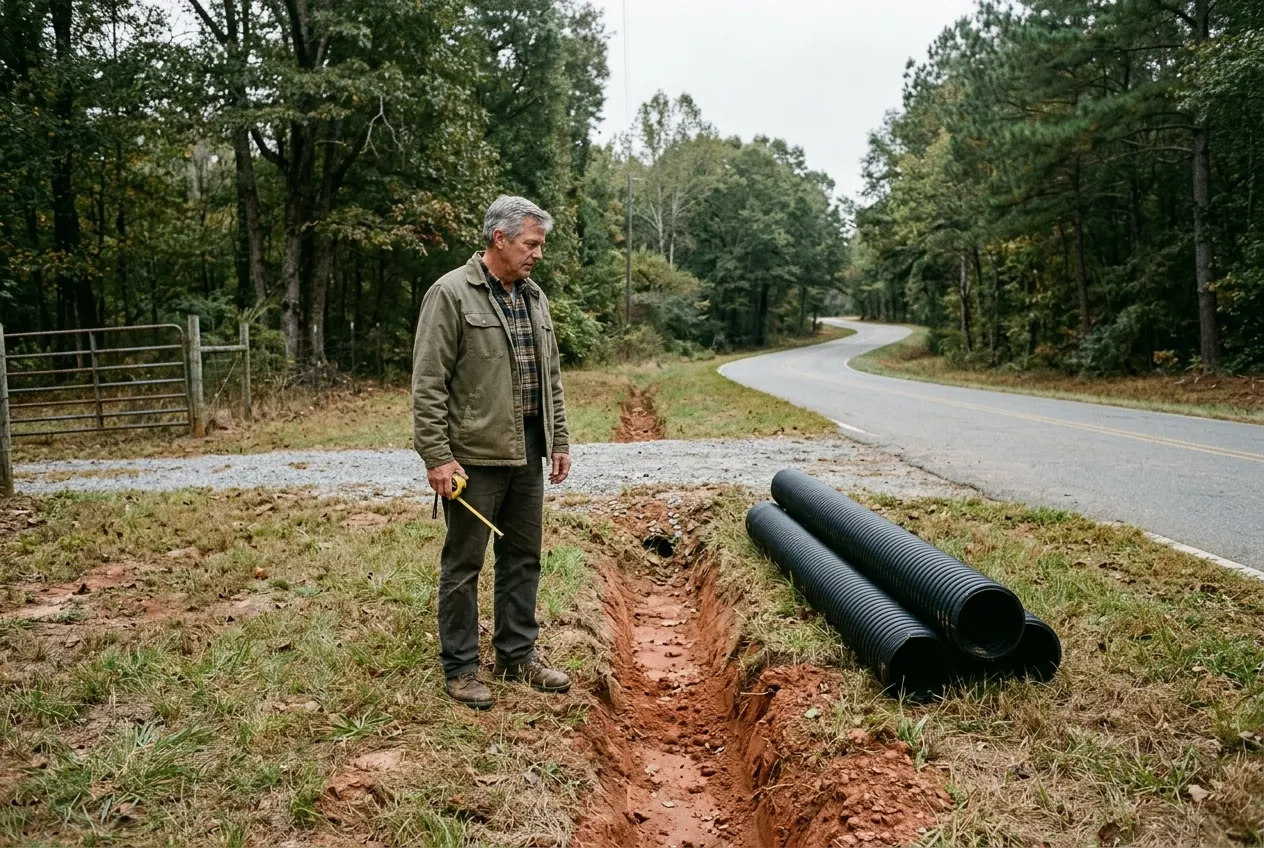
If a friend lends you their car and you bolt a roof rack onto it, whose say-so do you need, and whose car is the rack once it’s on?
The ditch is the state’s, the same way. What you install under permit in it becomes NCDOT’s. So ask first, and buy the pipe second. The driveway culvert guide goes into the pipe itself, and the gravel driveway page covers the driveway above it.
When There Is a Permit: What the Application Asks For
If NCDOT does ask for a permit, here is what the application, the NCDOT Street and Driveway Access Permit Application, actually contains.
- Where. The county, the route or road, and an exact distance from the nearest intersection. The policy also asks for the location on a segment of an NCDOT county map or other suitable map.
- What it’s for. The property use: residential or subdivision, commercial, educational, emergency services, or other. Also whether the property is inside a city’s zoning area.
- Who. The property owner signs, or an authorized agent. Applications are accepted only from the owner or their legally authorized agent, and NCDOT may ask for proof of ownership or authority.
- A plan. The policy asks for at least four site plans, drawn to scale. Freehand sketches are not acceptable.
- Four copies of the application. The form says to submit four copies to the local District Engineer.
- A $50 construction inspection fee. The form has the owner agree to pay it, and says it is reimbursed if the application is denied. NCDOT’s FAQ says there is no charge for applying, though there may be charges for services like inspections.
If a permit is needed: the order of events
1. Apply before you build -- The permit has to be in hand before work starts, or the driveway can be removed at the owner's expense. 2. NCDOT reviews it -- For small or simple requests, four weeks or less after you formally submit. A complicated request can take eight weeks or more. 3. Build to the permit -- Start within one year of approval. Tell the District Engineer in writing when work starts and when it is done. 4. NCDOT approves the finished work -- The District Engineer gives final approval before the connection opens for public use.
-
Apply before you build
The permit has to be in hand before work starts, or the driveway can be removed at the owner's expense.
-
NCDOT reviews it
For small or simple requests, four weeks or less after you formally submit. A complicated request can take eight weeks or more.
-
Build to the permit
Start within one year of approval. Tell the District Engineer in writing when work starts and when it is done.
-
NCDOT approves the finished work
The District Engineer gives final approval before the connection opens for public use.
Times are from NCDOT's FAQ and policy manual. Ask the District Engineer how long yours will take.
Some details people don’t expect:
- There is an online portal, but it needs a Business NCID. NCDOT’s user guide says applicants without an NCID are emailed their approval documents.
- Paved turnouts. The policy requires paved turnouts on permanent permitted connections. On a road with shoulders rather than curb and gutter, it says the turnout should extend 50 feet along the new driveway, and that gravel without a permanent wearing surface is not recommended. The District Engineer can modify the paving requirements. If you are planning the gravel driveway, ask how that applies to the first stretch.
- Bonds. The policy says performance and indemnity bonds, in an amount set by the Division Engineer, may be required for work in the right of way.
- Local rules can add to it. The policy says that if local government rules are more restrictive than NCDOT’s, the local rules govern, and the rule on driveways says the more restrictive of the municipal, county or state ordinance applies.
On a City or Town Street
If your road is a city street, NCDOT is not the office to call. The city is. What a city asks for varies, and the two big cities show the range.
- Raleigh says that if you add or replace a residential driveway you must first get permits from the City. New or widened driveways need a survey showing the work, with dimensions. A like-for-like replacement needs only the application. A contractor working in the right of way, or within five feet of it, must have a performance bond ($5,000 minimum) and liability insurance on file with the City, and the right-of-way part gets a pre-pour inspection. If the property has a private well or septic, approval from Wake County Environmental Services is required first. (More on that: septic systems.)
- Charlotte sends residential driveway questions, including new driveways on city- or state-maintained streets, to the Charlotte Development Center.
Your town may not have a web page for it. Call the public works or planning office, and say whether the road is city, county or state. Cities and NCDOT also coordinate: NCDOT’s policy says there is a general understanding that local governments hold building permits until the state permit is approved, where one is required.
If the Driveway Moves a Lot of Dirt
A driveway that cuts a hillside, or a new drive that is long and wide, can disturb enough ground to trigger a different permit, for erosion and sediment control. The state says an erosion and sedimentation control plan is required when land-disturbing activity covers more than one acre, and it has to be filed at least 30 days before the work begins and approved before it starts. A city or county that runs its own erosion program can set a lower line. The NCDOT policy also puts the applicant on the hook for the erosion-control, water-quality and wetlands permits that apply to the work in the highway right of way.
Most driveways don’t come close to an acre. If yours might, or your local program starts lower, our page on when grading needs a permit covers the line.
Who Does This Work, and How to Check Them
If a clerk says “no receipt needed” and the sign on the wall says “receipt required,” which do you trust at the counter?
A contractor’s “no permit needed” is the clerk. The agency’s written rule is the sign. Whoever builds your driveway should be able to tell you, without looking it up, whose road it is and who the office is. Ask them. A contractor who says “no permit needed” may be right for a single house. The place to confirm it is the District Engineer’s office, and you are allowed to call it yourself.
What would you do?
Read the situation, decide your first move, then tap to check.
1 You bought a lot on a rural road with an SR number and no driveway.
Call the NCDOT District Engineer's office before anyone touches the ditch.
Then: Ask whether a permit is needed and what pipe size and length they set.
2 Your contractor says no permit is needed for a state-road driveway.
He may be right: for one house the rule says normally excluded. Ask what the District Engineer said.
Then: Write down the name and the date of the answer.
3 You're building a house to sell and need a driveway on a state road.
Expect a permit conversation. The rule treats property developed for sale like commercial property.
Then: Ask the District Engineer who furnishes and installs the pipe.
4 Your house is inside city limits on a city street.
Call the city. Raleigh, for one, requires its own permit for a new or replaced residential driveway.
Then: Ask about bonds and insurance if a contractor will work in the right of way.
5 You want to widen the driveway where it meets the road.
Treat it like a new connection. Call the District Engineer before the equipment arrives.
Then: Ask whether the pipe in the ditch needs to be longer.
6 The road is private.
NCDOT's driveway rule is about state roads, so ask whoever owns the road, and check your deed and any road agreement.
Then: Where the private road meets a state road, that connection is in NCDOT's right of way, so call the District Engineer too.
To find and check a contractor who works driveways, use our hire guide, how to check a contractor’s license, and our directory of contractors checked against public records. For the trench and ditch work that comes with it, see excavation and drainage. The rest of the work is on the driveway page.