
Two questions shared-road owners are asking
Will NCDOT fix my private road after a storm?
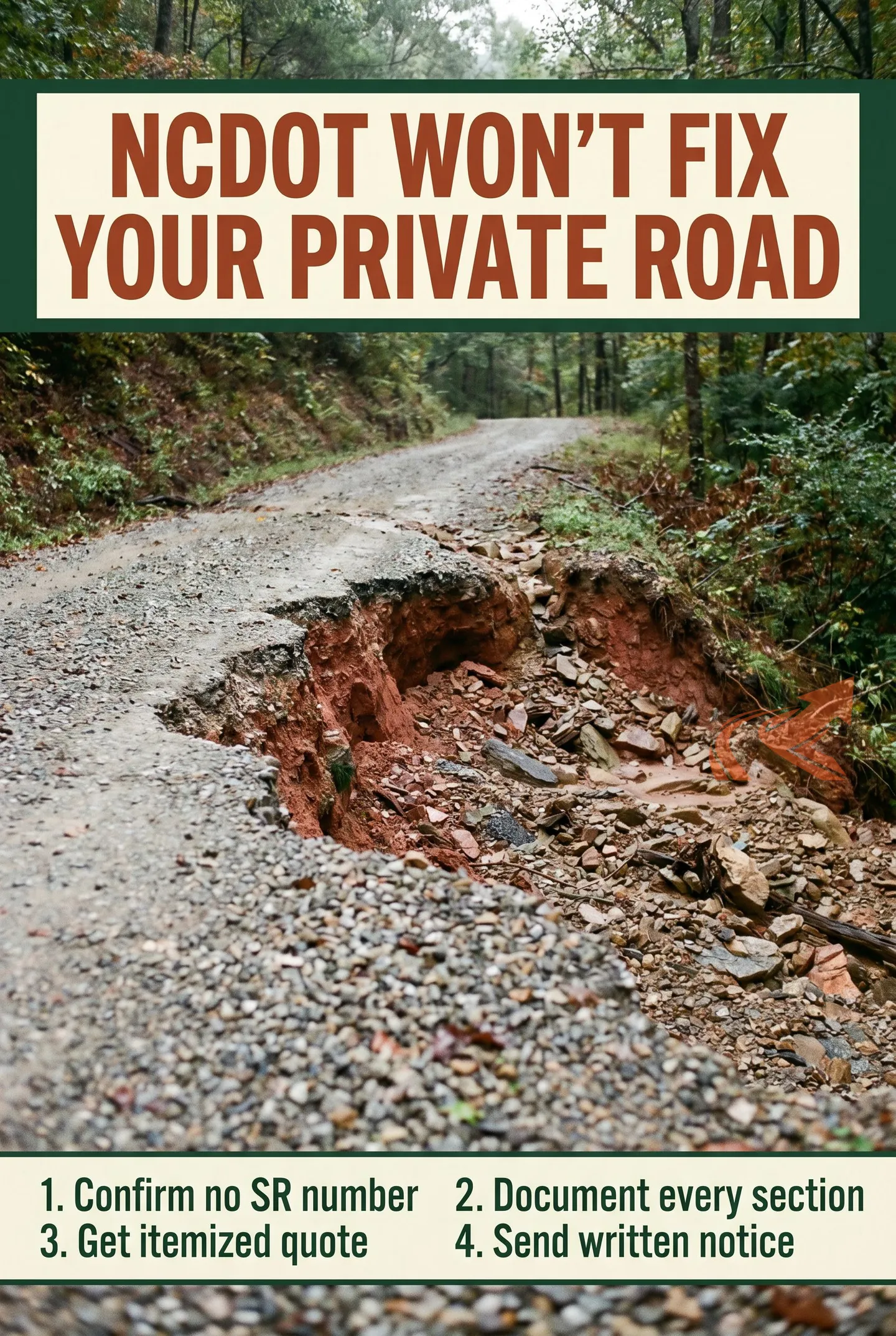
No. NCDOT repairs state-maintained roads -- those with SR numbers, US route numbers, or NC highway designations. A private road is the financial and legal responsibility of the property owners who use it, regardless of storm severity or disaster declaration. If your road has no route sign and your deed references a private access easement, it is not NCDOT's.
How do co-owners split private road repair costs in NC?
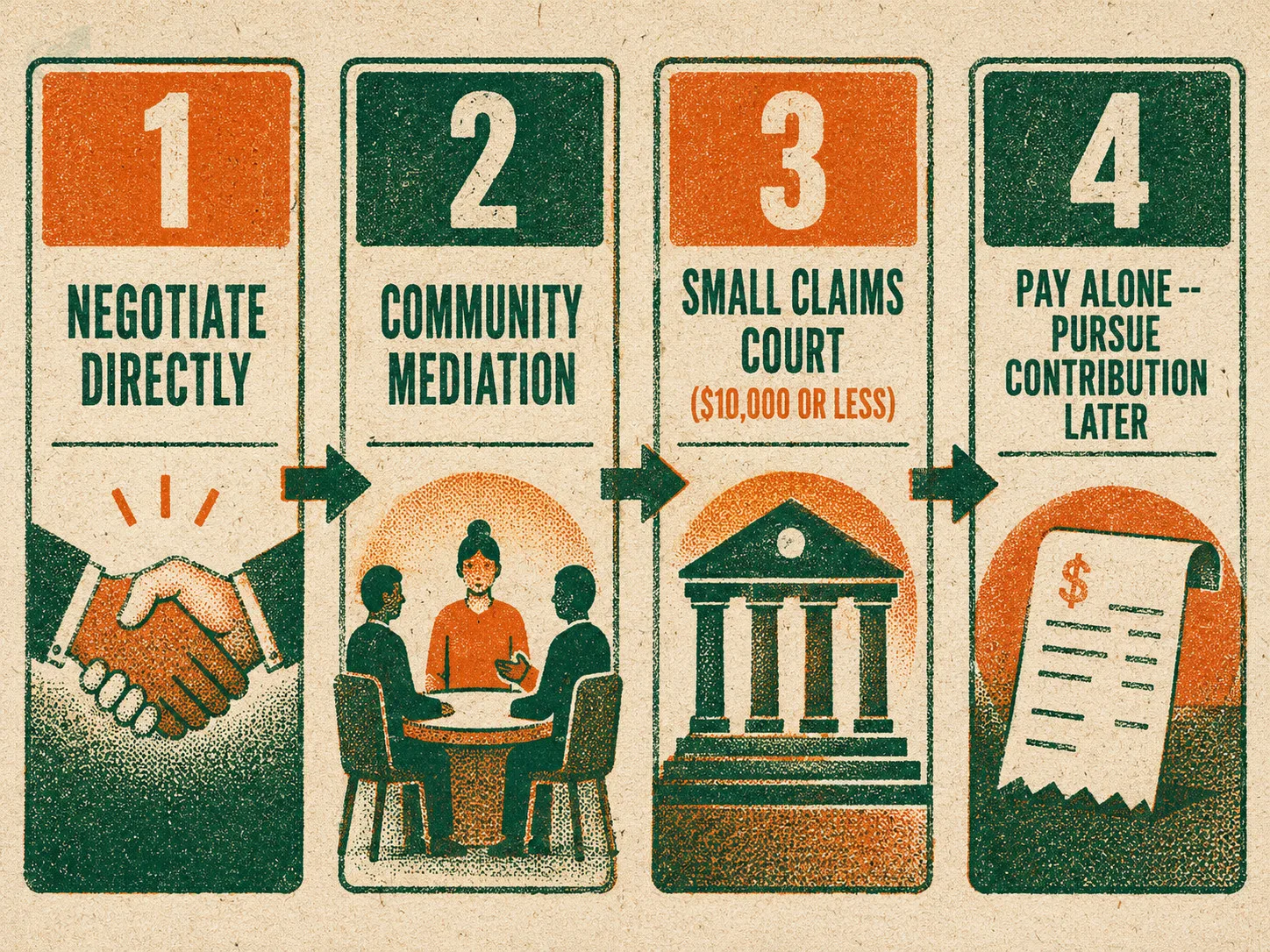
Start with the access easement recorded in your deed. If the easement has a maintenance clause, that clause governs the split. If no clause exists, North Carolina has no statute that sets a fixed split for an ordinary private road -- courts apply a common-law rule that everyone who uses and benefits from the road shares maintenance cost on a pro-rata basis. When a neighbor refuses to pay their share, options are mediation through a community mediation center, small claims court for amounts of $10,000 or less, or paying alone and filing a civil claim for contribution later.
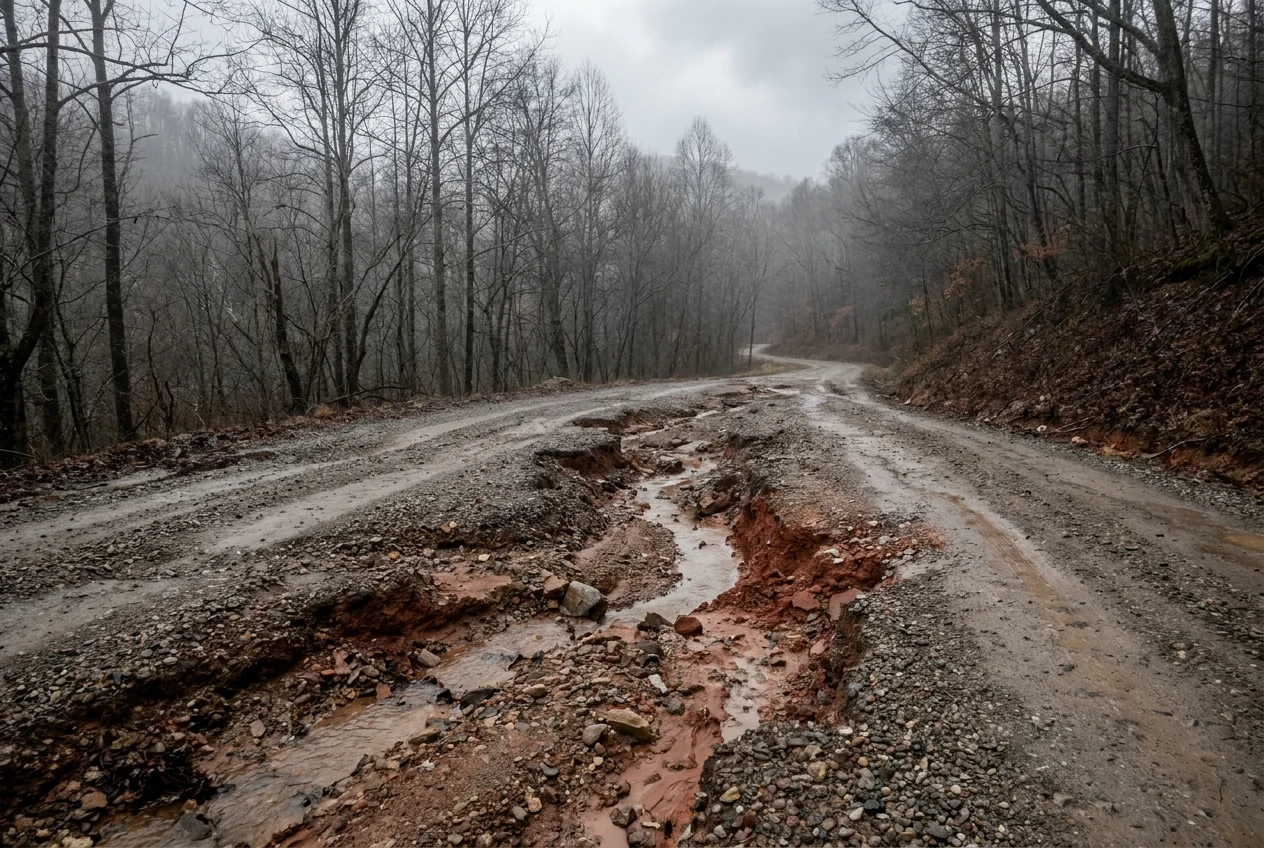
Dave’s private road in Rutherford County serves three properties. Half a mile of gravel road, one culvert at the bottom, two more upslope. Helene took out 200 feet of it — two complete washouts and a failed culvert. NCDOT showed up and fixed the state road at the bottom of the hill. Dave’s road begins where the state road ends. It is not on any list.
One neighbor says NCDOT should fix it. The other says the cost should be split but only for the section closest to his driveway. Dave isn’t sure who’s right, and he needs access to his property.
This page covers the NCDOT vs private road boundary, what North Carolina law says about shared maintenance costs, and what Dave’s options are when neighbors won’t agree.
NCDOT vs Private — The Responsibility Line
maintains state-numbered roads. Private roads — regardless of how many properties they serve or how essential they are for access — are maintained by the property owners, not NCDOT.
The line is usually visible on the ground: when the SR-numbered road ends and a private driveway begins, NCDOT’s obligation ends there.
How to confirm whether your road is state-maintained:
- Look for a route sign — NC highway number, US route number, or SR number on a green or white marker. No sign generally means private.
- Check the NCDOT Public Street Information Database Map (the HB620 map) at connect.ncdot.gov — it shows whether a road is state-maintained, municipally maintained, or private.
- Call the NCDOT Division Engineer’s office for your county. Division 13 covers Buncombe, Henderson, and Rutherford. Division 14 covers McDowell and adjacent counties.
- Look at your deed. If the access road is described as a “private access easement” or “private road,” it is private regardless of condition or traffic.
Private road indicators:
- No numbered route sign — only a privately placed street name sign
- Deed language referencing “private access easement,” “private road,” or “access right-of-way”
- No maintenance history from NCDOT (no resurfacing, no culvert replacement, no right-of-way mowing)
Post-Helene context: NCDOT is repairing damage to state-maintained roads across Buncombe, Henderson, Rutherford, and other declared counties. The repair queue prioritizes primary routes first, then SR-numbered secondary roads, then subdivision streets dedicated to NCDOT at development. Private roads are not in the queue.
The disaster declaration does not change that boundary — a private road stays the owners’ responsibility, and NCDOT will not add it to the repair queue.
But the declaration can change who helps pay. Under DR-4827-NC, Individual Assistance does extend to private roads and bridges, separate from NCDOT’s repair obligation. FEMA can reimburse private road or bridge repair costs when a FEMA inspection finds the road is the only drivable access to a primary residence, the applicant shares responsibility for maintaining it, and the property is not in an HOA or covenant responsible for the repair. The maximum IA award for all home repair categories combined (including private road access) was $43,600 for FY2025 — the share applicable to road or bridge repair specifically varies by inspection findings and is not a fixed per-location cap. When multiple households share the road, assistance is divided among all eligible applicants. This is homeowner aid for access to a residence — it does not turn the road into a state-maintained road or cover every co-user automatically. Confirm current eligibility and deadlines at the FEMA DR-4827-NC page.
NC Private Road Law — Who Pays?
How NC Courts Determine Who Pays for Private Road Repairs
1. Recorded easement with maintenance clause -- The clause governs. Courts enforce its written terms exactly -- a clause covering "maintenance and repair" does not extend to improvements like paving (Foxx v. Davis, COA22-1014). 2. Recorded easement without a maintenance clause -- Parties must negotiate or litigate. NC common law applies a pro-rata principle: maintenance cost is shared among users in proportion to how much of the road each uses. 3. No recorded easement -- Implied or prescriptive easements follow the same pro-rata common-law rule, but allocation turns on facts a court must weigh -- making these disputes the hardest to resolve without litigation.
-
Recorded easement with maintenance clause
The clause governs. Courts enforce its written terms exactly -- a clause covering "maintenance and repair" does not extend to improvements like paving (Foxx v. Davis, COA22-1014).
-
Recorded easement without a maintenance clause
Parties must negotiate or litigate. NC common law applies a pro-rata principle: maintenance cost is shared among users in proportion to how much of the road each uses.
-
No recorded easement
Implied or prescriptive easements follow the same pro-rata common-law rule, but allocation turns on facts a court must weigh -- making these disputes the hardest to resolve without litigation.
Source: NC Court of Appeals (Foxx v. Davis, 2023); NC common-law pro-rata sharing principle.
North Carolina has no single statute that fixes how ordinary private road repair costs are split. The default comes from your recorded easement first, and from common-law principles second — a legal framework, not an automatic enforcement mechanism.
This section describes the general NC legal framework for private roads. It is not legal advice — for a specific dispute, consult a North Carolina real estate attorney.
The controlling document is the access easement recorded in your deed or in a separate recorded agreement. Three scenarios:
Recorded easement with a maintenance clause. If the easement specifies how costs are divided — for example, “each party pays one-third” or “costs allocated pro-rata by number of properties served” — that clause governs. North Carolina courts enforce a maintenance clause according to its written terms, and will not read it to cover work beyond its language (in Foxx v. Davis, the Court of Appeals held that a clause requiring contribution to “maintenance and repair” did not extend to paving a gravel road).
Recorded easement without a maintenance clause. When an easement establishes access rights but says nothing about repair costs, the parties must negotiate or litigate. Under NC common law, where multiple owners use and benefit from a shared easement, maintenance cost is shared among the users on a pro-rata basis — courts look at who uses the road and in what proportion.
No recorded easement. Some shared rural roads operate on implied or prescriptive easements — use that is open, continuous, and mutual over many years. The same common-law principle applies: those who use and benefit from the road share its upkeep proportionally. Because allocation here turns on facts a court has to weigh rather than a recorded document, these disputes are the hardest to resolve without litigation.
governed roads. If the properties belong to an HOA with road maintenance in the governing documents, the HOA controls the process and can assess members for repair costs. The HOA documents supersede informal neighbor agreements.
What “pro-rata share” means in practice: if three properties use the full road equally, each pays one-third.
If one property only accesses the first quarter-mile and the others use the full half-mile, a court applying the pro-rata principle may weight each owner’s share by how much of the road they actually use rather than dividing equally. There is no fixed NC formula — allocation is fact-specific to each road and each owner’s use.
Enforcement: a co-user who pays for necessary repair can bring a civil action against the others for their contribution — this is an ordinary money claim, not a special private-road statute. Whether it is filed in small claims or District/Superior Court depends on the dollar amount. Small claims handles money disputes of $10,000 or less under G.S. 7A-210.
When a Neighbor Won’t Pay
When a co-user of a private road refuses to pay their share, the options are: negotiate, mediate, file in court, or pay alone and pursue contribution separately. None of these is fast.
Dave’s situation is common in WNC after Helene. The road is unusable. One neighbor is dug in. The other is uncertain. Here are the realistic options, in order of cost and speed:
Negotiate directly. A neighbor who hasn’t seen the scope of damage sometimes changes position after walking the road with a verified NC grading contractor and seeing an itemized repair quote. Put the scope in writing — photos, a contractor quote that breaks out each repair area separately — before the conversation.
Community mediation. North Carolina is covered by a statewide network of nonprofit community mediation centers — the Mediation Network of North Carolina — with regional centers serving counties across the state (several are named “Dispute Settlement Center”). These centers take walk-in neighbor and property disputes, which is the category a private road cost disagreement falls into. Mediation is lower cost and faster than litigation. Find the center for your county through the Mediation Network of North Carolina or your local clerk of court.
Small claims court. If the neighbor’s share is $10,000 or less, that amount can be filed in small claims court. A contribution claim after a co-user refuses to pay is an ordinary money-owed claim, which is squarely within small claims scope under G.S. 7A-210 — there is no separate “private road” claim type, and there does not need to be.
Pay alone and repair. When the road is the only access, waiting for a court outcome may not be realistic. Paying the full cost and pursuing contribution separately is sometimes the only path to restoring access. If this route is likely, the itemized quote and pre-repair documentation become evidence — not just records.
What Dave should do before anyone touches anything:
- Photograph every damaged section with GPS timestamps and location context
- Get a written, itemized repair quote that identifies each repair section by location and estimated cost
- Send written notice to each neighbor — text or email creates a record — identifying the damage, your proposed cost split, and a deadline for response
- Keep all receipts, delivery tickets, and inspection records if you pay alone
The Repair Sequence for Shared Roads
The physical repair sequence for a private road washout is the same as any driveway repair — but shared ownership adds a documentation layer that a single-property owner doesn’t need.
Shared-road documentation before the first machine touches the road:
- Photograph every damaged section with GPS timestamps before any work begins
- Get an itemized quote that breaks out each repair area by location and cost — not a lump sum for the whole road
- If multiple contractors are quoting, get at least two written quotes
- Keep delivery tickets and invoices organized by repair section — each section’s cost should be traceable separately
The repair sequence (same as the NC driveway washout repair guide):
- Clear debris
- Identify the water source — failed culvert, upslope sheet flow, or a redirected NCDOT ditch
- Repair culvert or drainage cause before filling
- Compact base in lifts, not as a single pour
- Fill voids in lifts
- Re-crown to shed water
- Verify drainage paths before calling the work done
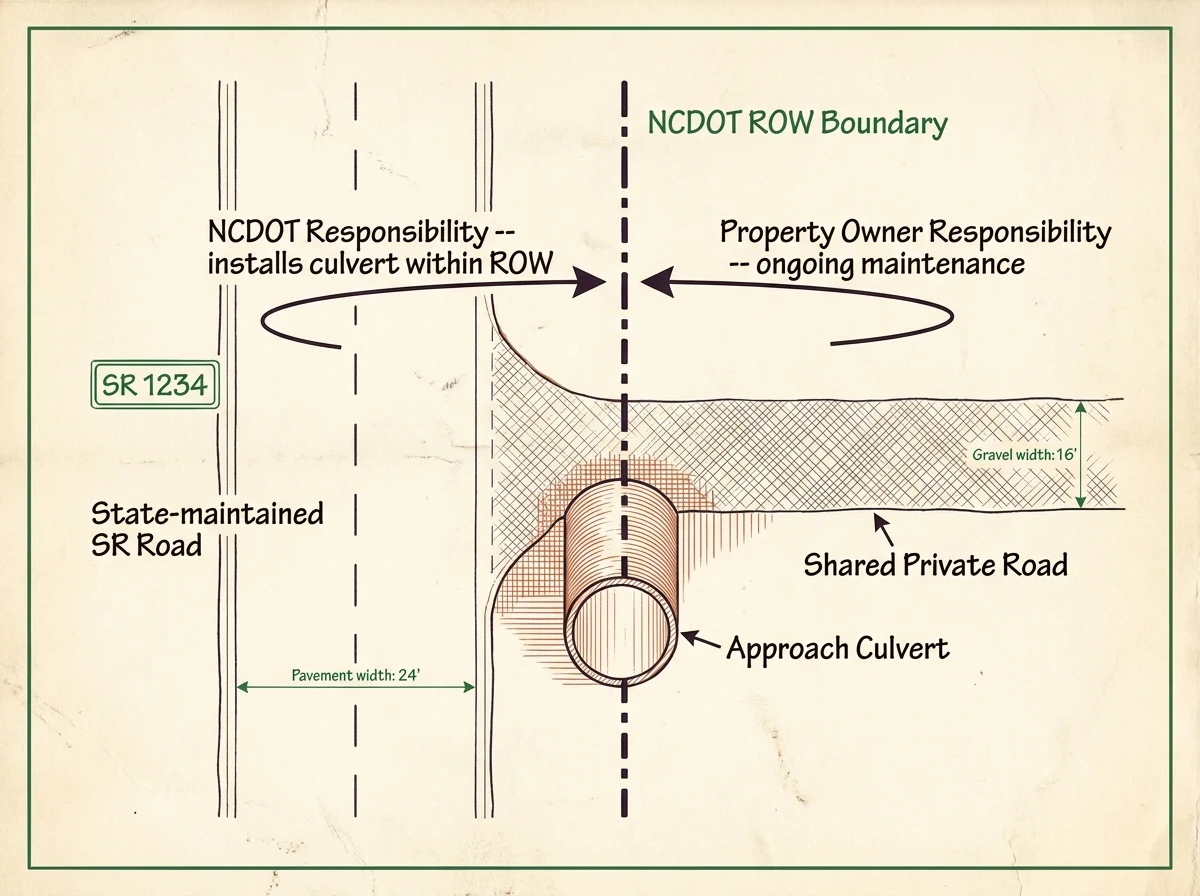
One additional check for shared roads: confirm the maintenance responsibility for the culvert at the road junction. Under NCDOT’s Driveway Access Policy and Driveway Permit FAQ, NCDOT maintenance forces will install a driveway approach culvert within the state right-of-way when the property owner furnishes and delivers the pipe — but ongoing maintenance of the culvert (clearing, repairs, replacement) remains the property owner’s responsibility, even for culverts installed by NCDOT. If the approach culvert failed and you believe it sits within NCDOT’s right-of-way, contact the NCDOT Division Engineer for your county to confirm whether NCDOT considers it state-maintained. Do not assume state ownership — the default is owner responsibility.
For slope stabilization after repair, see erosion barriers for private road slope control.
For Helene-specific WNC damage context, see post-Helene private road repair in WNC.
Getting Repair Started
Private road repair is a legal and logistical problem before it is a grading problem. Settle the cost-split question in writing before work starts.
A signed written agreement on contribution proportions — even a text exchange — is worth more than a verbal understanding. An itemized quote that breaks out each repair area separately serves as both the scope document and the basis for contribution claims if litigation follows.
If you’re in Rutherford, Buncombe, or another WNC county post-Helene, private road repair wait times in post-Helene NC has current data on contractor availability and queue depth.
When you’re ready to get quotes from licensed NC operators, hire an NC grading operator who works in your county.
If you’re deciding whether to use fixing a shared driveway when NCDOT won’t help as a reference, that hub covers the general washout repair sequence — this spoke covers the neighbor-cost and legal layer on top.
Written Notice Template — Send Before Starting Repair Work
Copy this before starting shared road repair
Send to each co-user by text or email to create a written record. Adjust names, dates, and amounts to your situation.
[Date]
Hi [Neighbor Name],
I wanted to follow up on the damage to our shared road at [road description / address]. I’ve attached photos of the damage and a repair quote from [Contractor Name], NC License #[XXXXX].
The quote is $[total amount] for the full repair. Based on [equal thirds / frontage / prior agreement], I’m proposing we each contribute $[amount per party].
I’d like to schedule repairs within [X weeks]. Please let me know by [date] if you agree to the proposed split so I can move forward with scheduling.
[Your Name]
Keep the contractor’s license number in the notice. It documents you used a licensed NC operator, which matters if costs are later disputed in court.