
The two questions Ray asks before signing a quote
Should I use flowable fill or compacted stone/CABC?
If compaction equipment can reach the void and work it in lifts, compacted stone is almost always cheaper. If the void is under a slab, under a structure, or otherwise access-constrained -- flowable fill is the only option that actually fills the void rather than bridging over it.
Why does flowable fill cost more than gravel if it is just concrete slurry?
Flowable fill material runs higher per cubic yard than ABC. But equipment cost plus multiple compaction passes for stone can close -- and sometimes reverse -- that gap when access is constrained.
Ray Pettiford received two quotes for a void repair under his garage slab — one for flowable fill, one for compacted . The flowable fill quote was higher per cubic yard. Ray wanted to know why — and which one was actually right for his situation.
The answer is not about which material is better. It is about whether compaction equipment can physically reach the void to do the job correctly.
The Core Distinction: Compaction Access
The single question that drives the flowable fill vs stone decision is whether compaction equipment can reach the void to compact stone in lifts.
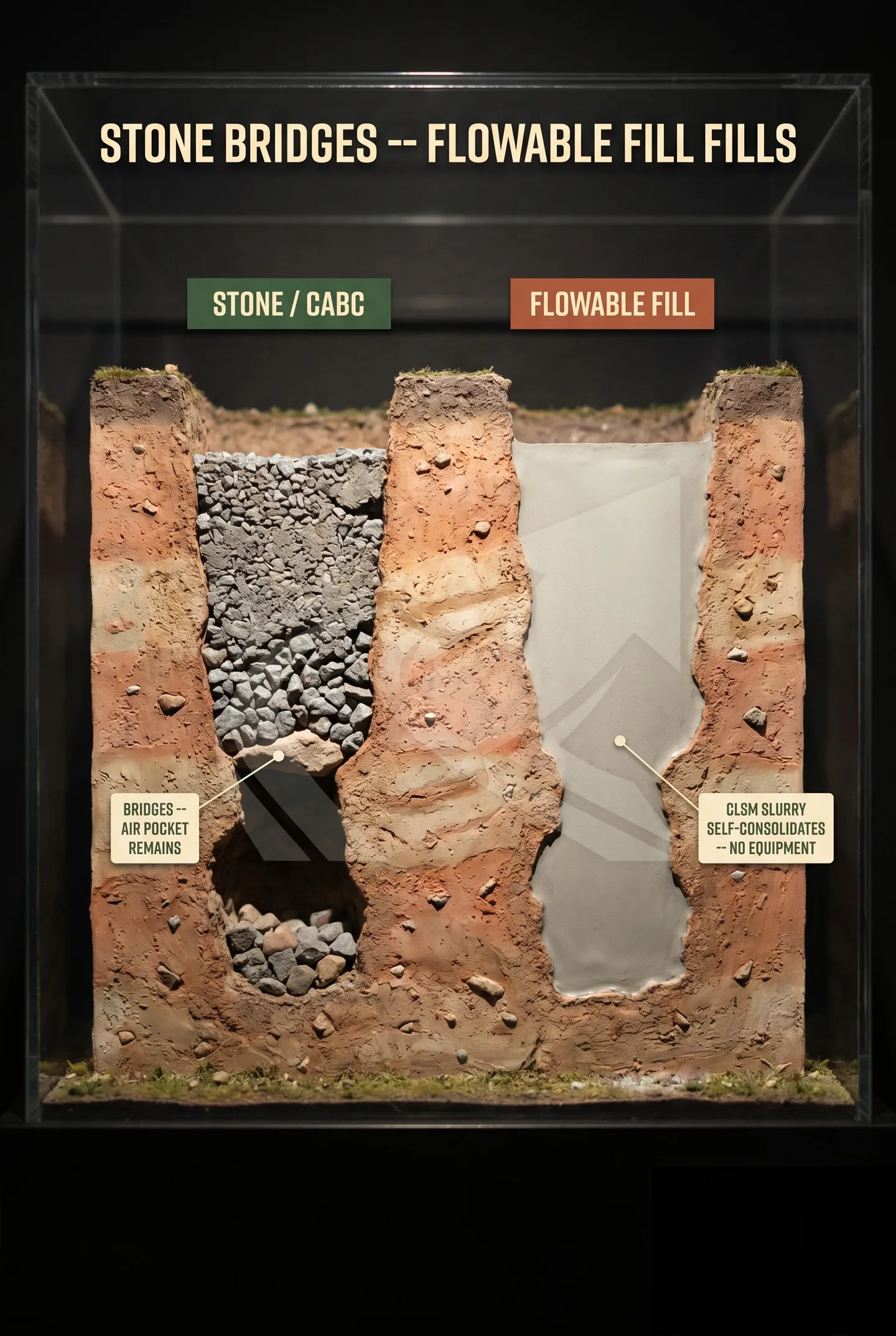
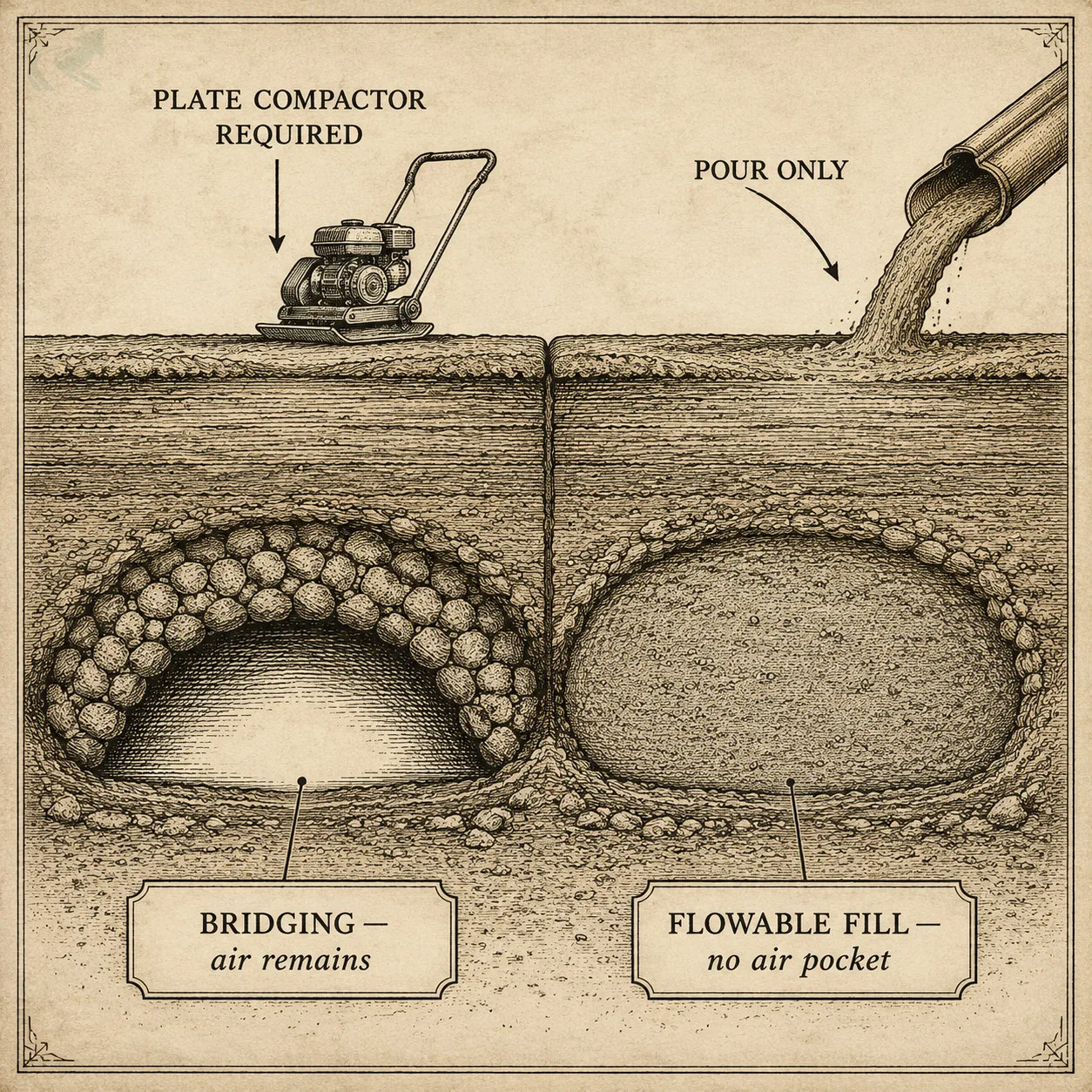
Stone and do not self-consolidate. Placed loose into a void, stone arches across the opening rather than filling it — a behavior called bridging. The stone skeleton spans the gap with air underneath. That air pocket remains and the void is not actually filled.
Compacted stone works when a plate compactor, jumping jack, or roller can work the material in lifts — typically 6 to 8 inches at a time — until each layer reaches design density. That requires physical access to the void opening.
Flowable fill — technically — does not bridge. It flows into irregular void geometry the way water does, displaces air, and sets without compaction. No equipment access required beyond the point of pour.
When access exists: stone is almost always cheaper. When access is constrained: flowable fill is not just cheaper after accounting for equipment — it is frequently the only method that fills the void at all.
When Stone and CABC Win
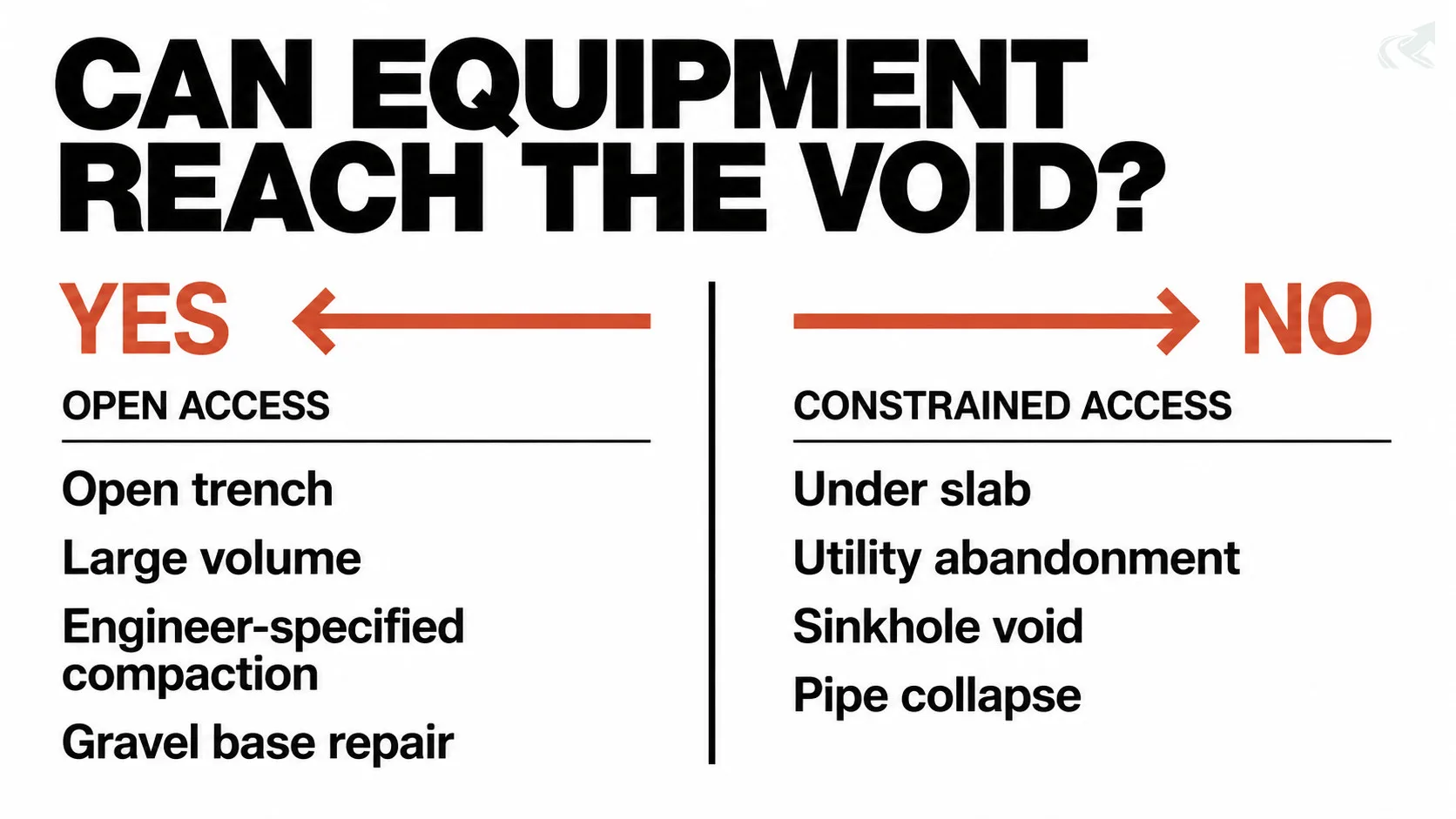
Stone and compacted CABC are the right choice when equipment can access the void, volume is large, and a structural fill specification calls for compacted stone.
North Carolina applications where compacted stone wins:
- Open trenches above grade — utility trenches, stormwater repairs, and road base work where the void is accessible from above and compaction lifts are achievable
- Large-volume fills — when cubic yardage is high enough that flowable fill’s higher material cost would be significant even with the access offset
- Engineer-specified structural fills — some NC structural specifications require compacted stone with nuclear gauge density testing, especially for building pad preparation and load-bearing applications
- Gravel driveway base repair — surface-accessible void on a gravel driveway where a plate compactor can work the replacement lifts
Compacted stone also has a documentation advantage for some structural applications: nuclear gauge density testing on compacted stone produces a measurable density number. Flowable fill compressive strength is typically tested by break cylinders at 28 days — a different verification path that not all inspectors are familiar with on residential jobs.
For large, open, accessible applications in North Carolina, compacted is typically the lower-cost, lower-complexity choice.
When Flowable Fill Wins
Flowable fill is the correct material when equipment access to the void is physically impossible, or when the void geometry is irregular enough that stone would bridge rather than fill.
The access-constrained formula: if a plate compactor cannot enter the space, flowable fill is the method.
North Carolina applications where flowable fill is the correct specification:
- Under slabs and structures — the most common residential case. A void under a concrete garage slab, porch slab, or addition foundation cannot be reached with compaction equipment. Flowable fill is poured through a drilled hole or open edge and flows to fill the void. Stone dropped through the same hole would arch and leave air pockets.
- Utility abandonment — when a water main, gas line, sewer pipe, or storm drain is abandoned in place, North Carolina utilities and municipalities typically specify flowable fill to fill the annular space around the pipe or the pipe interior. The pipe bore and annular gap are both access-constrained.
- Sinkholes with irregular void geometry — sinkhole voids in NC Piedmont clay and limestone transition zones are rarely regular in shape. Flowable fill follows the void geometry; stone bridges across it. See a real NC sinkhole repair with flowable fill for how this plays out on an actual job.
- Abandoned basement and crawl space fill — decommissioned basement voids and crawl spaces that will be backfilled for structural reasons may have access-constrained geometry that defeats compaction-lift methodology.
- Pipe collapse and buried culvert repair — collapsed culverts and failed underground pipes beneath driveways and structures in North Carolina are frequently repaired with flowable fill when the void cannot be opened from above without disturbing the slab or structure. The same access logic applies to deep driveway divot repair with flowable fill when the underlying void is too deep for compacted stone.
The access test is binary. If a plate compactor can reach it, evaluate cost. If a plate compactor cannot reach it, the choice is already made.
Cost Comparison
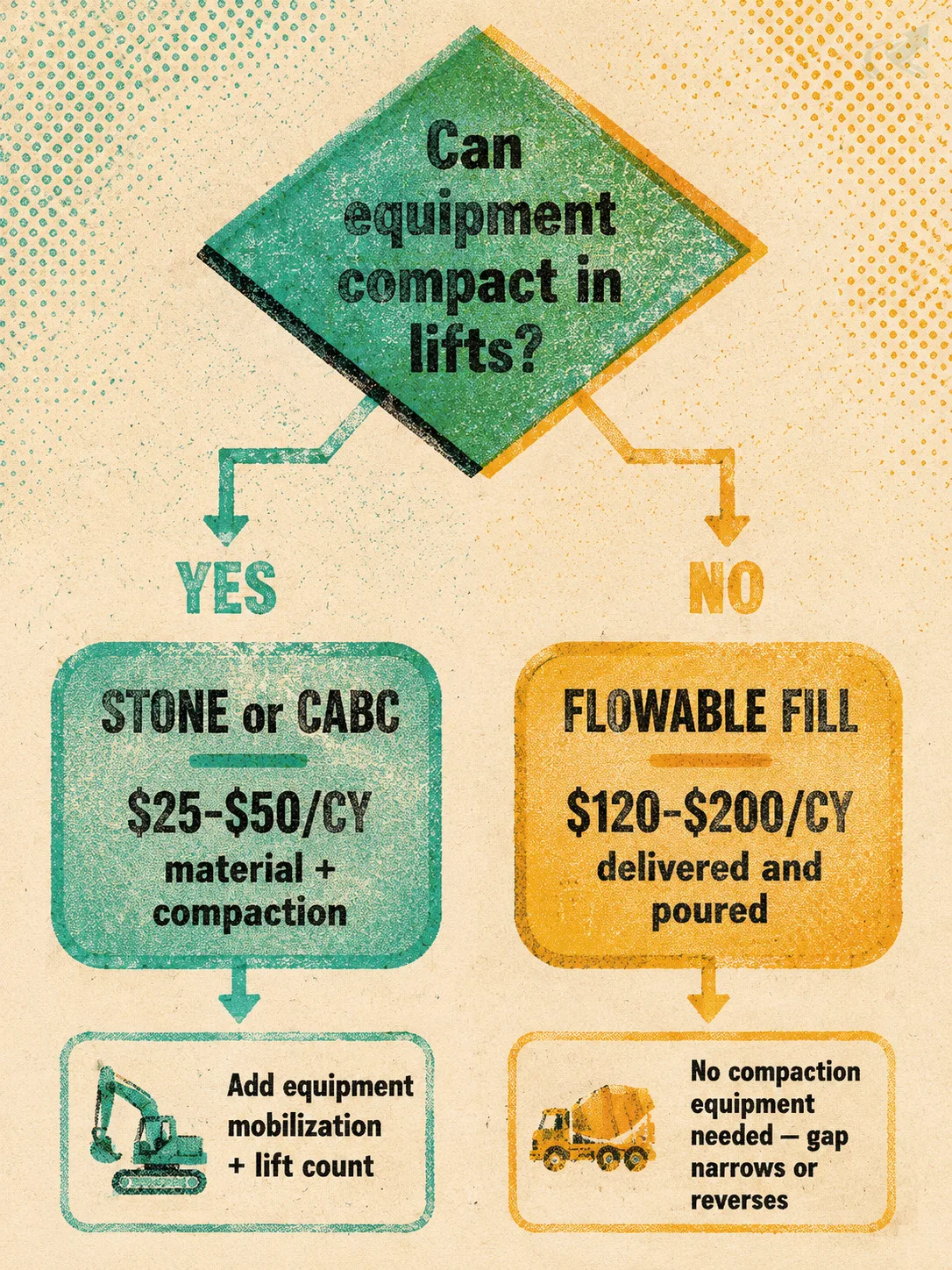
Flowable fill material costs more per cubic yard than compacted stone, but equipment cost and multiple compaction passes for stone can close or reverse the gap at access-constrained applications.
Approximate North Carolina market context (Triangle and Triad, 2025-2026 — confirm with your contractor for current pricing):
- Flowable fill (CLSM): typically $120 to $200 per cubic yard delivered and poured, depending on mix design strength and batch plant proximity. Mix design affects cost — excavatable low-strength CLSM at 50 psi runs lower than high-early-strength mixes.
- Compacted CABC: material alone typically $25 to $50 per cubic yard at the quarry in North Carolina. Add haul, delivery, and placement. Compaction labor and equipment cost depends on the number of lifts required.
Why the cost gap narrows at access-constrained jobs:
- Equipment mobilization for compaction — even a plate compactor or jumping jack — adds cost beyond material alone
- Access-constrained voids often require more lifts for smaller increments of fill, compounding labor
- Equipment downtime if access is partially constrained and compaction requires custom rigging
For large, open-access jobs — a road base repair, an open trench, a building pad — compacted stone typically wins on total cost by a wide margin. For under-slab and access-constrained applications, the flowable fill premium over material cost is often offset by equipment savings and faster mobilization.
Get an itemized quote that separates material cost from placement and compaction cost. The line item comparison is what tells you the real cost difference for your specific situation. For stone deliveries, also verify load volume — how to verify your NC gravel load covers the yards-vs-tons math that keeps contractors honest on bulk material orders.
Compressive Strength Comparison
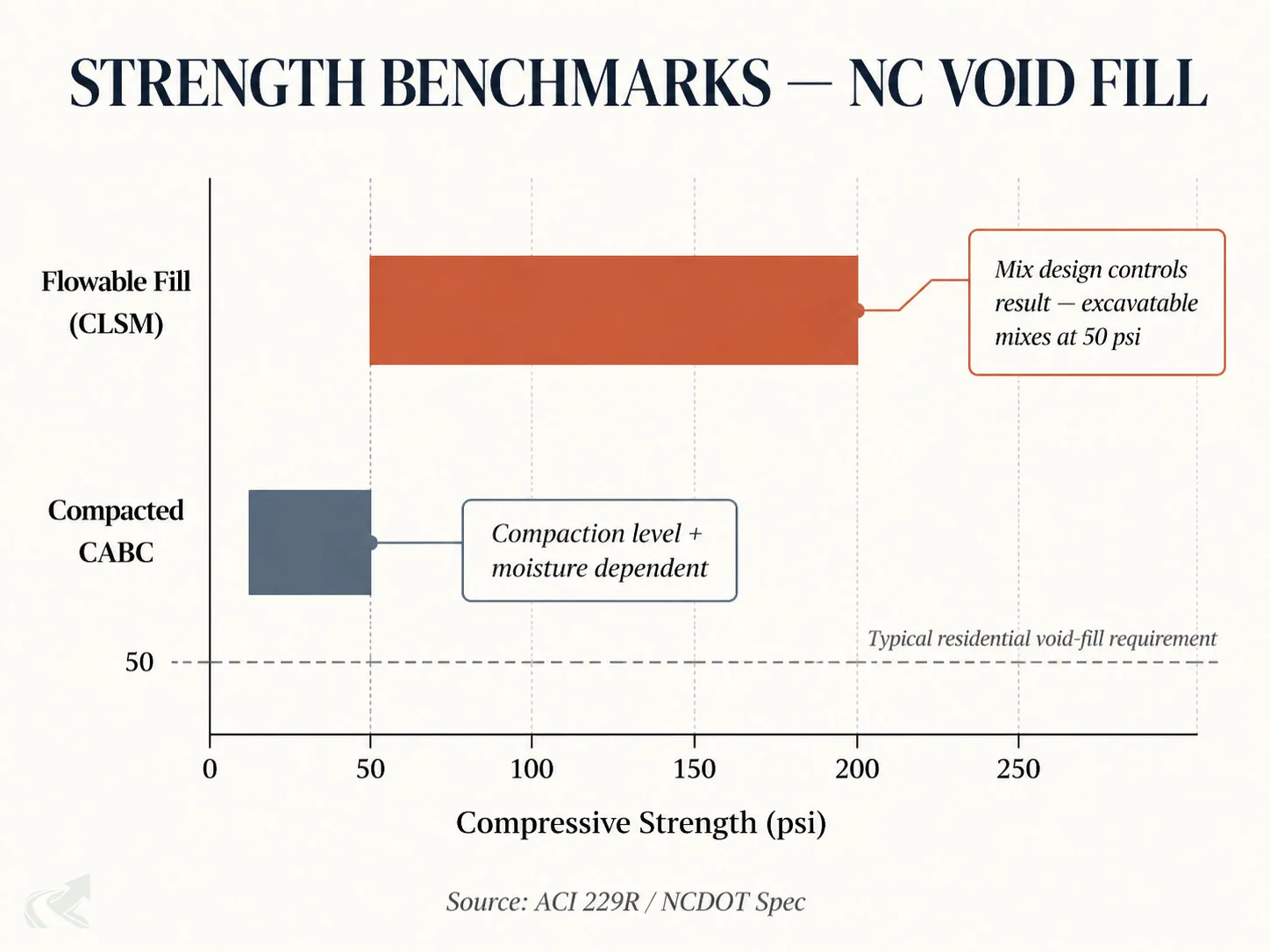
Flowable fill and compacted stone produce different compressive strength profiles — and for most residential void fill applications in North Carolina, either meets load requirements when correctly specified.
Strength benchmarks:
| Material | Compressive strength | Notes |
|---|---|---|
| Flowable fill (CLSM) | 50-200 psi typical | ACI 229R range; mix design controls result; excavatable mixes at the low end |
| Compacted CABC | 15-50 psi bearing capacity | Varies with compaction level and moisture; NCDOT spec ensures upper range on road applications |
For most residential slab-support and utility abandonment applications, the structural requirement is modest — the fill needs to resist settlement and transmit load to subgrade, not carry structural column loads. Both materials typically satisfy that requirement when correctly specified.
When higher strength matters:
- Engineer-specified structural fill — a licensed PE will specify the compressive strength required. If the spec calls for CLSM at 150 psi minimum 28-day break, that controls the mix design. If the spec calls for compacted stone to 95% Standard Proctor, that controls the compaction method.
- Future excavatability — if the filled area may need to be re-excavated later (utility replacement, future construction), specify excavatable CLSM at the low end of the strength range. High-strength CLSM is not excavatable with hand tools and is difficult to remove with mechanical equipment. Compacted stone is always excavatable.
For applications where neither an engineer spec nor re-excavation is a concern, ask your contractor which mix design they are pricing — not all flowable fill is the same strength or cost.
Flowable Fill vs Compacted Stone — Decision Matrix
| Factor | Flowable fill | Compacted stone/CABC |
|---|---|---|
| Access requirement | None — pours to the void | Equipment access required for compaction lifts |
| Bridging risk | None — self-consolidating | Moderate over irregular void geometry |
| Material cost per CY | Higher | Lower |
| Total cost at access-constrained sites | Often competitive | Higher due to equipment + lift count |
| Compressive strength | 50-200 psi (mix-dependent) | 15-50 psi bearing capacity (compaction-dependent) |
| Future excavatability | Yes — specify low-strength mix | Yes |
| Volume uncertainty tolerance | High — flows to fill | Low — bridging risk with irregular geometry |
| Typical NC applications | Under slabs, utility abandonment, sinkholes | Open trenches, building pads, large-volume structural fill |
Contractor Clipboard — Decision Guide
Copy this before calling a North Carolina contractor for a quote:
Flowable fill vs stone decision guide: (1) Can equipment access the void to compact stone in lifts? If No — flowable fill. (2) Is the void under an existing structure, slab, or behind a wall? If Yes — flowable fill. (3) Is the void geometry irregular (sinkhole, pipe collapse, annular space)? If Yes — flowable fill. (4) If open access and large volume — stone is likely the lower-cost option. Verify with your contractor and get an itemized quote separating material from compaction labor.
For context on flowable fill material, mix designs, and how North Carolina contractors specify and deliver it, see the flowable fill overview for NC fill jobs.
For more on ABC gravel vs flowable fill for NC fill jobs and how ABC is specified and ordered, see the ABC gravel spoke. For aggregate definitions including CABC and related terms for flowable fill comparison, see the resources page. To find a grading and hauling contractor in North Carolina who can assess your void and specify the right material, see the directory.