
Two questions people often ask
What does a flowable fill sinkhole repair actually look like in NC?
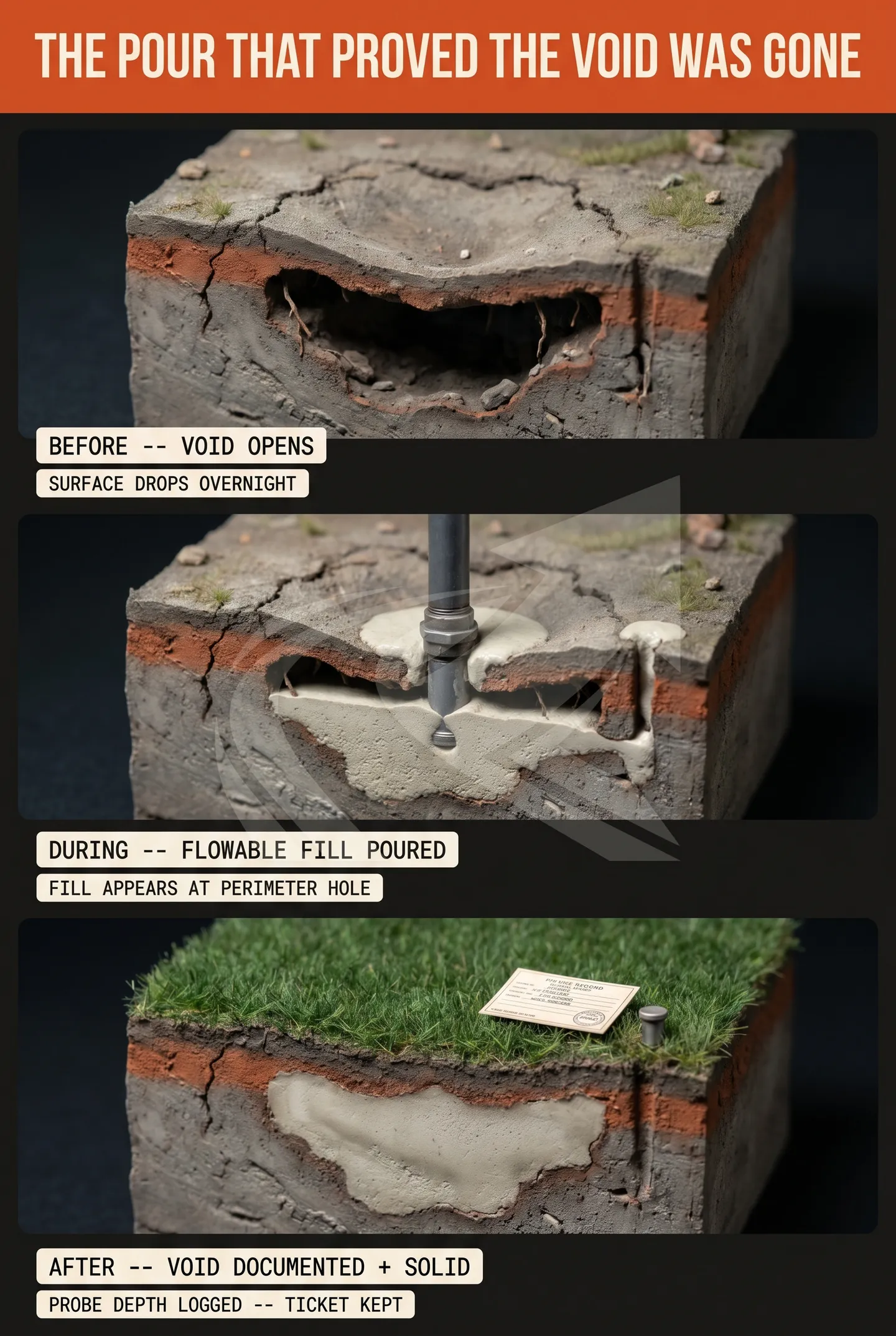
Discovery (surface depression or sudden collapse) -- probe assessment to measure void depth and extent -- flowable fill pour from above with flow confirmation at void edges -- 24-48 hour cure -- surface restoration (fill, compact, seed or pave). Total visible time on-site: typically 4-8 hours. NC Piedmont karst note: document everything -- some voids recur.
Is one flowable fill pour enough to fix a sinkhole permanently?
It fills the current void. If the underlying karst dissolution process is ongoing, a new void can form adjacent to the repair. Re-probe at 6-month intervals if you're in an active karst area. Document what was poured so any future contractor knows what they're working with.
Why NC Piedmont Gets Sinkholes
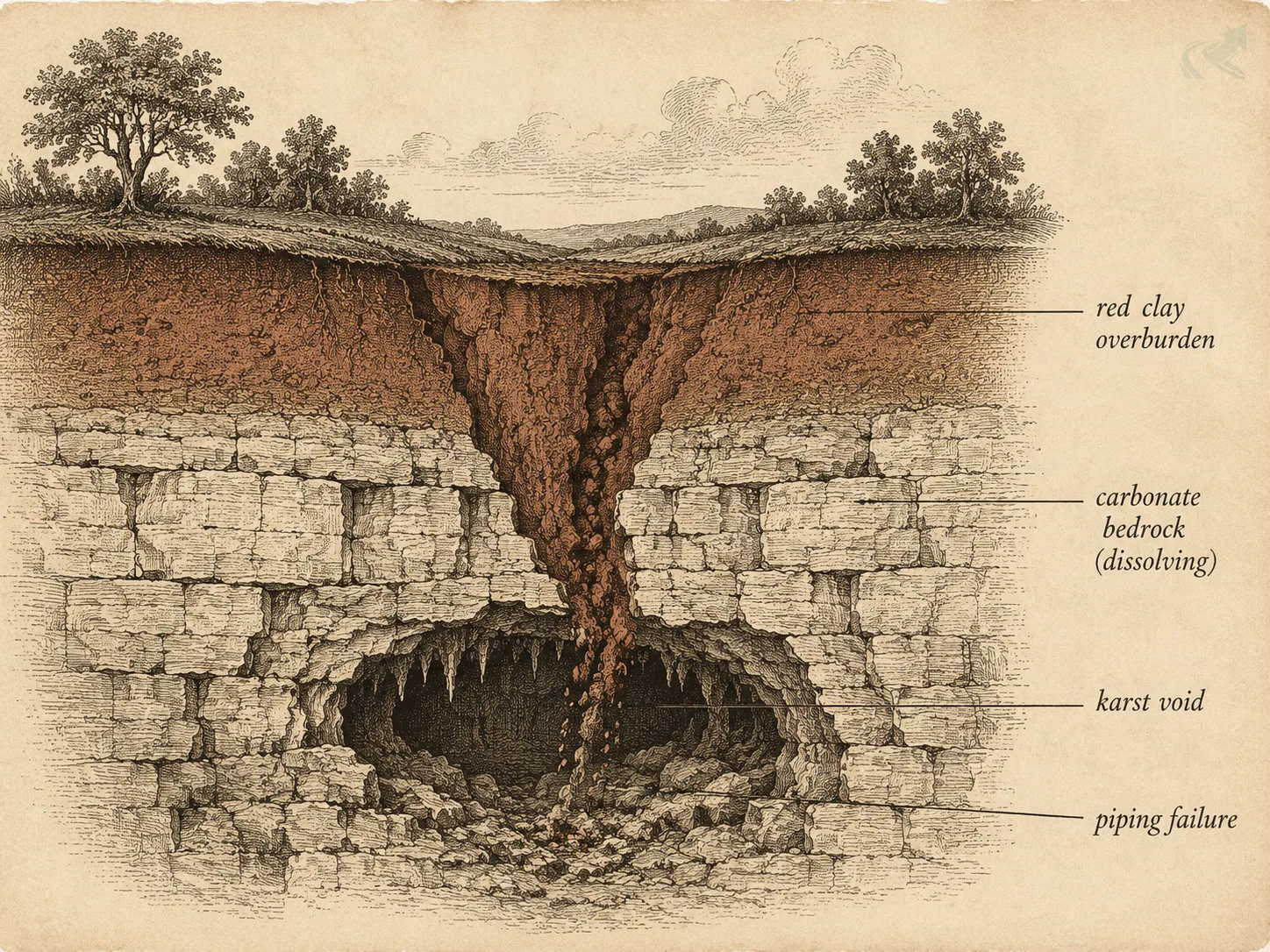
The answer starts underground — specifically, in fractured limestone bedrock beneath the Piedmont’s red clay.
North Carolina’s Piedmont sits on a mosaic of geology. In parts of Guilford, Alamance, Chatham, and Randolph counties, limestone and dolostone formations run close to the surface. Water dissolves carbonate rock slowly over time, carving voids through a process called karst development.
Above that bedrock, the region’s red clay acts as a lid — and how NC clay changes with moisture when used as fill explains what eventually breaks that lid: a dry spell contracts it, a heavy rain saturates it, or a utility trench disturbs the lateral support, and the clay pipes downward into the void below.
The result is a surface depression that appears with little warning. Sometimes a slow subsidence over weeks. Sometimes a sudden drop overnight.
NC sees this more than most homeowners expect, particularly in the central Piedmont. The conditions that produce it — soluble bedrock, thick clay overburden, variable rainfall — are a standard part of the regional geology.
Discovery and Assessment
A surface depression is the symptom. The void underneath is the problem — and you need to know its depth and extent before any repair starts.
Surface depressions range from a soft low spot in a lawn to a collapsed hole with an open cavity visible inside. Both can indicate a void below, but the scale matters.
A contractor’s first step is probing. A metal probe rod is driven into the depression at multiple points to measure how deep the soft zone extends and where it stops. A depression that probes to 18 inches is a different scope than one that probes to 6 feet.
When to call a geotechnical engineer before a contractor:
- Void is within 10 feet of a structure foundation
- Depression is wider than 8-10 feet at the surface
- The probe drops freely with no resistance — indicating a large open cavity
- The sinkhole appeared suddenly rather than settling slowly
For a typical lawn or driveway sinkhole in North Carolina — under 6 feet deep, not adjacent to a foundation — a qualified grading contractor can assess and repair without engineering oversight. When in doubt, get an engineer’s opinion first. A site visit from a geotech costs far less than a repair that misses the void extent.
The Repair Sequence
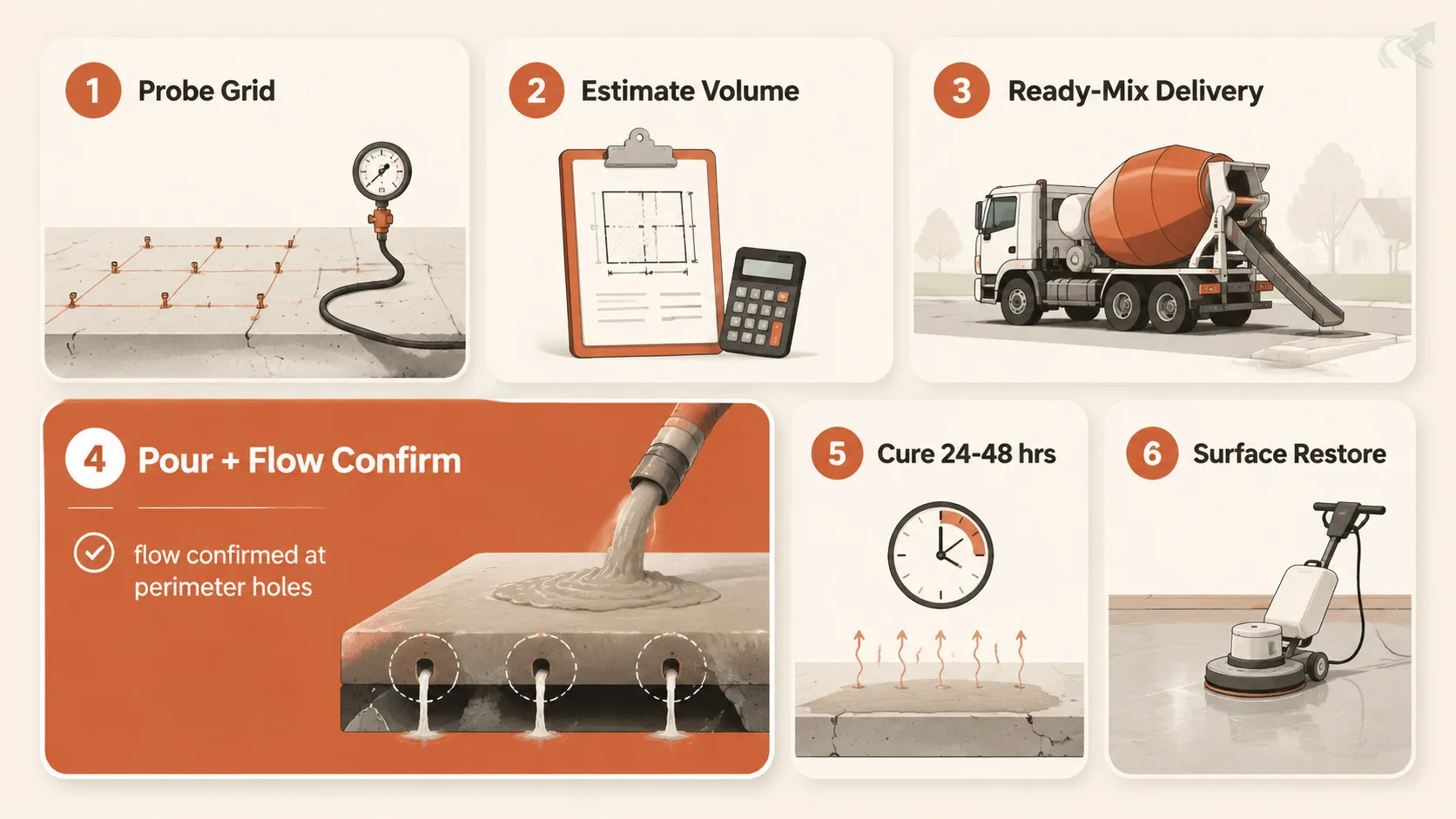
A properly documented flowable fill sinkhole repair follows six steps — and every step has a confirmation point.
Step 1: Probe Assessment
The contractor probes a grid pattern across the depression to map the void’s footprint. Depth readings are recorded at each probe location. This produces an estimated void volume — the number that drives the ready-mix order.
Step 2: Volume Estimation
Void volume is estimated from the probe grid: footprint area times average depth, adjusted for soil density and estimated fill factor. Over-ordering is standard practice — see flowable fill quantity in yards and tons for how volume conversions work when placing a ready-mix order. Unused material can be redirected; running short means a second truck and a partially filled void.
Step 3: Ready-Mix Delivery
A ready-mix truck delivers CLSM — controlled low-strength material, the technical name for flowable fill. For sinkhole repair in North Carolina, a standard mix is 50-150 psi compressive strength with high flow characteristics (see flowable fill vs stone and CABC for NC fill jobs for why self-compacting material is the only practical choice in a confined void). The truck ticket documents cubic yards delivered. Keep it.
Step 4: Pour with Flow Confirmation
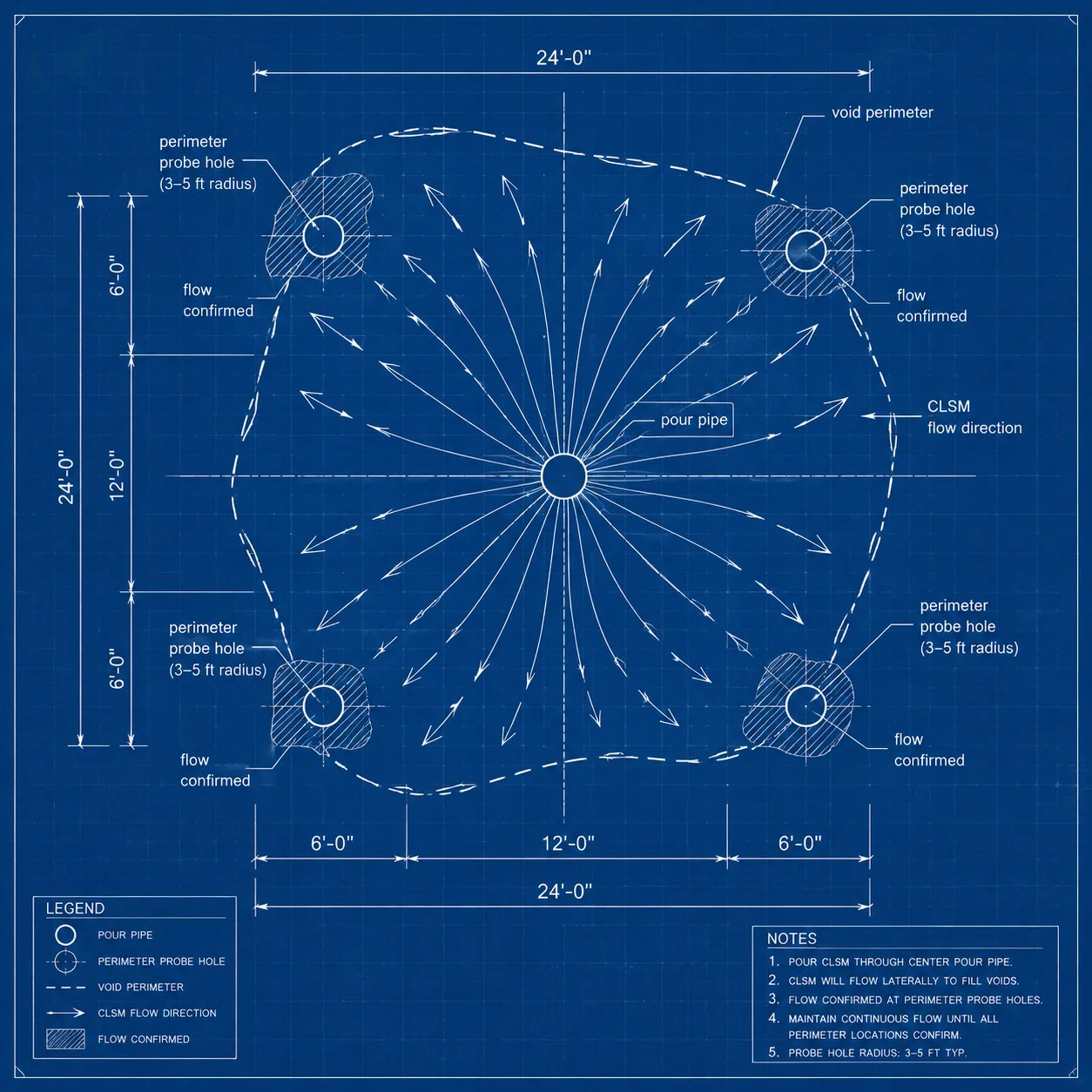
Material is poured from the surface — typically through a 4-inch pipe lowered to void depth to avoid bridging. Additional probe holes are drilled at the void perimeter, 3-5 feet outside the pour point. The pour continues until flowable fill appears at these perimeter holes. That appearance is flow confirmation — physical evidence that the material has traveled laterally and filled the void, not just the pour point.
This step is what separates a documented repair from a guess. If the contractor stops when the depression looks full without confirming flow at the perimeter, the void may extend beyond the pour area.
Step 5: Cure Period
Flowable fill sets within hours but reaches design strength in 24-48 hours under normal NC temperatures. The site is kept off-limits during that window. Cold weather (below 40 F) extends cure time; direct summer sun has minimal effect on curing rate at typical slab depths.
Step 6: Surface Restoration
After cure, the contractor fills any residual surface depression with compacted soil, adds topsoil, and seeds or sodds to match the surrounding grade. Driveway or paved areas require saw-cutting the settled section and patching with asphalt or concrete after the flowable fill has cured beneath.
What Can Go Wrong — The Recurrence Risk
Flowable fill fills the void that exists today. It does not stop the geological process that created it.
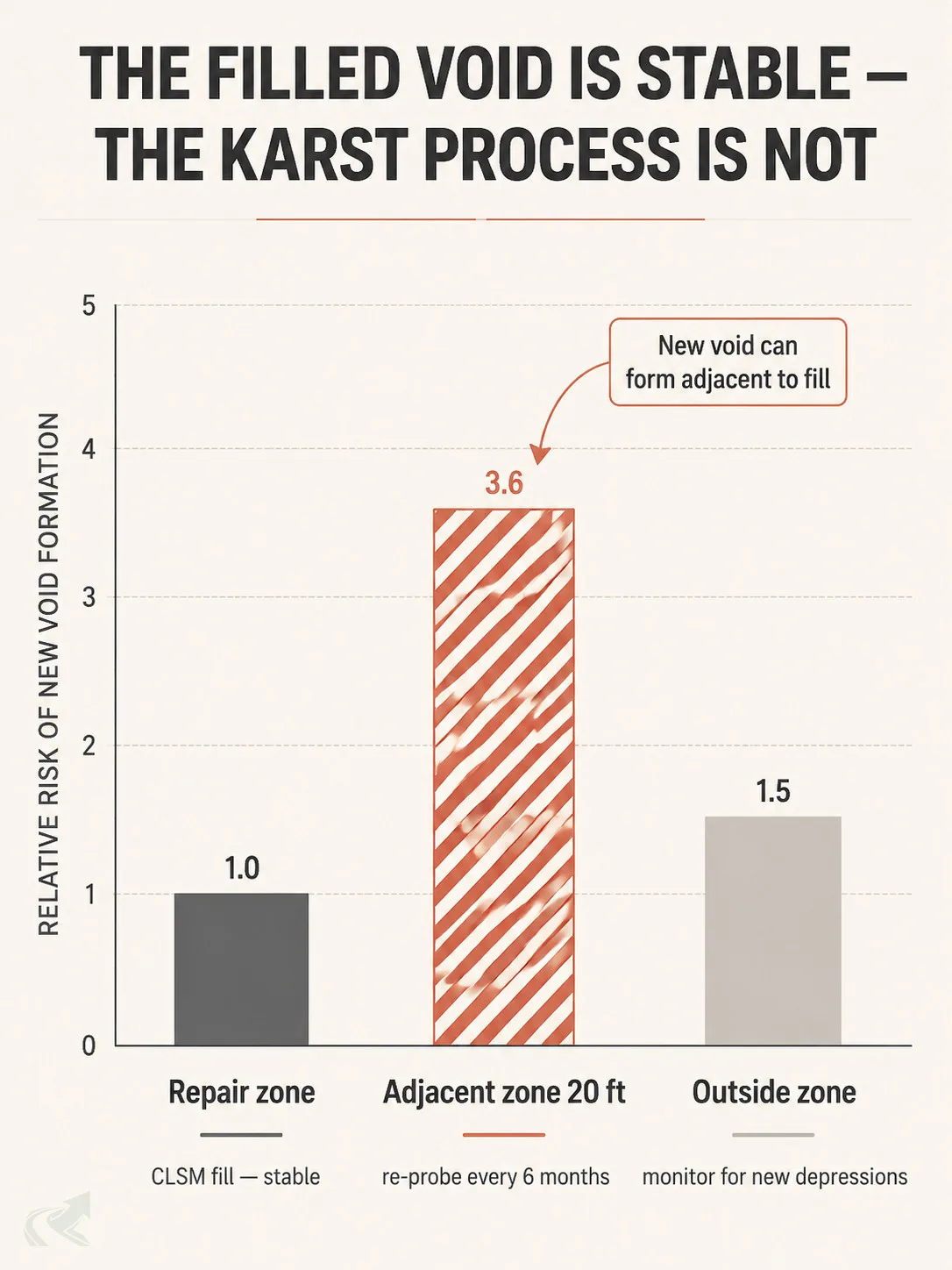
In active karst areas of North Carolina, dissolution of bedrock continues after a repair. The filled void is now solid CLSM — that zone will not re-collapse. But the karst process does not stop at the repair boundary. A new void can form adjacent to the fill, in rock that was not affected by the original collapse.
What to watch for after repair:
- New soft spots or depressions within 20 feet of the repair perimeter
- Changes in drainage pattern on the repaired area
- Cracking in nearby hardscape that was not cracked before
Re-probing at 6-month intervals is recommended for properties in confirmed karst geology. The probe takes 30 minutes and tells you whether a new void is forming before it reaches the surface.
This is not a failure of the original repair. It is the nature of karst. A contractor who tells you the sinkhole is fixed forever without qualification may not be familiar with how North Carolina’s Piedmont geology behaves.
Common Mistakes in NC Sinkhole Repair
These three errors account for most repair callbacks — all three are avoidable with the right sequence.
Filling the depression without probing the void depth. Dumping gravel or topsoil into the depression caps the void from above without filling it. The weight of the cap material accelerates settling into the void below. The depression returns within weeks.
Stopping the pour before flow confirmation. A pour that ends when the surface depression looks full may have filled only the vertical shaft above the void. The void extends laterally, unchecked. Re-probe after cure to confirm — or use the perimeter confirmation method during the pour.
Assuming the repair is permanent in active karst. Document the repair, note the karst geology in your property records, and schedule a 6-month re-probe. If a new depression forms adjacent to the repair, it is a new void, not a failed pour. Treating it as a contractor error leads to disputes that the pour ticket and flow confirmation record resolve immediately. A contractor who guarantees permanence without disclosing the karst recurrence risk is showing warning signs in NC hauling contractor quotes worth noting before you sign.
Documentation — What You Should Have After the Job
A complete sinkhole repair record should fit on one page. If the contractor cannot produce these items, the repair is not fully documented.
Items to collect on the day of the pour:
- Ready-mix delivery ticket (cubic yards, mix design, delivery date)
- Probe grid results (depth readings at each probe location)
- Photograph of the depression before the pour
- Photograph of the surface during flow confirmation (flowable fill visible at perimeter probe holes)
- Photograph of the restored surface after cure
- Notation of whether engineer oversight was obtained
Keep this record with your property documents. If the property changes hands, the disclosure package should include it. If a new depression forms nearby, the next contractor will want to know what was poured, where, and how deep, so they can determine whether this is a new void or a continuation.
The easiest format: a single document titled “Sinkhole Repair Record” with date, contractor, probe depths, cubic yards on the ticket, flow confirmation noted yes or no, and a 6-month re-probe reminder.
Find a Contractor for This Work
Flowable fill for NC sinkhole repair covers material selection, mix specs, and how to read a quote before you commit. If you’ve seen a similar issue on a paved surface, deep driveway divots repaired like sinkholes with flowable fill covers how contractors apply the same method to pavement failure.
For context on what makes the Piedmont different, NC Piedmont clay and sinkhole formation details the soil-bedrock interface that produces these conditions.
NC contractors apply a rain delay policy for NC sinkhole repair jobs — CLSM pours are weather-sensitive. Ask about it when scheduling.
Find a grading and hauling contractor in North Carolina in the NC Grade and Haul directory — listings include license status pulled from the NC Licensing Board for General Contractors.