
What people ask before getting a driveway grading quote
How much does driveway grading cost in NC?
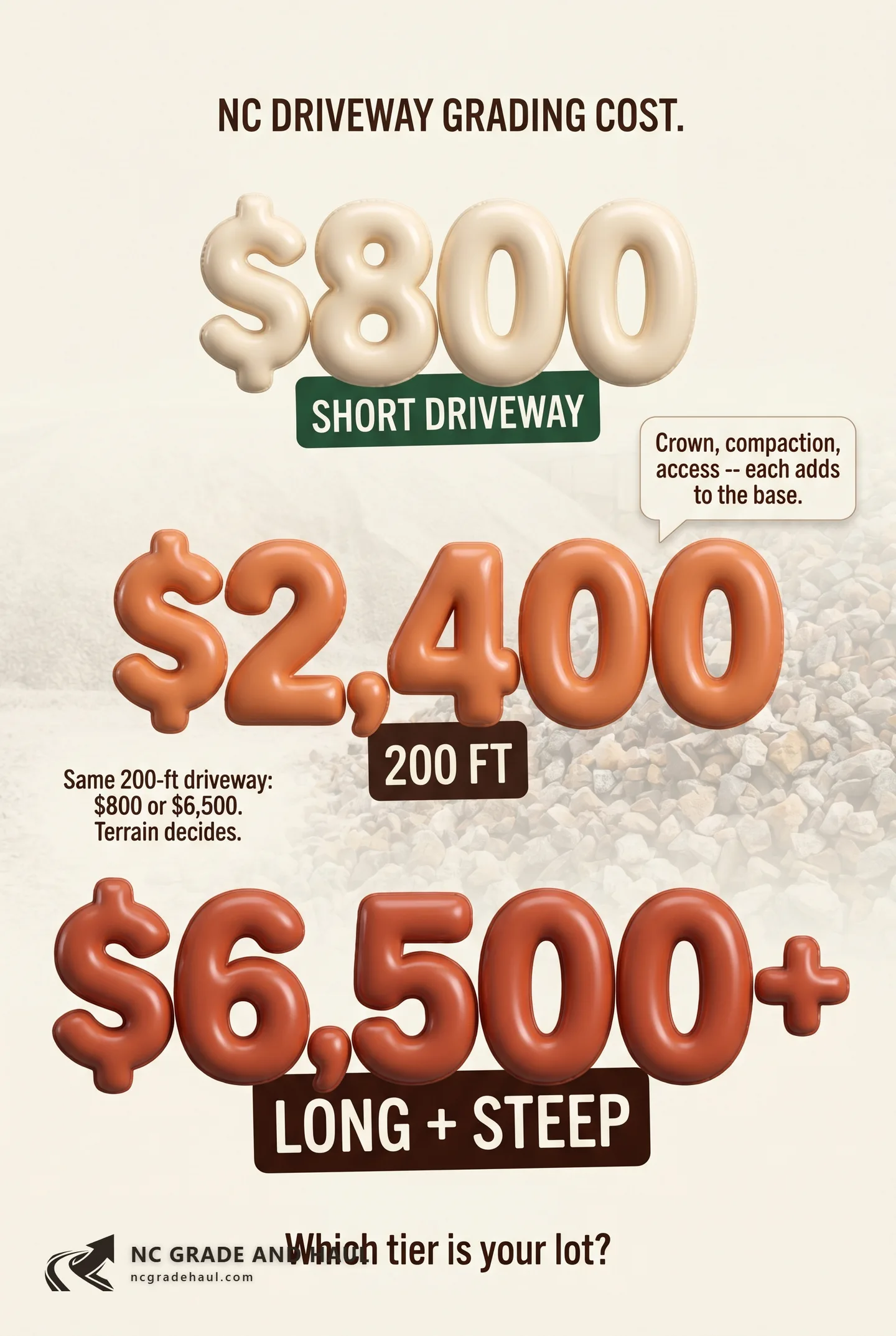
Surface regrading only (gravel redistributed, crown pass, no base work): roughly $500-$1,500 for a standard suburban driveway. Full regrading with base correction, crown, and compaction: roughly $1,500-$4,000 for the same drive. Add culvert work and budget an additional $800-$2,500 depending on pipe size and condition. Add gravel top-up by tonnage -- ABC stone runs roughly $25-$50/ton at the quarry; delivered and spread prices vary by haul distance. These are market estimates -- your actual cost depends on drive length, soil, access, and what the base actually needs. Get an itemized quote from at least two NC contractors before signing.
What should an itemized driveway grading quote include?
Mobilization fee, base assessment and prep, compaction (roller pass listed explicitly), gravel material by tonnage with type (ABC or CABC) and price per ton, crown specification (usually 3-4%), culvert work if applicable, and apron regrading if the drive connects to a state road. If the quote is a lump sum with none of those line items, you can't evaluate what's being skipped.
Two quotes for the same 80-foot driveway in Holly Springs. One came in at $1,100. The other at $3,400. Both contractors said they’d grade the driveway. Neither quote explained why the numbers were $2,300 apart.
That gap is almost never about markup or contractor greed. It’s about scope — specifically, whether the lower quote is doing base correction or just spreading gravel on top of a problem. This page gives you the framework to read both quotes.
What the Price Bands Actually Mean
The difference between a $900 grading job and a $3,500 grading job is almost always base treatment — not markup, not geography, not contractor greed.
Driveway grading quotes in North Carolina fall into three scopes. The footage is often the same. What changes is what the contractor is actually doing to the base.
Driveway Grading Scope: What Each Price Band Includes
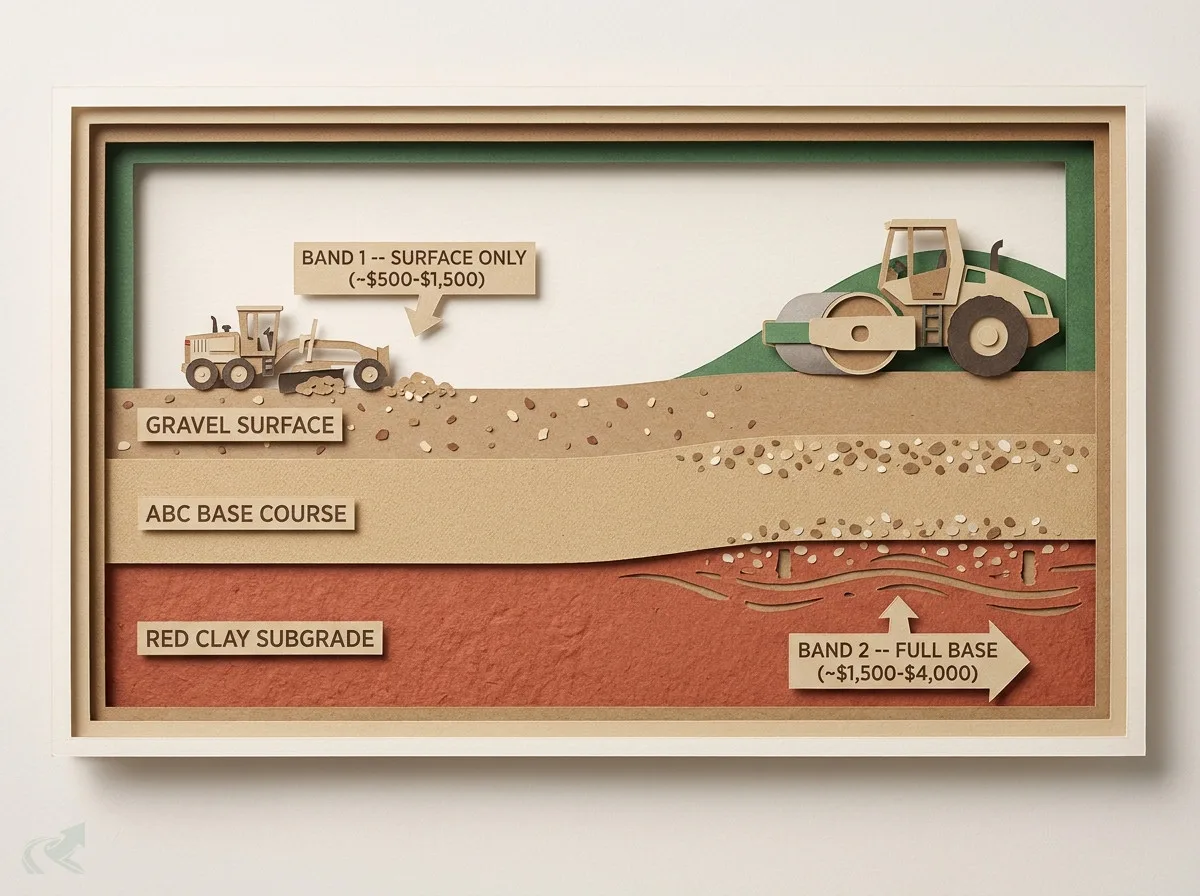
Comparison. Band 1 -- Surface Grading Only (~$500-$1,500): Existing gravel redistributed and shaped; Crown pass (ask if it is included); No base assessment or correction; No compaction verification; Right for cosmetic restoration only -- confirmed-firm base. Band 2 -- Full Base Correction (~$1,500-$4,000): Base investigation: walk-it-wet test, soft-spot ID; Subgrade repair where soft spots found; Drum roller compaction + proof-roll; Crown established to spec (3-4%); Gravel top-up included or priced per ton.
- Existing gravel redistributed and shaped
- Crown pass (ask if it is included)
- No base assessment or correction
- No compaction verification
- Right for cosmetic restoration only -- confirmed-firm base
- Base investigation: walk-it-wet test, soft-spot ID
- Subgrade repair where soft spots found
- Drum roller compaction + proof-roll
- Crown established to spec (3-4%)
- Gravel top-up included or priced per ton
Band 3 adds culvert, swale, or apron work to Band 2 scope -- roughly $800-$2,500 more. If the driveway fails every spring, Band 1 is paying twice.
Band 1: Surface grading only — roughly $500-$1,500 for an 80-100 ft suburban drive (market estimate; varies by contractor and site)
- Existing gravel redistributed and shaped
- Crown pass (or not — ask explicitly whether crown is included)
- No base assessment or correction
- No compaction verification
- Appropriate only when: the base is confirmed firm, crown geometry is close, and the job is cosmetic restoration after gravel migration
What it skips: subgrade investigation, drum roller compaction, fill material for low spots, any correction of drainage failures built into the base.
Band 2: Full regrading with base correction — roughly $1,500-$4,000 for an 80-100 ft suburban drive (market estimate; varies by soil condition and access)
- Base investigation (walk-it-wet test, visual soft-spot identification)
- Subgrade repair where soft spots are found
- Compaction with drum roller and proof-roll
- Driveway crowning in NC to spec (3-4%)
- Gravel top-up included or priced separately by tonnage
This is the scope that actually fixes a driveway that washes out or develops low spots after every rain.
Band 3: Grading with drainage work — add roughly $800-$2,500 to Band 2 scope (varies widely by pipe size, trench depth, and swale extent)
- Includes all Band 2 scope
- Plus culvert replacement or installation, swale work, or apron regrading
- This is the scope when washout is the presenting problem — not just aesthetic gravel migration
If your driveway fails every spring and the gravel ends up in the yard, Band 3 is the right scope. Band 1 on a drainage problem is paying twice.
By Drive Length — What to Expect
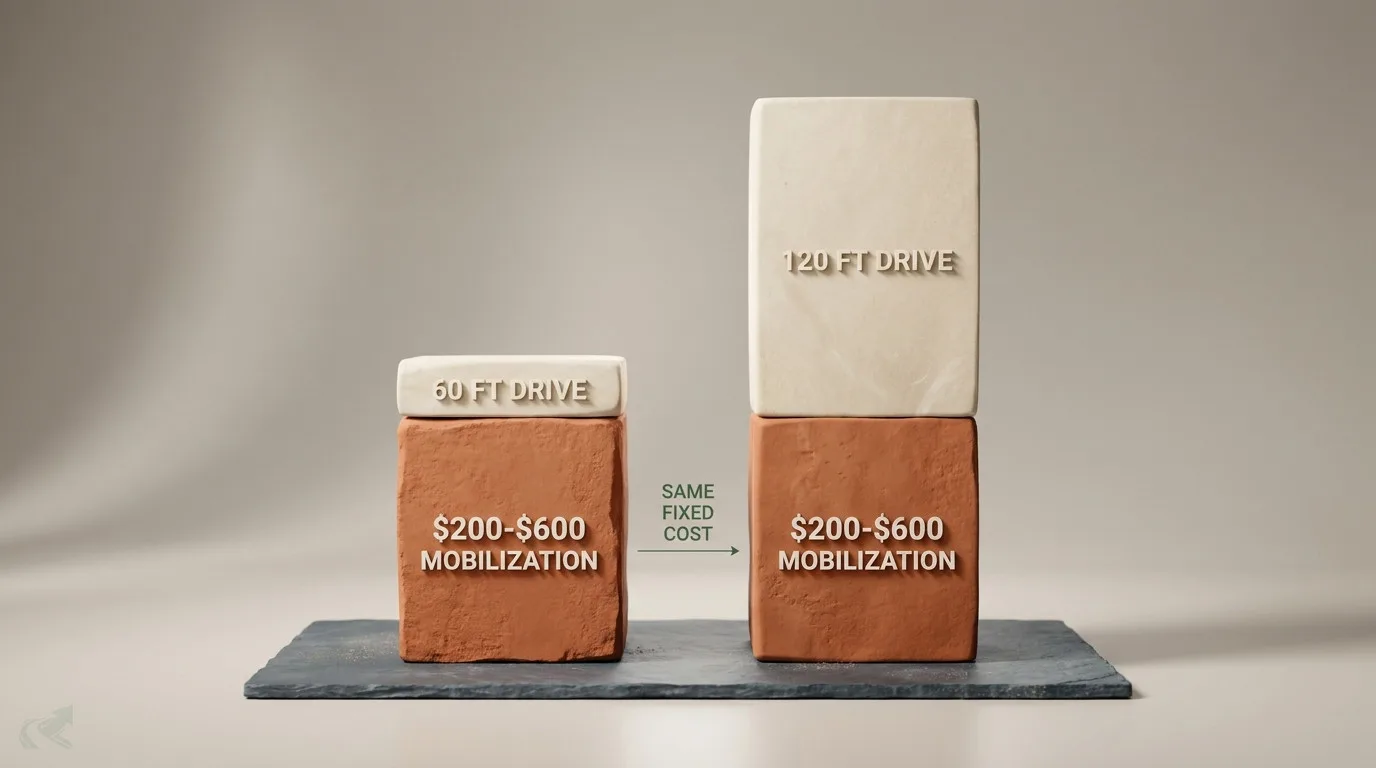
Driveway length determines mobilization cost efficiency — short drives cost more per linear foot because mobilization is fixed regardless of footage.
Every North Carolina grading contractor pays the same to load, transport, and deploy equipment whether the job is 60 feet or 600 feet. That fixed cost gets spread across fewer linear feet on short driveways.
How Drive Length Affects Cost per Linear Foot
1. 50-100 ft (suburban) -- Mobilization dominates -- fixed equipment cost spread over fewest feet. Surface: ~$500-$1,500 / Full base: ~$1,500-$3,000 2. 100-200 ft -- More efficient per foot. Mobilization still significant but better spread. Surface: ~$800-$2,000 / Full base: ~$2,000-$4,000 3. 200-400 ft -- Per-foot cost decreases noticeably. Multiple gravel loads required. Surface: ~$1,500-$3,500 / Full base: ~$3,500-$7,000 4. 400+ ft (rural) -- Often priced per linear foot in rural NC markets. Ask contractor for per-LF Band 2 scope pricing.
-
50-100 ft (suburban)
Mobilization dominates -- fixed equipment cost spread over fewest feet. Surface: ~$500-$1,500 / Full base: ~$1,500-$3,000
-
100-200 ft
More efficient per foot. Mobilization still significant but better spread. Surface: ~$800-$2,000 / Full base: ~$2,000-$4,000
-
200-400 ft
Per-foot cost decreases noticeably. Multiple gravel loads required. Surface: ~$1,500-$3,500 / Full base: ~$3,500-$7,000
-
400+ ft (rural)
Often priced per linear foot in rural NC markets. Ask contractor for per-LF Band 2 scope pricing.
Mobilization fees in NC typically run $200-$600 regardless of drive length. A 60 ft driveway can cost nearly as much as a 120 ft one because that fixed cost does not change.
| Drive length | Surface regrading | Full base + crown | Notes |
|---|---|---|---|
| 50-100 ft (suburban) | ~$500-$1,500 | ~$1,500-$3,000 | Short drive; mobilization dominates cost |
| 100-200 ft | ~$800-$2,000 | ~$2,000-$4,000 | More efficient per foot; mid-range |
| 200-400 ft | ~$1,500-$3,500 | ~$3,500-$7,000 | Multiple gravel loads; per-foot cost decreases |
| 400+ ft (rural) | Ask for per-LF pricing | Ask for per-LF pricing | Often priced per linear foot in rural NC markets |
These are directional market estimates only — not guaranteed ranges. Get an itemized quote from at least two contractors before signing.
Most NC grading contractors charge a mobilization fee for any job under a minimum threshold — typically in the $200-$600 range, though this varies by contractor and market. A 60-foot suburban driveway that doesn’t hit the minimum can cost nearly as much as a 120-foot one because the mobilization fee is the same either way.
For longer rural driveways in Guilford County or similar markets, ask for per-linear-foot pricing on Band 2 scope. Contractors who work rural driveways regularly can usually break it down that way — and once you have a per-ton material price, yards vs tons when pricing driveway gravel shows how to convert so the tonnage line items in the quote make sense.
Regional Price Variation — Triangle vs Charlotte vs WNC
Triangle and Charlotte metro pricing runs higher than Triad or rural markets. WNC pricing post-Helene is elevated due to surge demand and difficult access. For why mountain work prices differently at all — shallow soil over rock, access, hauling distance — see earthwork in Western North Carolina.
This is directional — every contractor sets their own rates. What matters more than regional averages is whether the scope in two quotes is actually equivalent.
- Triangle (Wake, Durham, Orange counties): Higher labor costs and equipment mobilization, more competition among contractors, but also more contractors who are accustomed to doing itemized scope documentation. Triangle market pricing generally runs above Triad for comparable scope — the differential reflects labor market and equipment availability, not scope differences.
- Charlotte metro (Mecklenburg): Similar to Triangle pricing. Piedmont clay base conditions are comparable — the same base correction approach applies.
- WNC (Buncombe, Henderson, Rutherford): Post-Helene contractor demand surge has pushed prices higher than pre-storm levels and extended lead times. The storm caused an estimated $347 million in combined damage across 24 WNC counties; WNC businesses reported an average loss of $322,000, and the region faces a documented shortage of roughly 34,000 housing units — all of which keeps contractor pipelines full and rates elevated. Steep-slope work — water bar installation, slope management — adds scope and time that’s not needed in Piedmont work. Get quotes from multiple verified NC grading contractors and expect longer scheduling windows than in metro markets.
- Triad (Guilford, Forsyth): Typically lower than Triangle for comparable work. Rural Guilford specifically — longer driveways, less mobilization friction, fewer permit complications — may run lower still on Band 2 scope.
The comparison only works if scope is equivalent. A Triangle quote for Band 1 work and a Triad quote for Band 2 work are not the same quote at different prices.
Itemized Quote Anatomy — What Each Line Should Cost
A legitimate driveway grading quote is itemized by work element — not by square footage or lump sum.
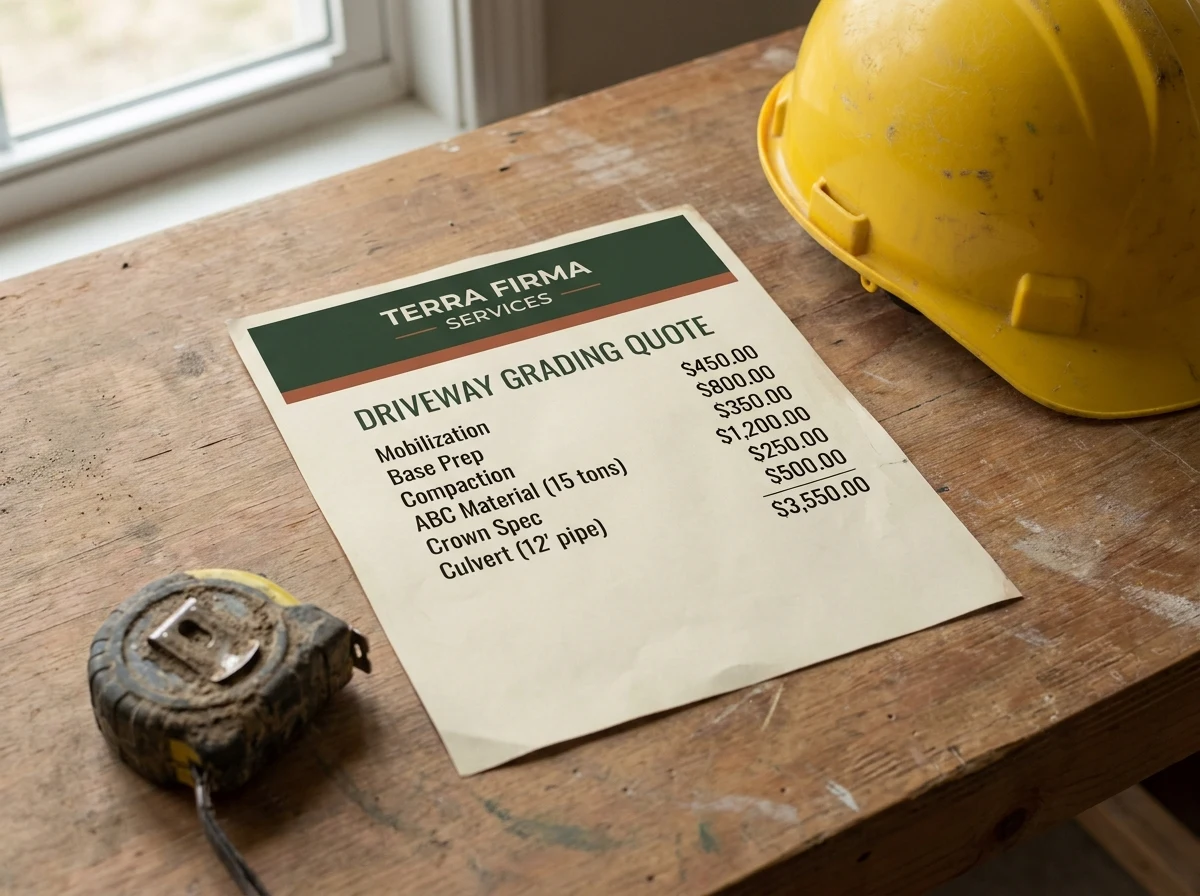
Here are the line items that belong in a North Carolina driveway grading quote for Band 2 scope:
- Mobilization: Fixed fee for equipment transport to site. Varies by contractor and distance — ask for it as a separate line so you can see what you’re paying just to get the machines there.
- Base assessment and prep: If charged separately, this is the line item that tells you the contractor is actually investigating the subgrade — not just grading over it.
- Compaction (roller pass): Should be listed explicitly. If it’s absent from the quote, the work may be absent from the job.
- Material — gravel by tonnage: or , listed as tons with material type and price per ton. ABC gravel for NC driveways runs roughly $25-$50/ton at the quarry; delivered-and-spread cost depends on haul distance. Always ask for material to be priced per ton with type called out — not “per load.”
- Crown specification: Listed as “grade to 3% crown, confirmed by level” or similar. If it’s not written, it’s not guaranteed.
- Culvert work: Separate line item if included, with pipe diameter and material called out.
- Apron regrading: Separate if the driveway connects to a NCDOT-maintained road.
Red flags in quote format:
- Lump sum with no line items: You can’t evaluate what’s included or excluded. “Grade driveway: $1,400” tells you nothing about scope.
- “Per yard” or “per load” without specifying material type: Loading price without accountability. Five loads of what?
- No mention of crown or compaction: These are the two most important things in a driveway grading quote. Their absence is information.
Common Mistakes When Reading Driveway Grading Quotes
Most quote errors come from comparing numbers instead of comparing scope.
- Taking the lowest quote without asking what it includes. A $900 Band 1 quote on a Band 2 problem means you’re paying $900 now and $3,000-$4,000 to fix it right in 18 months. The scope gap, not the price difference, is the mistake.
- Not asking about gravel material type. “5 loads of gravel” without specifying ABC vs CABC vs #67 washed stone is not a quote. The contractor can substitute screenings or unwashed crusher run and the quote price is technically honored.
- Accepting lump-sum pricing without line-item breakout. If you can’t see the base assessment, compaction, and material line items, you can’t evaluate what’s being skipped. Ask once — in writing.
The number in the quote is not the answer — the scope behind the number is. Ask for an itemized quote that lists base assessment, compaction method, crown specification, and material by tonnage and type.
A $1,200 lump sum that skips base treatment will cost $3,000 to fix right within two years. An itemized $2,800 quote that shows base correction, drum roller compaction, and crown spec is the better deal — even if the number is higher.
Find a grading contractor in North Carolina who can give you that itemized quote. If you’re in the Raleigh area, driveway grading cost in Raleigh NC has market-specific ranges. For a deeper look at how to compare quotes side by side, see itemized vs lump-sum driveway grading quote.