
Before you call a contractor
How do I measure a gravel pile to check my delivery volume?
Step 1: Measure base diameter at widest point. Step 2: Measure height at peak. Step 3: Apply formula -- V (cubic feet) = 1.05 x (diameter/2)^2 x height x 3.14. Step 4: Divide by 27 = cubic yards. Step 5: Subtract 5-8% for settle factor. Compare to ticket.
What tools do I need to measure a gravel pile?
A tape measure and a phone calculator. No special equipment required. The cone volume formula does the work.
The Measurement Method
You need two numbers: base diameter and pile height.
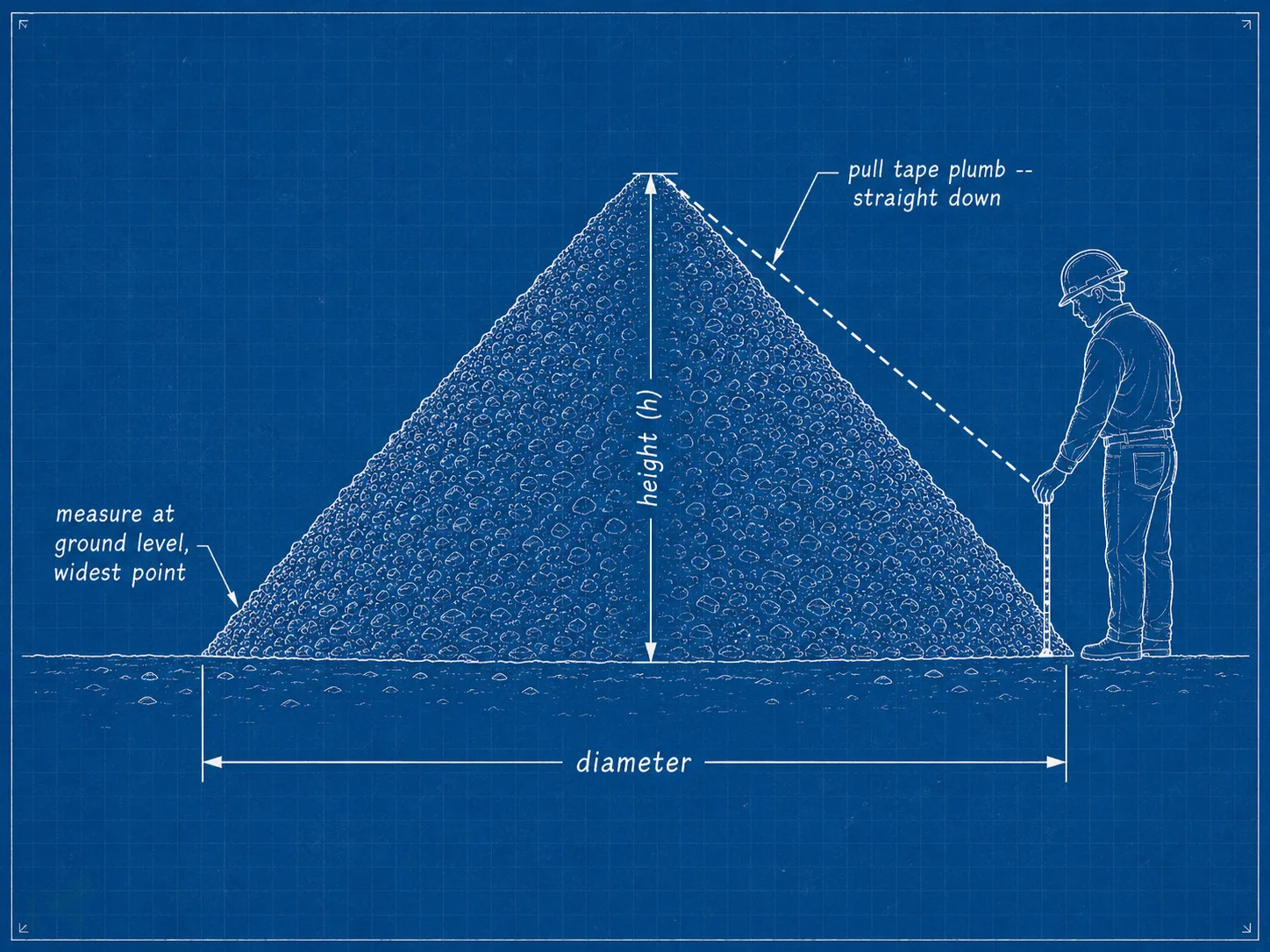
Walk the perimeter of the pile and find the widest point across the base. NC dump truck gravel delivery typically produces a single cone-shaped pile; if the driver spread across multiple drop points, measure each separately. Stretch your tape measure straight across that widest point at ground level. That is your base diameter.
For height, stand at the edge of the pile and have a helper hold the end of the tape at the peak. Pull the tape plumb — straight down — from the peak to the ground. That is your pile height.
If you are working alone, prop a straight stick or board vertically at the edge and measure from ground to where it meets the slope line at the peak angle. A phone level app helps confirm the tape is vertical.
Write both numbers down in feet. Inches matter — convert partial feet to decimals (6 inches = 0.5 feet).
The Formula
Plug your two measurements into this formula to get cubic yards.
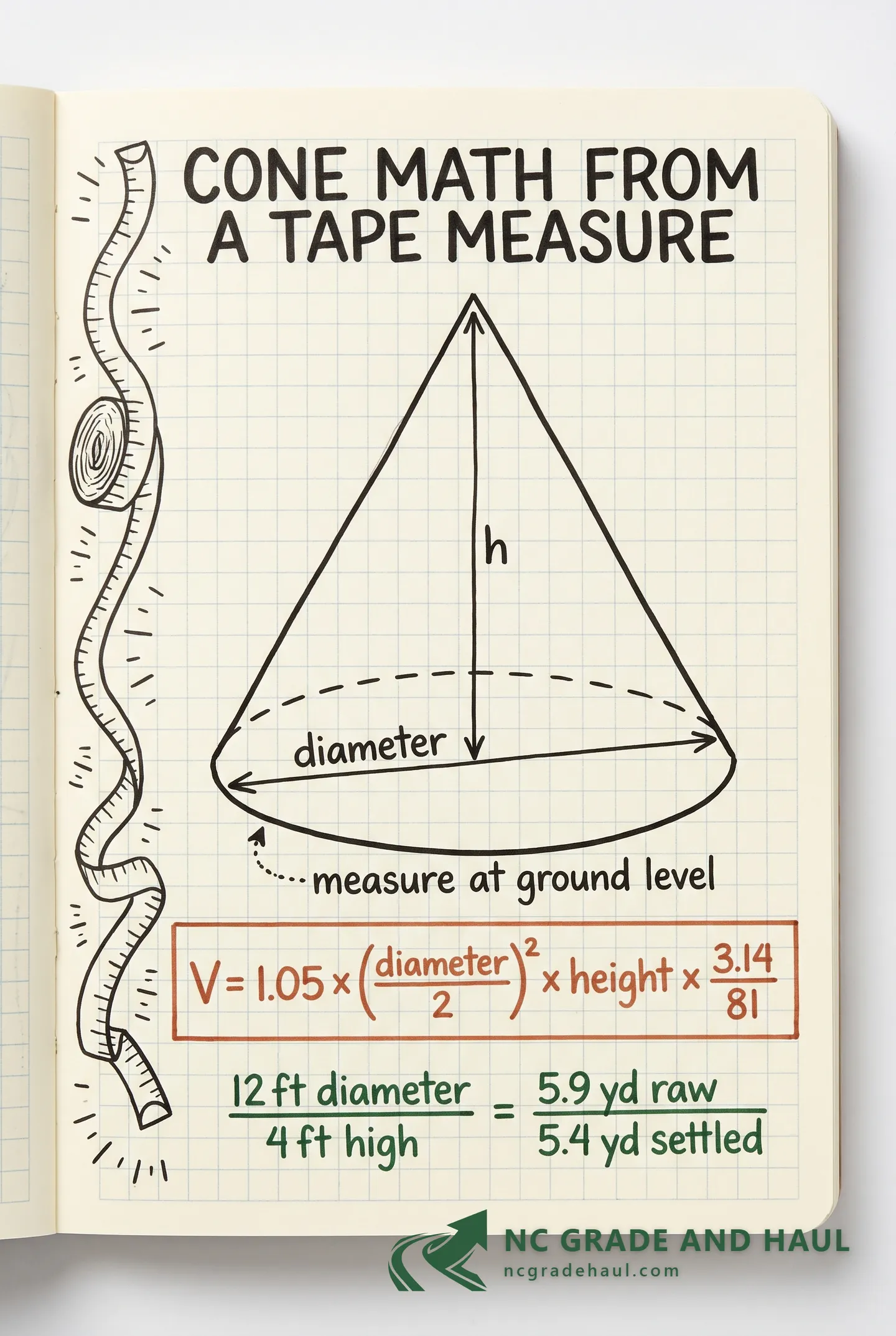
A cone’s volume formula is: V = (1/3) x pi x r^2 x h
Where r = radius (half the diameter) and h = height.
Because real gravel piles are not perfect cones — they slump slightly at the base — multiply by 1.05 to correct for the slightly flatter-than-cone shape.
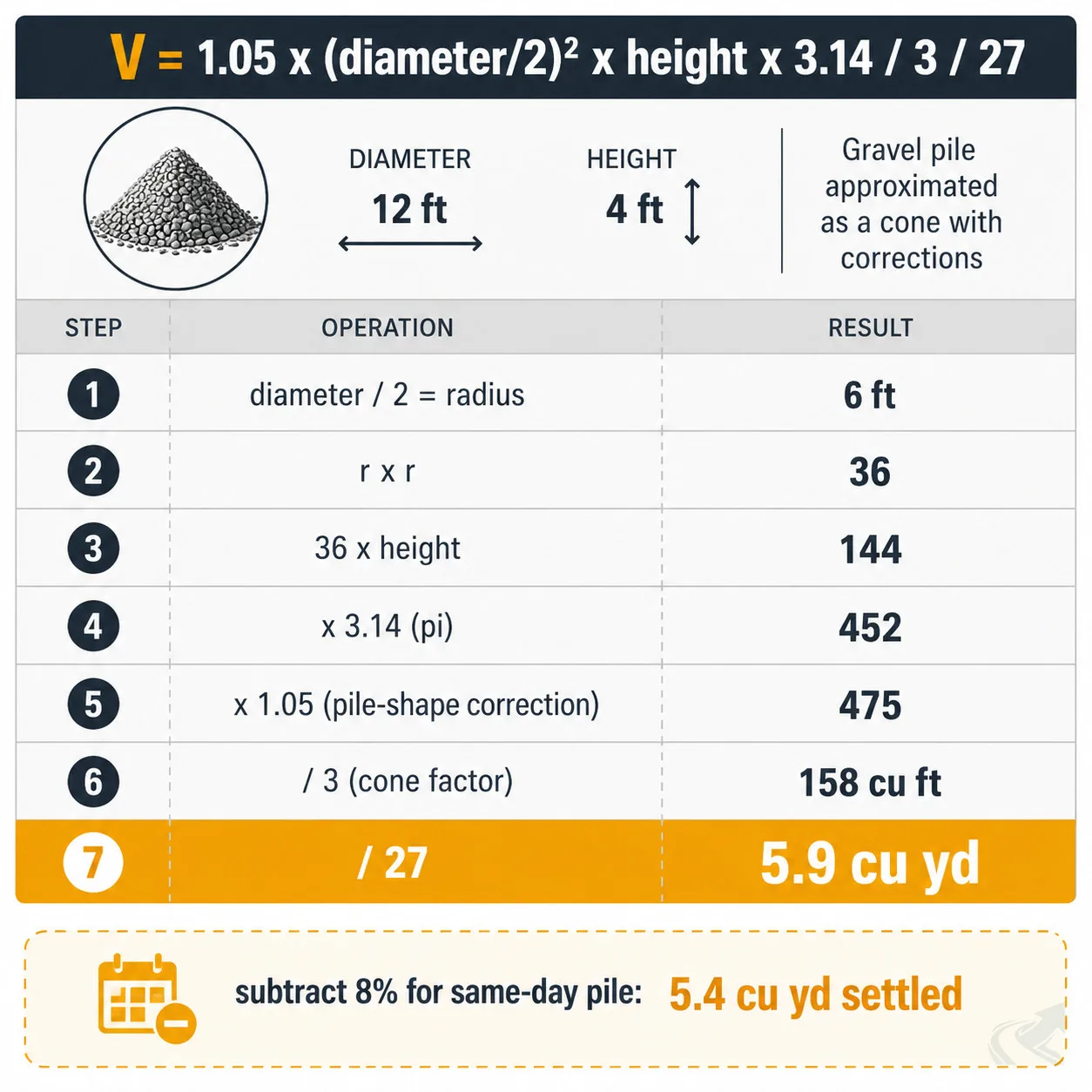
Step-by-step:
- Divide diameter by 2 to get radius
- Multiply radius x radius (r^2)
- Multiply r^2 x height
- Multiply by 3.14 (pi)
- Multiply by 1.05 (pile-shape correction)
- Divide by 3 (cone factor)
- Divide by 27 (converts cubic feet to cubic yards)
Worked example — 12-foot diameter pile, 4-foot height:
- Radius = 6 feet
- r^2 = 36
- 36 x 4 = 144
- 144 x 3.14 = 452
- 452 x 1.05 = 475
- 475 / 3 = 158 cubic feet
- 158 / 27 = 5.9 cubic yards (before settle)
Shareable formula shortcut:
Gravel pile cubic yards = 1.05 x (diameter/2)^2 x height x 3.14 / 3 / 27. Subtract 8% for settle. Example: 12ft diameter, 4ft high — 5.9 yards raw, 5.4 yards settled.
If the settled figure comes up significantly short against your ticket, that is one of the red flags when a NC gravel delivery seems short — worth documenting before you call the supplier.
Pile Shape Reference
        *
       /|\
      / | \   <-- height (h)
     /  |  \
    /   |   \
   *---------*
   |--diameter--|
Measure height straight down from the peak. Measure diameter at ground level across the widest point.
The Settle Factor
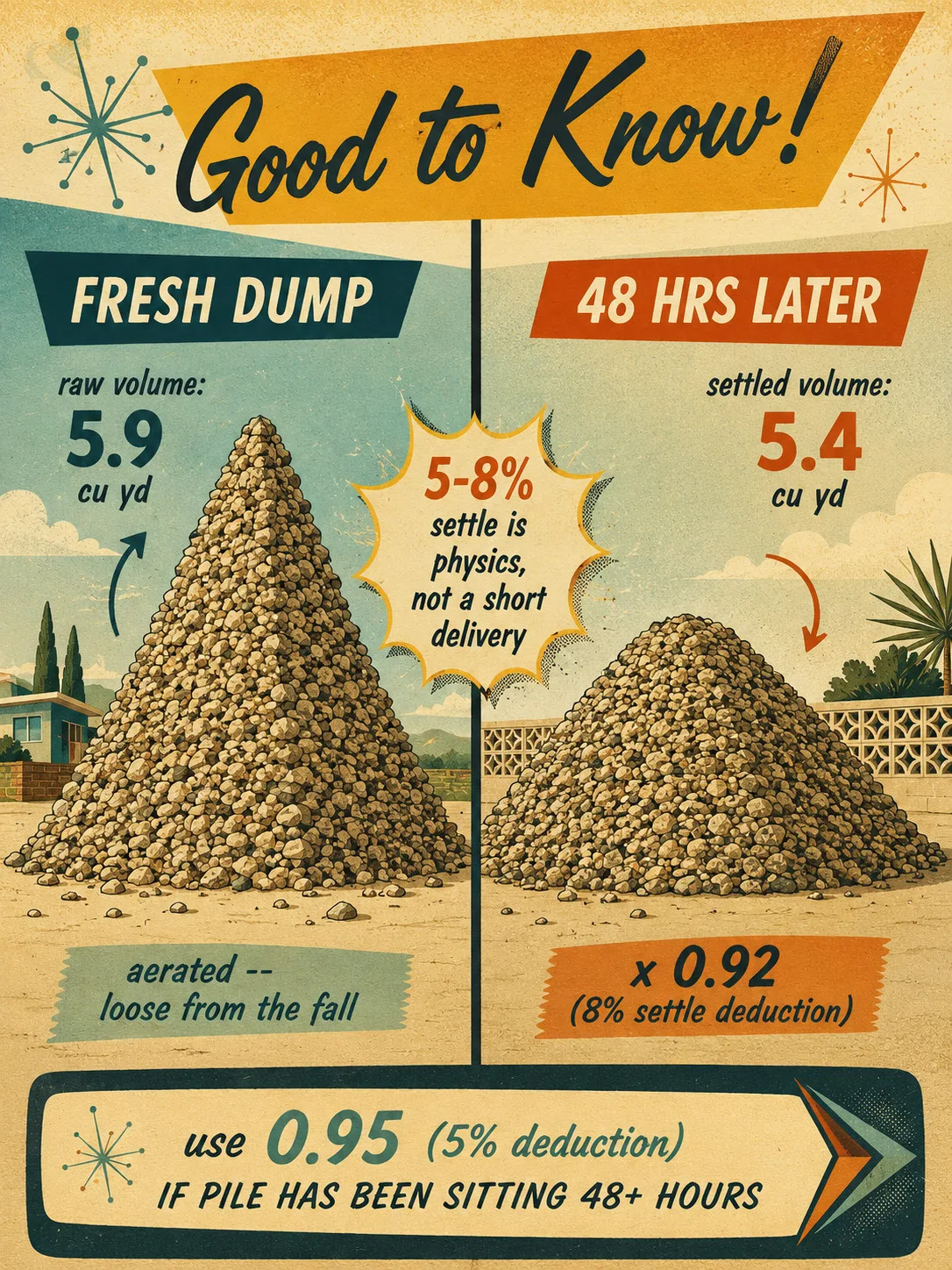
Freshly dumped gravel is loose — it will compact 5-10% as it settles.
When a truck dumps a load, the material is aerated and loosely stacked from the fall. Over the next few days — from traffic, rain, and gravity — gravel self-compacts into a denser configuration. Understanding NCDOT weight limits and gravel delivery math helps you cross-check whether the truck’s rated payload is consistent with what you ordered.
A fresh pile always measures slightly larger than its settled volume. That is not a short delivery. It is physics.
Apply a settle deduction before comparing to your ticket:
- Standard settle allowance: 5-8% for crushed stone and gravel
- Use 8% for fresh same-day piles
- Use 5% for piles that have been sitting 48+ hours
To apply: take your cubic yard calculation and multiply by 0.92 (for 8% settle) or 0.95 (for 5% settle).
Using the example above: 5.9 yards x 0.92 = 5.4 yards settled volume.
Compare the settled figure to your delivery ticket — not the raw pile measurement.
Interpreting the Result
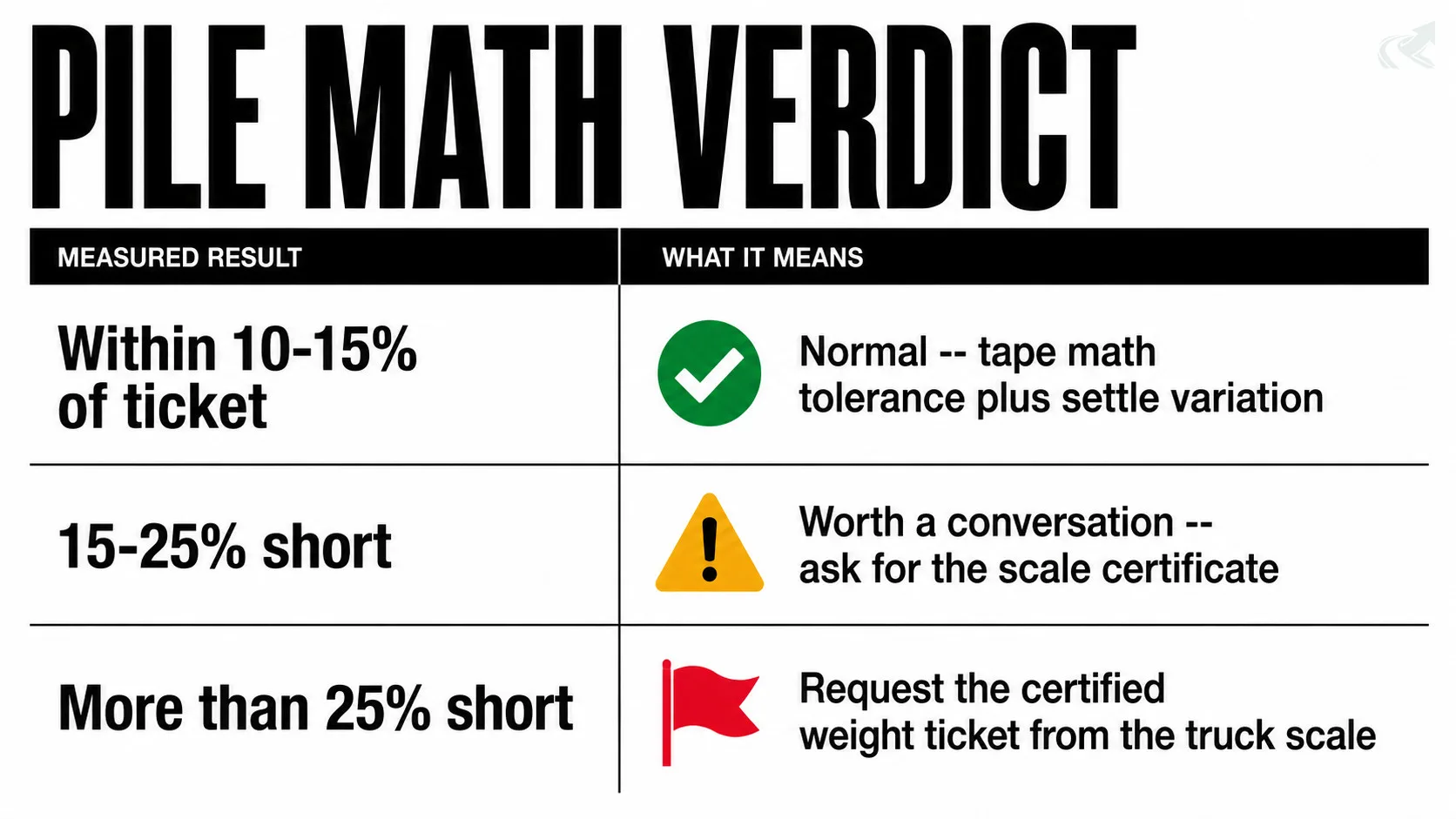
A variance of 10-15% from your ticket is within normal measurement tolerance.
Tape measure pile math is an estimate, not a certified scale reading. Several factors introduce variation:
- Pile shape is never a perfect cone
- Diameter measurement shifts if the base is not level ground
- Compaction rate varies by material type (pea gravel settles differently than crushed granite)
What is normal vs. a red flag:
| Result | What it likely means |
|---|---|
| Within 10-15% of ticket | Normal — tape math tolerance plus settle variation |
| 15-25% short | Worth a conversation with the supplier — ask for scale certificate |
| More than 25% short | Request the certified weight ticket from the truck scale |
North Carolina suppliers are required to have a certified truck scale or use a third-party certified scale. If the variance is significant, ask for the scale certificate — it is a legal document showing the net weight of material delivered. Knowing how to evaluate NC contractor quotes helps you decide whether a short-pile conversation is worth pursuing or whether the gap is within acceptable tolerance. Use pile math in the gravel volume verification system alongside the ticket.
When Pile Math Is Less Accurate
Pile math works best on a single fresh cone. Several situations reduce its accuracy.
If the delivery was spread across multiple drop points, or if equipment has already moved the material, you cannot reconstruct the original volume from what remains. The cone model assumes an undisturbed pile.
Other accuracy-reducers:
- Wet material — saturated gravel weighs more per yard; pile shape also slumps more
- Very large piles (15+ foot diameter) — harder to measure height accurately without a helper
- Irregular shapes — if the pile was dumped against a wall or on a slope, the cone model does not apply
In these cases, the scale certificate from the truck is the primary verification tool. Cross-checking NC gravel delivery tickets with pile measurements covers how to read that document.
Check Your Numbers and Find a Contractor
If your pile math and your delivery ticket are within the normal 10-15% window, the delivery is almost certainly accurate. If the gap is wider, start with the settle factor — then request the scale certificate.
For a quick unit conversion after you have your cubic yard estimate, the gravel quantity converter to cross-check pile measurements converts between cubic yards and tons using material-specific weights.
To understand how weight and volume relate before the next delivery, see gravel weight per yard to compare with pile volume.
When you are ready to order, hire an NC hauling operator who can confirm material weights and assist with accurate volume planning before the truck rolls.