
What homeowners ask before checking a delivery ticket
How much does a cubic yard of gravel weigh?
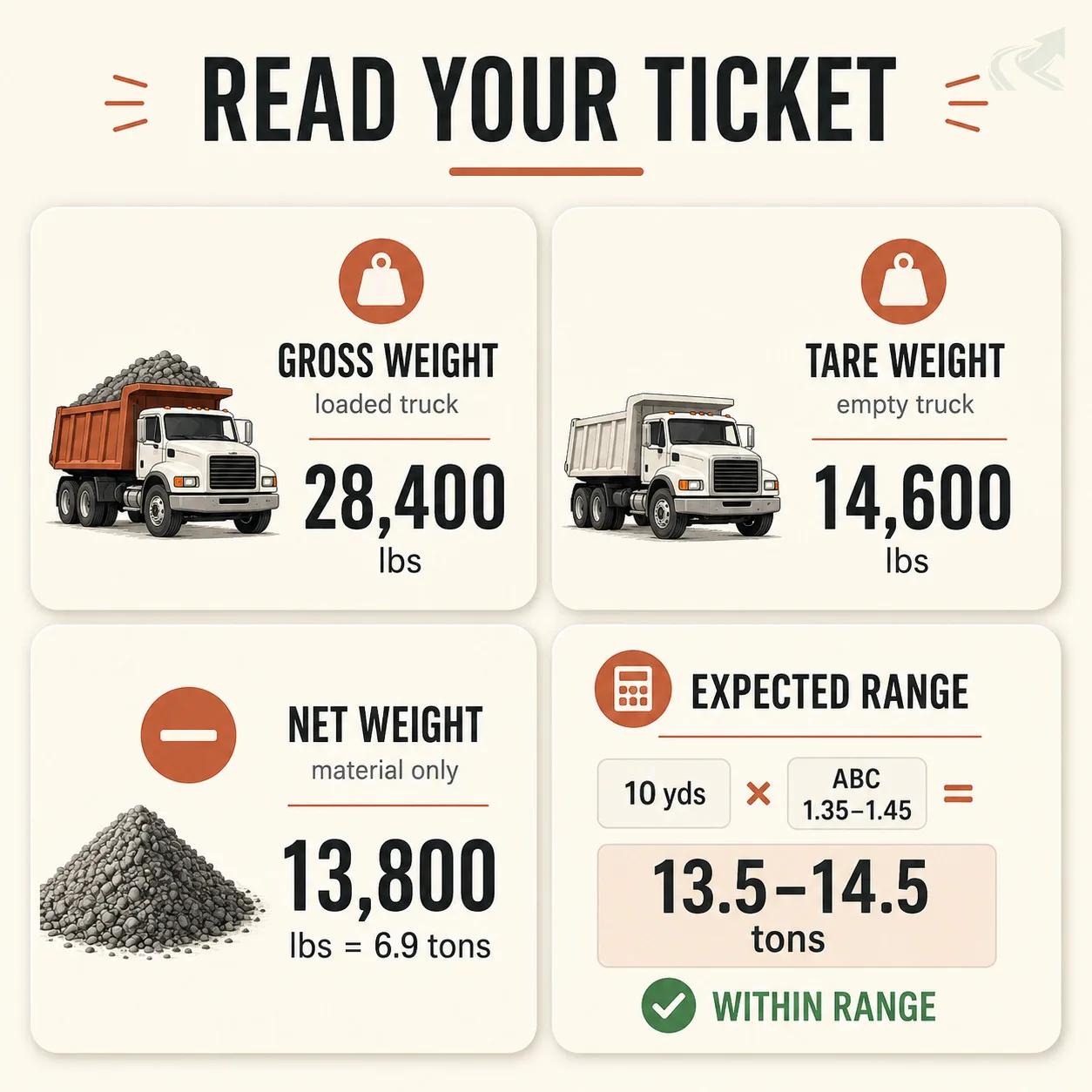
It depends on the material. ABC gravel weighs roughly 1.35--1.45 tons per cubic yard. #67 washed stone is roughly 1.25--1.35 tons per yard. Fill dirt runs 1.0--1.2 tons per yard; topsoil is lighter at 0.8--1.0 tons. Use the number to check your delivery ticket: 10 cubic yards of ABC should appear as approximately 13.5--14.5 tons net weight on the scale ticket.
How far off can a tonnage reading be before something is wrong?
A 10--15% deviation from the expected range is normal -- moisture content and quarry-specific density account for most of it. A deviation of 20% or more is worth questioning. Request the scale certificate from the hauler. The scale certificate shows the truck gross weight, tare weight, and net weight from a certified scale -- those three numbers should reconcile.
Ray got 10 cubic yards of ABC gravel delivered to his North Carolina property. The ticket showed 11.2 tons net. He wasn’t sure if that was right. It was — barely within range. But he had no way to know that without the weight data.
This page is that data. Use the table below to run the check yourself.
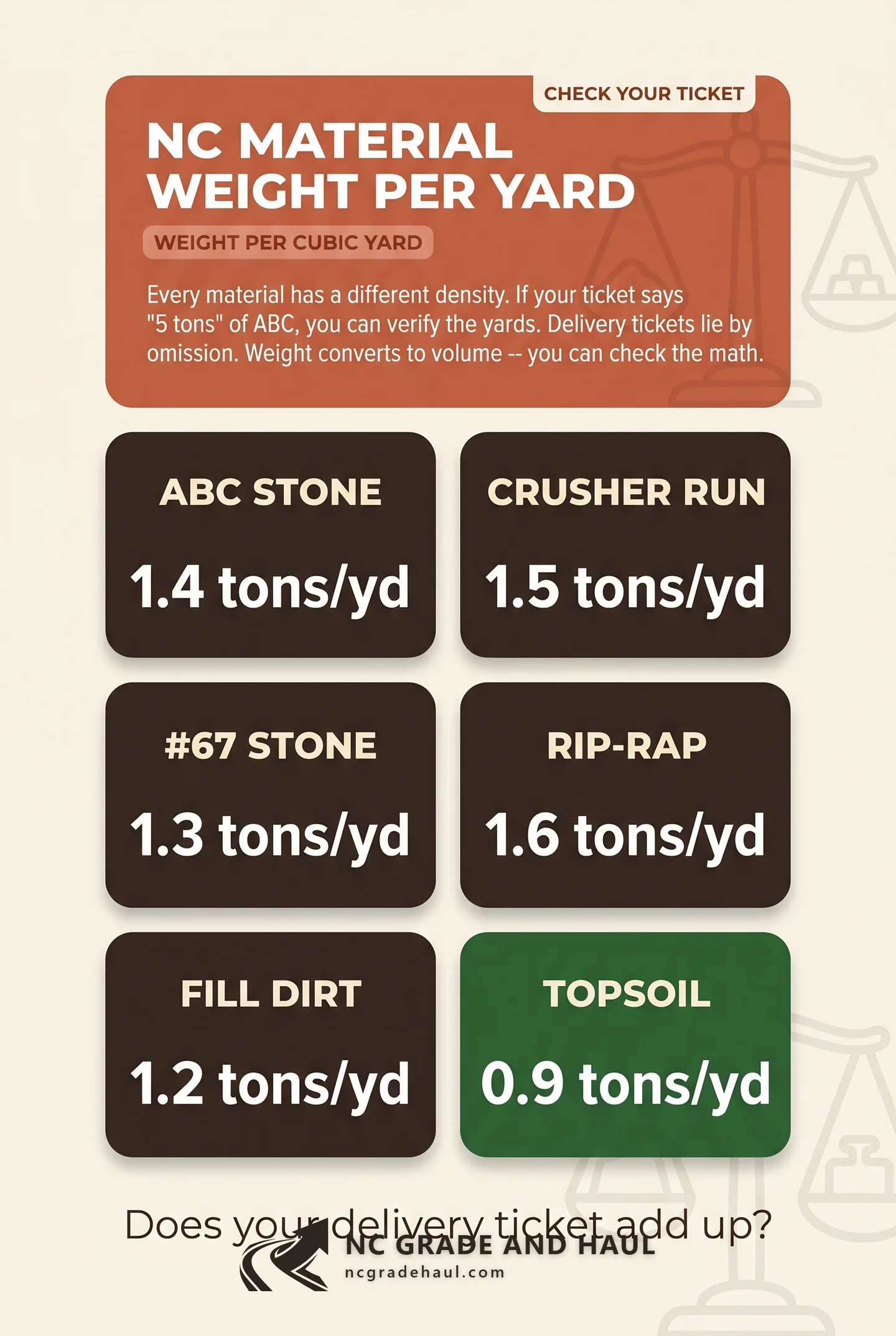
The Weight Reference Table
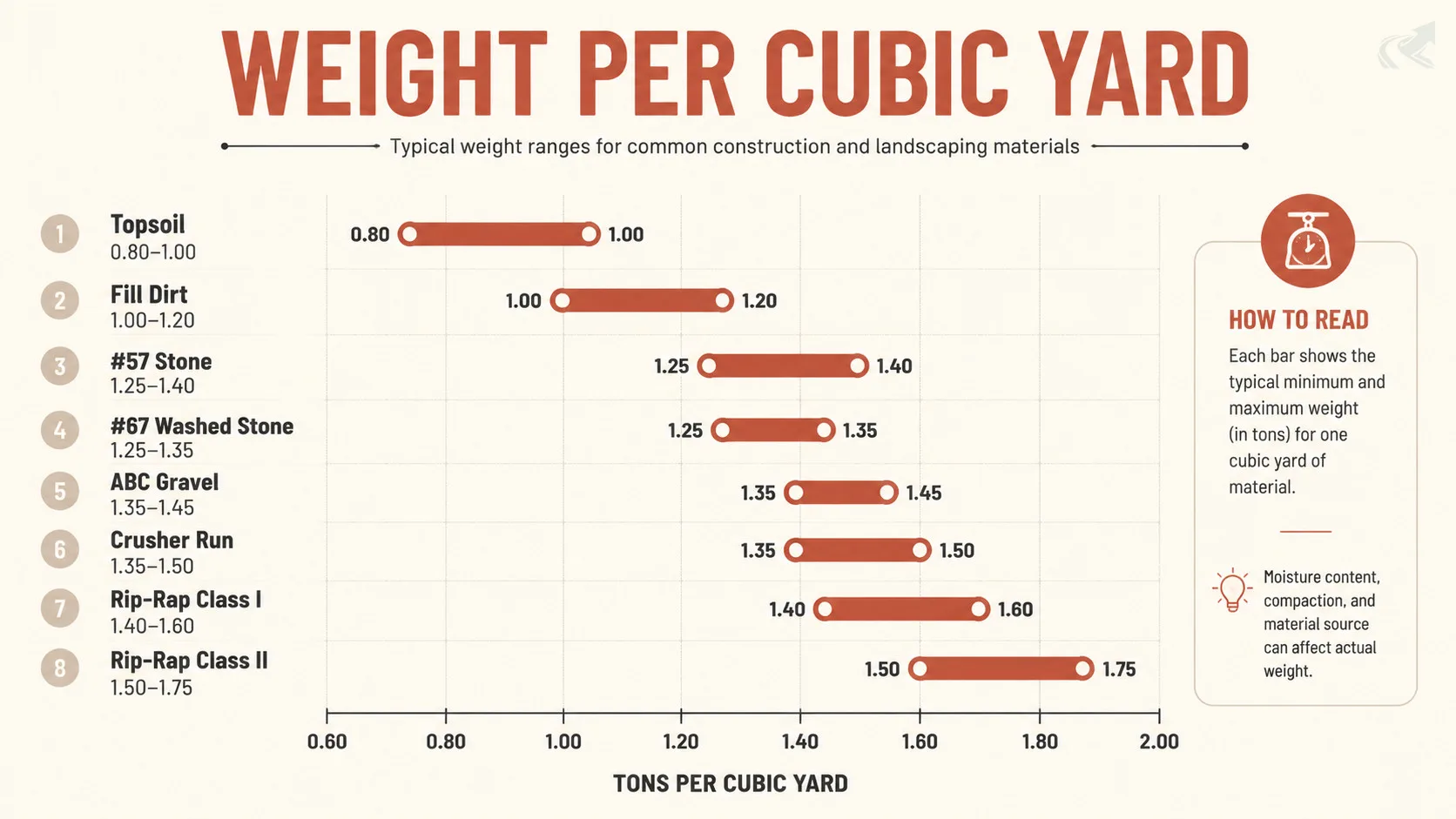
A cubic yard of granular material weighs between 0.8 and 1.8 tons depending on what it is — find your material below, then multiply by the cubic yards delivered.
Density varies by quarry source, stone type, and moisture content. The figures below are representative ranges drawn from NCDOT aggregate specifications and standard industry practice. They are not single-point lookup values — they are ranges, and your actual delivery may fall anywhere inside them.
| Material | Approx. tons per cubic yard | Notes |
|---|---|---|
| ABC gravel weight per cubic yard / CABC (Aggregate Base Course) | 1.35—1.45 | Dense-graded; includes fines. The NC driveway base standard. |
| Crusher run | 1.35—1.50 | Dense-graded, coarser than ABC; similar density range. |
| #67 washed stone | 1.25—1.35 | Open-graded, no fines; lighter because of higher void content. |
| #57 stone | 1.25—1.40 | Similar to #67; minor variation by quarry source. |
| Rip-rap (Class I) | 1.40—1.60 | Larger stone with irregular void space; heavier than gravel. |
| Rip-rap (Class II) | 1.50—1.75 | Heavier stone class; higher density per yard. |
| Fill dirt (dry to moist) | 1.00—1.20 | Wide range; dry clay-heavy fill sits toward the high end, sandy fill toward the low. |
| Topsoil | 0.80—1.00 | Organic content reduces density; screened topsoil toward lower end. |
Verify at source. These are planning ranges. For permitted work or disputed deliveries, request the quarry’s gradation spec sheet and the hauler’s certified scale certificate — those documents govern, not a reference table.
Why Material Weight Varies
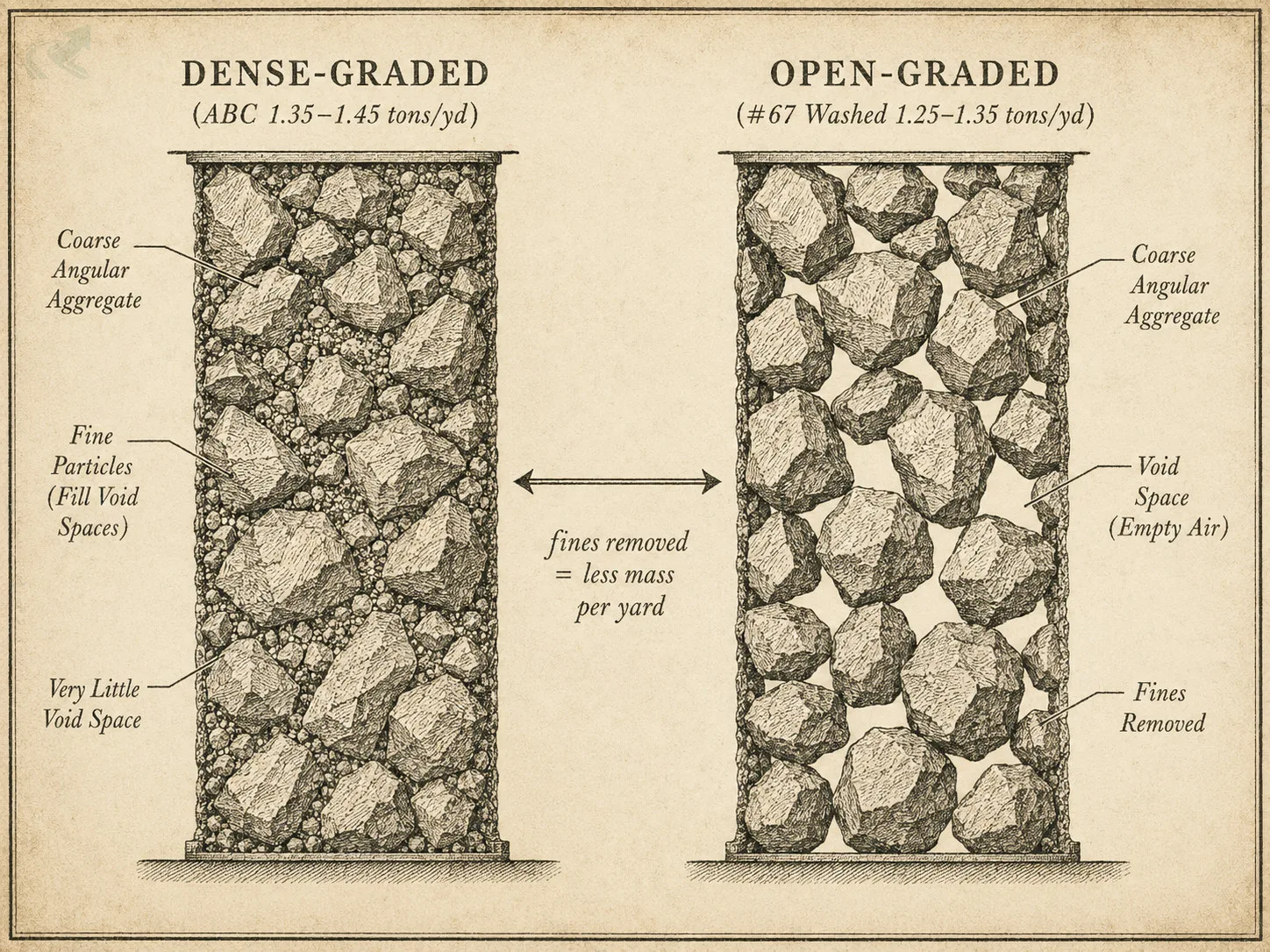
Material weight varies because density is not fixed — it depends on stone mineralogy, gradation, fines content, and moisture at the time of delivery.
Three factors drive most of the variation in North Carolina aggregate deliveries:
Rock type at the quarry. Granite — common in the NC Piedmont — is denser than limestone, which is more common in other regions. A ton of Piedmont granite aggregate occupies less volume than a ton of limestone aggregate from a different region. This is why weight-per-yard figures from out-of-state sources may not match what you see on a local ticket.
Open-graded vs dense-graded. Dense-graded mixes (ABC, crusher run) include fines that fill the void space between larger stones. Open-graded mixes (#67, #57 washed stone) have those fines removed. The void space in open-graded material means less mass per cubic yard — which is why washed stone consistently weighs less per yard than ABC of comparable stone type.
Moisture content of fill materials. Dry fill dirt and dry topsoil weigh less than the same material wet. A load delivered after heavy rain can weigh 10—15% more per yard than the same load in dry conditions. The scale ticket captures the actual weight at the time of delivery — the reference table range has to accommodate that natural variation. Understanding how NC gravel deliveries work and what to watch helps you set the right expectations before the truck arrives.
How to Use This to Verify Your Delivery Ticket
The check is one calculation: multiply your ordered cubic yards by the weight range for your material, then compare the result to the net weight on the delivery ticket.
Step-by-step:
-
Find your ordered volume in cubic yards. This is usually in the purchase order or haul agreement. If the contract quoted tons, the weight table helps you back-check whether the tonnage is plausible for the volume. You can also cross-check volume from the other direction by measuring your gravel pile to verify delivery volume once the material is on the ground.
-
Find your material in the table above. Use the low and high ends of the range to produce an expected-weight range in tons. Example: 10 cubic yards of #67 washed stone should weigh approximately 10 x 1.25 to 10 x 1.35 = 12.5—13.5 tons.
-
Read the net weight on the delivery ticket. The delivery ticket (sometimes called a scale ticket or weight ticket) should show three values: gross weight (loaded truck), tare weight (empty truck), and net weight (material only). The net weight is the number to compare.
-
Compare. If the net weight falls within the expected range, the delivery is consistent with what you ordered.
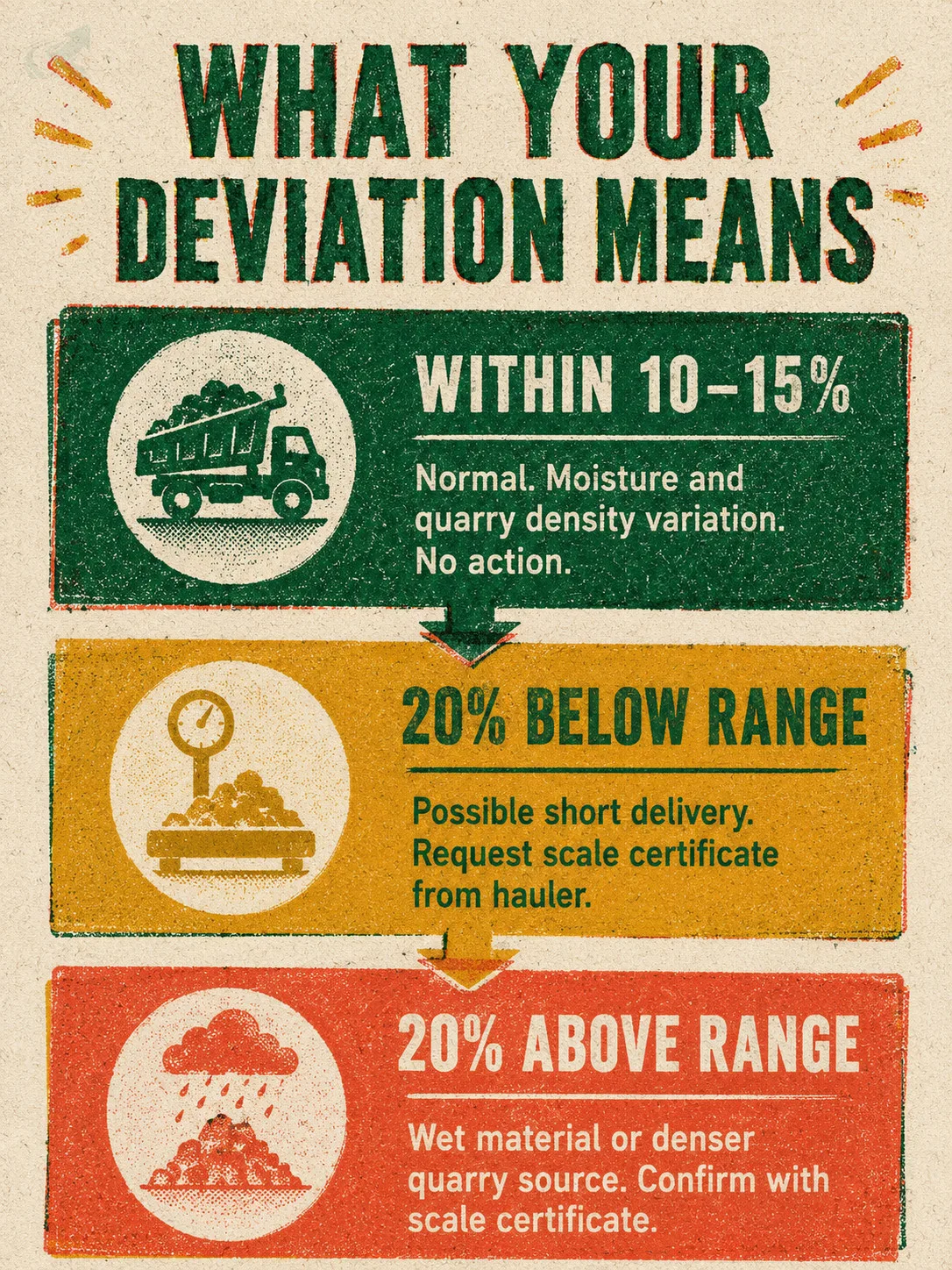
What a deviation means:
- 10—15% below or above the range: Normal. Moisture, quarry density variation, and rounding in ordered quantities all contribute. No action required.
- 20% or more below the range: The delivery may be short. Request the scale certificate — a separate document issued by the certified weigh station that shows the same gross/tare/net values with a station seal. The hauler is required to provide it. A persistent gap between what the ticket shows and what the math says is one of the red flags when a NC gravel delivery seems short worth documenting.
- 20% or more above the range: Possible wet material or a denser quarry source than typical. Still worth confirming with the scale certificate before assuming an error.
The scale certificate is the governing document. The delivery ticket is issued by the hauler; the scale certificate is issued by an independent certified scale facility. When numbers conflict, the scale certificate controls.
The Gravel Converter Tool
The manual calculation is multiplication — but a dedicated tool handles the full conversion including unit-switching between yards and tons.
The formula is:
Expected tons = ordered cubic yards x weight per yard (from table above)
To reverse it (checking what volume a tonnage represents):
Expected cubic yards = net weight in tons / weight per yard
For a calculator that handles both directions and lets you select material type, see the gravel yard-to-ton converter tool. The tool uses the same reference ranges as the table above.
If you are doing the math manually, use the midpoint of the range as your center estimate, then treat the full range as your acceptable window. For ABC gravel: midpoint is 1.40 tons/yard. Ten yards = 14.0 tons expected; acceptable range is 12.8—16.2 tons (allowing 10% variation on each side of the range endpoints).
For broader context on why yards and tons are different units and how North Carolina haulers typically quote jobs, see yards vs tons context for gravel weight per yard.
Next Step — Checking the Full Delivery Ticket
Weight is one line on a delivery ticket — scale weight and material grade are the other two numbers worth checking.
Once you have confirmed the net weight is within the expected range for your material, the next check is the material specification listed on the ticket. A ticket showing “ABC” when the quarry loaded crusher run — or showing a quantity in yards when the contract specified tons — signals a documentation discrepancy worth resolving before the contractor leaves the site.
For a step-by-step walkthrough of using weight per yard to verify the delivery ticket — including what every field on a North Carolina delivery ticket means and what to ask the hauler when something does not add up — see the delivery-ticket spoke.
To find a contractor in NC who hauls gravel and fill, see the hire an NC hauling operator directory. All listings include license status verified against the NC Licensing Board.