
Questions Raleigh homeowners ask
Why does my new Raleigh yard still flood after a year?
The most common cause in Wake County production subdivisions is minimum-spec builder grading -- enough slope to pass inspection, not enough to drain Piedmont red clay under a 1-inch rainfall event. A grading contractor can diagnose whether your yard needs regrading, a French drain, or both.
Will a French drain fix my flat subdivision yard?
Maybe -- but not if your yard slopes toward the house. Negative grade has to be fixed with regrading first. Installing drainage hardware on a negatively graded yard gives you a buried pool instead of a surface pool.
Say you closed on a new production-builder home in Holly Springs two years ago. The yard is flat. After any decent rain, water sits for 48 hours in the low corner near the foundation. You called the builder. They said the grading is within spec.
They are technically correct. That is the problem.
North Carolina’s minimum residential grading standard and “drains well in Piedmont red clay” are two different things. This page explains why, gives you a diagnostic framework to identify your specific root cause, and tells you what each fix actually looks like.
The Flat-Lot Problem: Why Raleigh Yards Drain Poorly by Design
Most Wake County production subdivisions were graded to minimum slope standards — which is not the same as “drains well in a rain event.”
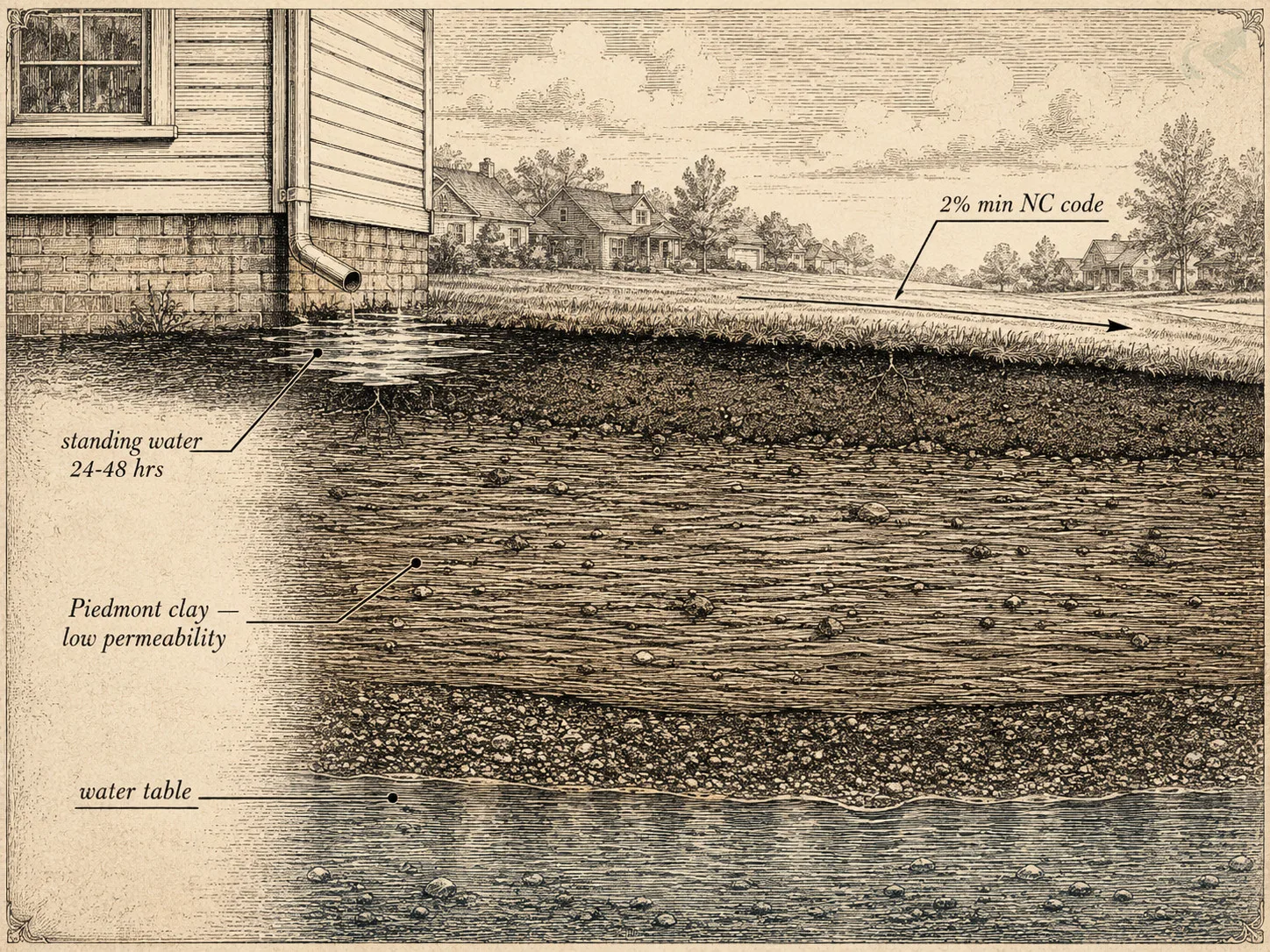
The Piedmont zone around Raleigh sits in low-relief terrain. Unlike the mountains or the Coastal Plain, the Triangle’s natural topography is gently rolling at best and nearly flat at worst. Water doesn’t shed quickly here.
North Carolina’s minimum residential grading standard calls for a 2% slope away from the foundation. Production builders commonly grade to that 2% minimum and stop. The spec is met. The job is done. The permit gets signed.
The trouble: a 2% slope on a 0.2-acre lot moves water slowly under dry conditions. Under a 1-inch rainfall event on Piedmont clay — a soil with low permeability that seals tight under builder equipment — that 2% slope barely functions. Standing water 24—48 hours after rain is routine in post-2015 production subdivisions across Wake County.
This is not a homeowner error. It is a minimum-spec problem built into the economics of high-volume residential construction.
The Three Root Causes of Standing Water in Raleigh Yards
Not every yard drainage problem has the same fix — three root causes produce the same symptom but need different solutions.
Before anyone installs drainage hardware, you need to know which root cause you are dealing with.
-
Negative grade. The yard slopes toward the house, not away from it. Standing water pools at or near the foundation. Fix: regrading to establish positive drainage away from the structure. A French drain will not solve negative grade — it moves water to a buried trench where it pools instead of pooling on the surface. Regrading has to come first.
-
Compaction from builder equipment. Heavy equipment during construction compacts the subsoil, reducing permeability so that even a properly sloped yard holds water. Water sits broadly across the lot rather than collecting in one low spot. Fix: subsoil aeration plus organic amendment, sometimes combined with a French drain.
-
No outlet. The yard has adequate slope but no path for water to exit. Neighboring lots, privacy fencing, and hardscape block the natural flow line. Water pools in the center or low corner with no route to the street. Fix: a French drain with a positive outlet that daylights to street curb, a county stormwater swale, or approved storm drain infrastructure.
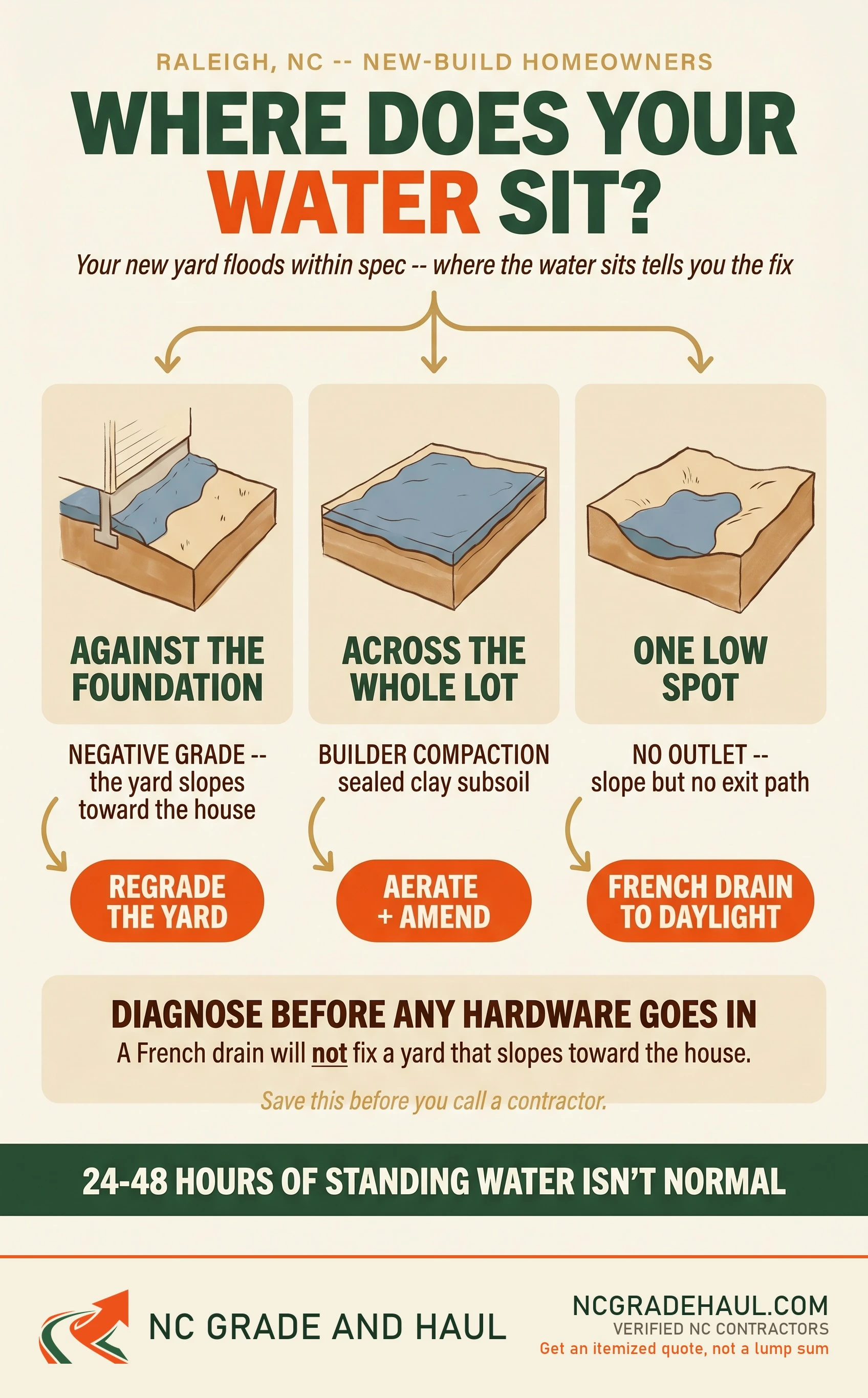
Quick self-diagnosis: Where does the water sit after rain? Against the foundation (likely negative grade), broadly across the lot (likely compaction), or in one low center spot despite the yard generally sloping (likely no outlet)?
Three root causes of standing water -- and where the water sits
1. Negative grade -- The yard slopes toward the house. Water pools against the foundation. The fix is regrading -- a French drain alone will not solve it. 2. Builder-equipment compaction -- Construction traffic sealed the clay subsoil. Water sits broadly across the whole lot on a hardpan layer. The fix is subsoil aeration plus amendment. 3. No outlet -- The lot has slope but no exit path. Water pools in one low center spot. The fix is a French drain that daylights to a positive outlet.
-
Negative grade
The yard slopes toward the house. Water pools against the foundation. The fix is regrading -- a French drain alone will not solve it.
-
Builder-equipment compaction
Construction traffic sealed the clay subsoil. Water sits broadly across the whole lot on a hardpan layer. The fix is subsoil aeration plus amendment.
-
No outlet
The lot has slope but no exit path. Water pools in one low center spot. The fix is a French drain that daylights to a positive outlet.
Read where the water sits after rain -- the location tells you which root cause you have before any hardware goes in.
What Wake County Stormwater Rules Mean for Your Project
Most residential yard drainage fixes in Raleigh don’t require a permit — but stormwater ordinances control where you can discharge water.
Here is the permit threshold picture for Wake County:
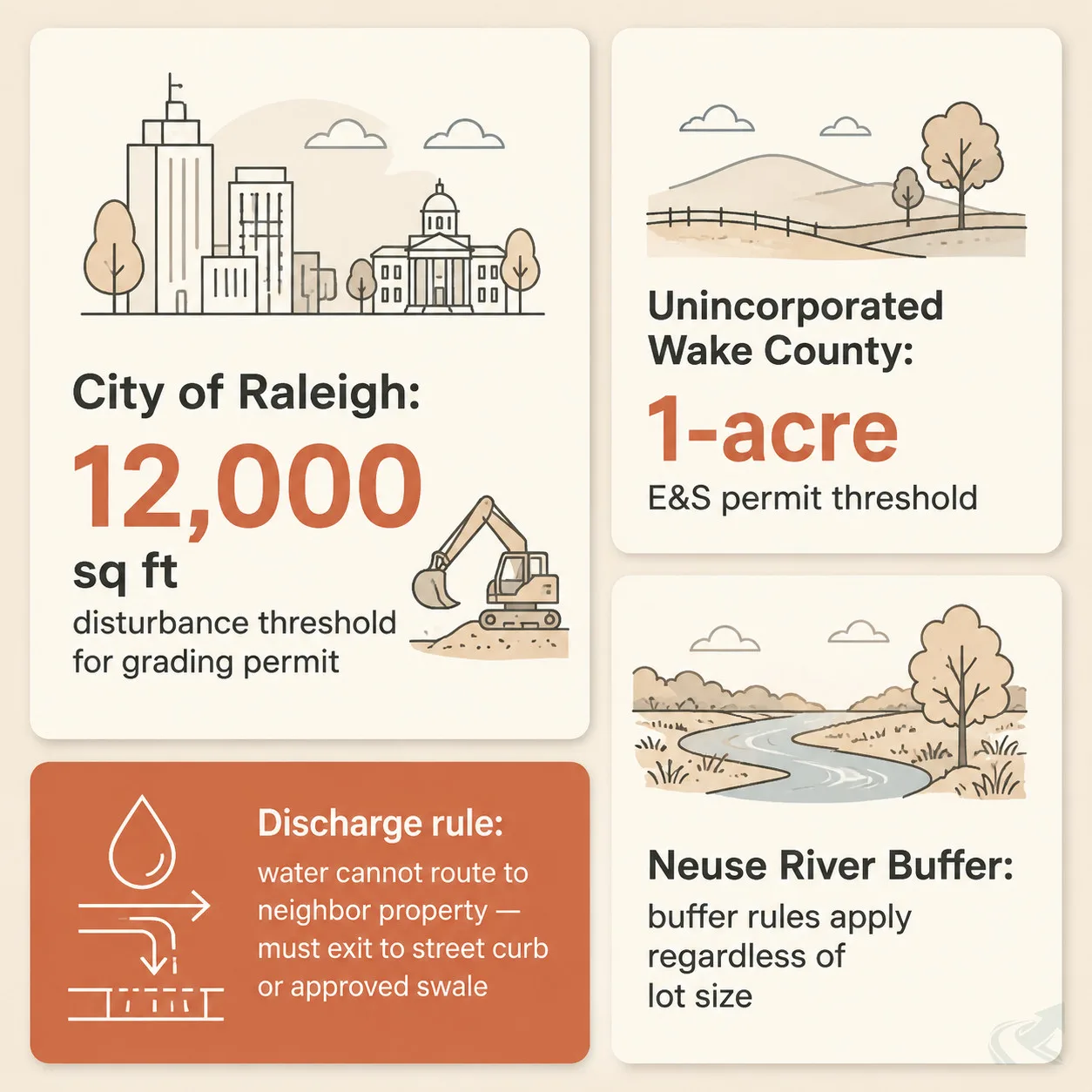
- City of Raleigh: land disturbance of 12,000 square feet or more triggers a city grading permit. Most residential regrade-and-drain projects on standard subdivision lots fall under that threshold.
- Unincorporated Wake County: a 1-acre land disturbance threshold applies for an permit. Typical residential drainage work is well under that threshold.
- Neuse River buffer: if your yard backs to a Neuse tributary or a mapped stream buffer, NCDEQ riparian buffer rules apply to drainage work regardless of lot size or disturbance area.
Where the rules matter regardless of permit threshold: discharge location. North Carolina stormwater ordinances prohibit routing drainage to a neighbor’s property. Your discharge point must go to a street curb-and-gutter, designated stormwater infrastructure, or a county-approved swale. A contractor who suggests running a French drain outlet across your property line is setting you up for a neighbor complaint and a code violation.
For the full regulatory picture, see Wake County stormwater ordinances and yard drainage.
When Your Builder Is the Problem — and What You Can Do
If your standing water appeared in the first two years of a new construction home, the builder’s grading may be the root cause — and in some cases you have recourse.
Most North Carolina new construction comes with a 1-year workmanship warranty. Drainage grading falls under workmanship. If the drainage failure manifested within that window and you reported it in writing, you have a documented basis for a warranty claim.
After the warranty period, the path changes. A licensed grading contractor can inspect the site and provide a certification letter stating that the site condition deviates from industry-standard drainage practice. That document is what a builder dispute requires before it goes anywhere — whether to mediation, your HOA, or an attorney.
One practical note: builders in production subdivisions grade dozens of lots on tight timelines. The standard isn’t malice; it’s minimum-spec economics. “It’s within spec” is accurate but incomplete. The NC standard was written as a floor, not a target. Getting that in writing from a qualified contractor changes the conversation.
For the full builder-dispute playbook, see NC builder accountability when Raleigh yard drainage fails. To get a contractor assessment, find a verified grading contractor in Raleigh NC who can evaluate your site and provide the documentation you need.
Common Mistakes That Make Drainage Worse
Three mistakes that turn a fixable problem into an expensive one.
-
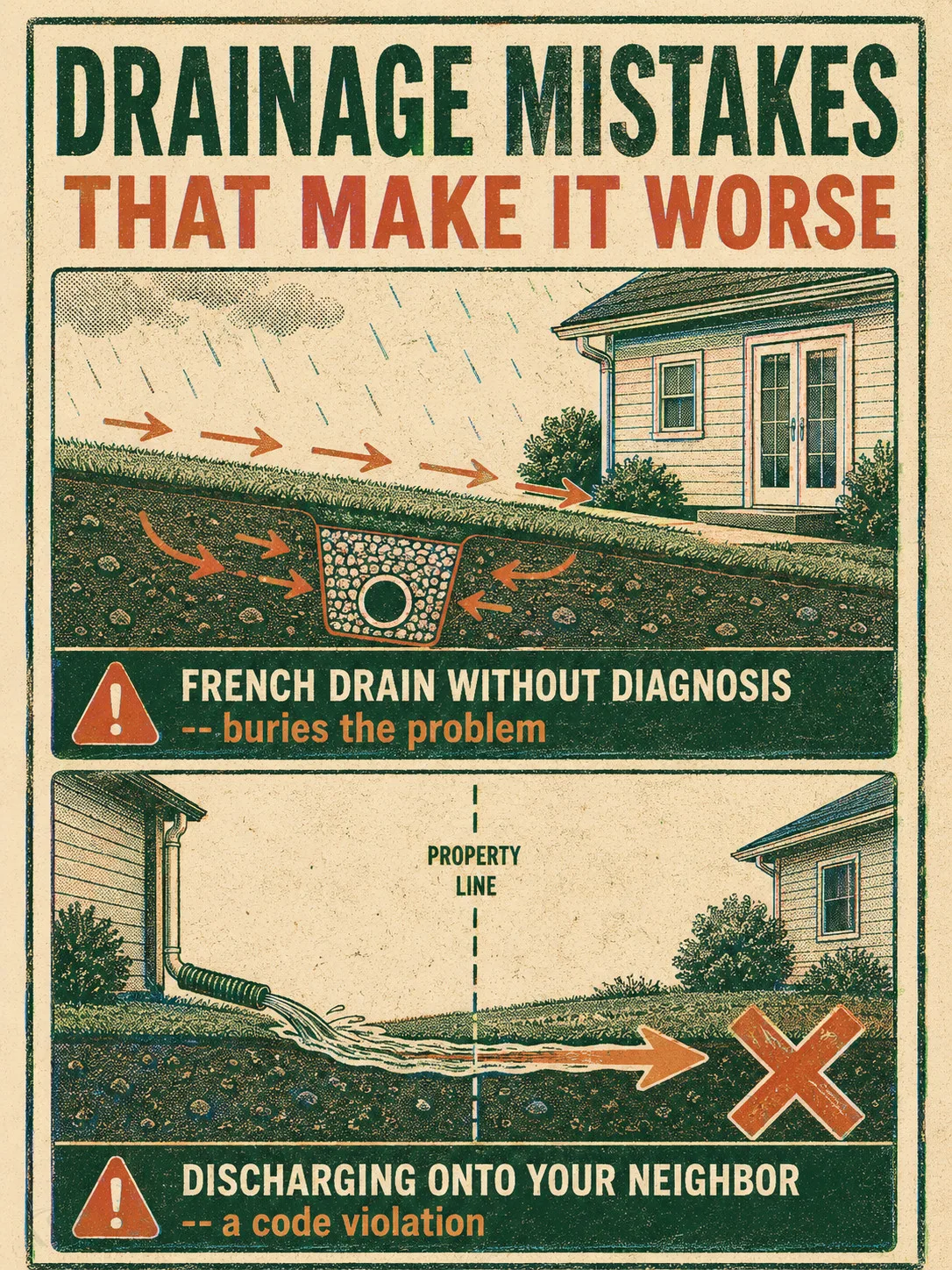
Installing a French drain without diagnosing the root cause. A French drain does not fix negative grade. If the yard slopes toward the foundation, the water finds the drain trench and pools there instead of on the surface. Same problem, now buried. The diagnosis step is not optional.
-
Discharging drainage to a neighbor’s lot. NC stormwater rules prohibit it. Any contractor who suggests this is passing your problem to your neighbor — and leaving you exposed to a complaint or a code violation when the neighbor notices.
-
Waiting on the builder. Workmanship warranty periods are short. After year one, the builder’s obligation narrows significantly. If you have standing water in a home under two years old, document it now and send written notice before the window closes.
Ask Before You Hire
Copy this question to your clipboard before calling contractors:
“Is my yard sloping toward the house, away from it, or flat? Show me where the water is supposed to go after a 1-inch rain — and where it’s actually going.”
A contractor who can’t answer this on the phone without hesitation hasn’t diagnosed your yard yet. Ask for an itemized quote that separates the diagnosis from the proposed fix.
What This Page Does NOT Cover
Other drainage topics that need their own page:
- French drain design, sizing, and installation in Raleigh — see Raleigh French drain installation
- Foundation perimeter drainage (crawl space moisture, basement water intrusion) — see foundation drainage
- Initiating a formal builder dispute or pursuing warranty claims — see builder accountability
- Standing water caused by neighborhood-scale stormwater infrastructure failure (not a homeowner-fixable issue — requires engagement with the city or HOA)
- Checking your yard’s actual slope grade before deciding on a fix — check your Raleigh yard slope before planning drainage
For the full NC yard drainage solutions for standing water framework, including how different drainage systems compare, see the NC yard drainage solutions for standing water hub.
From our directory
Verified contractors near you
Every listing is cross-checked against the NC Licensing Board public record before it appears. Pick your city:
Or browse the full NC contractor directory.