Two questions Raleigh homeowners ask first
Do I need a permit to install a French drain in Raleigh?
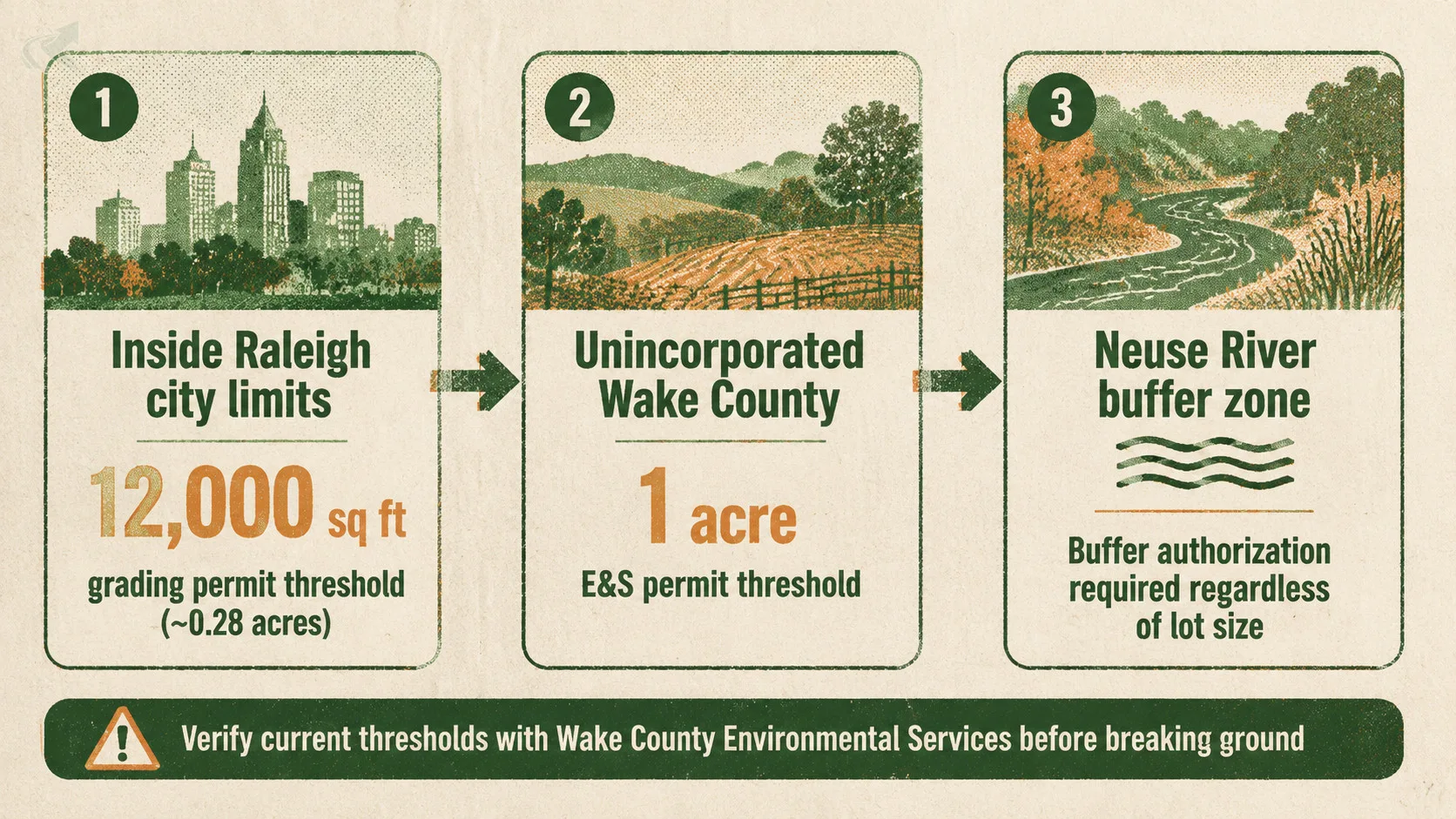
If your project disturbs 12,000 sq ft or more within Raleigh city limits, a city grading permit applies. Unincorporated Wake County threshold is 1 acre. Most residential subdivision lots fall under both numbers -- but any work within a Neuse River buffer zone requires a separate buffer authorization regardless of lot size. Verify current thresholds with Wake County Environmental Services before breaking ground.
Why does my neighbor's French drain work when mine failed?
Soil is the most likely answer. Piedmont red clay drains at roughly 0.1--0.5 inches per hour -- dramatically slower than sandy soils. A French drain that works in a sandier yard becomes a saturated trench in NC clay if it lacks a proper outlet and correct aggregate. The design has to account for where your lot actually drains, not just where a trench runs.
You got two quotes on your Holly Springs lot that don’t agree. One contractor said “French drain.” The other said “you need regrading.” Your yard holds water for 48 hours after a heavy rain, and the lot is flat — production-builder flat. Both quotes are technically possible. Neither contractor explained why they differed.
Here’s what the disagreement usually comes down to in Wake County: Piedmont clay soil and a flat lot change the math on whether a French drain alone solves the problem, or whether it buys you two years before the same water comes back.
This page answers the local design questions — the ones specific to North Carolina’s clay soils and Wake County’s permit thresholds — that generic French drain advice skips.
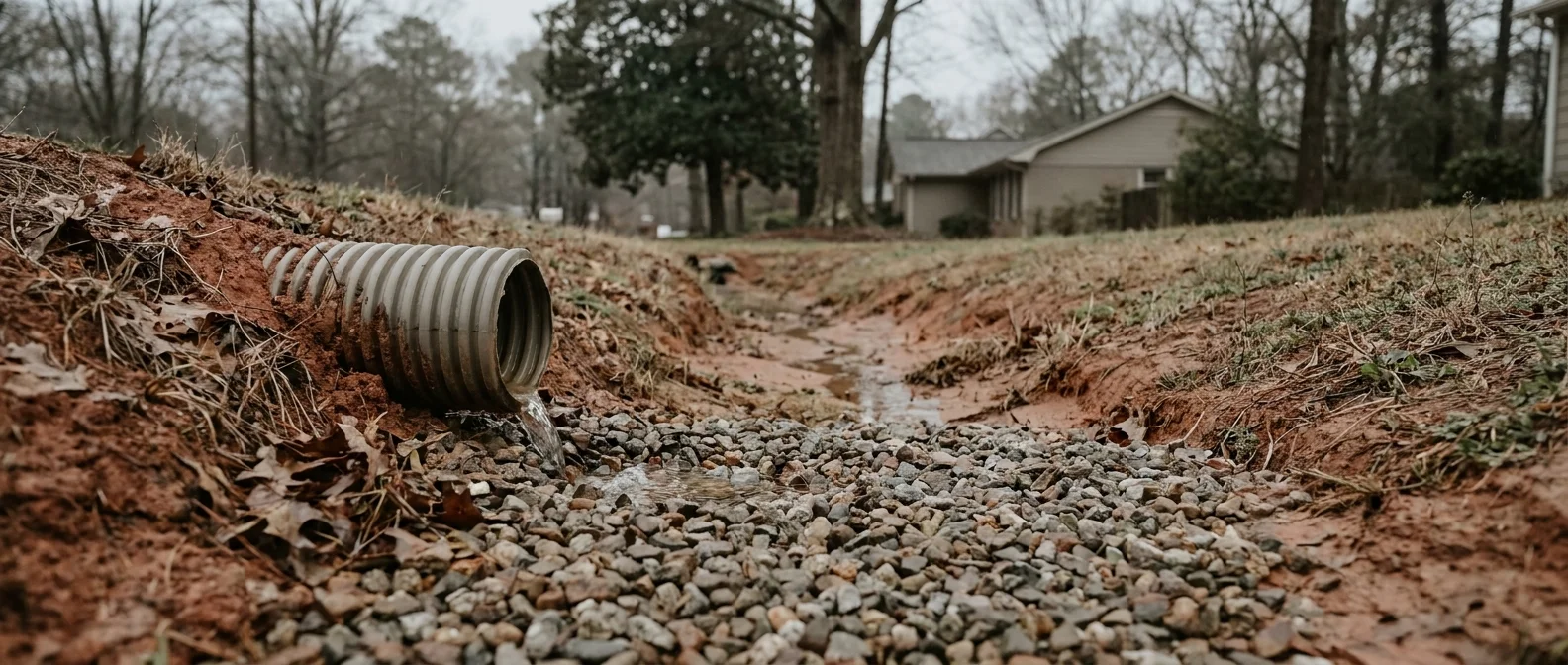
Why Raleigh French Drains Fail More Than They Should
The clay doesn’t drain — it absorbs slowly, then sheds. A French drain that works in sandy soil becomes a saturated trench in Piedmont red clay.
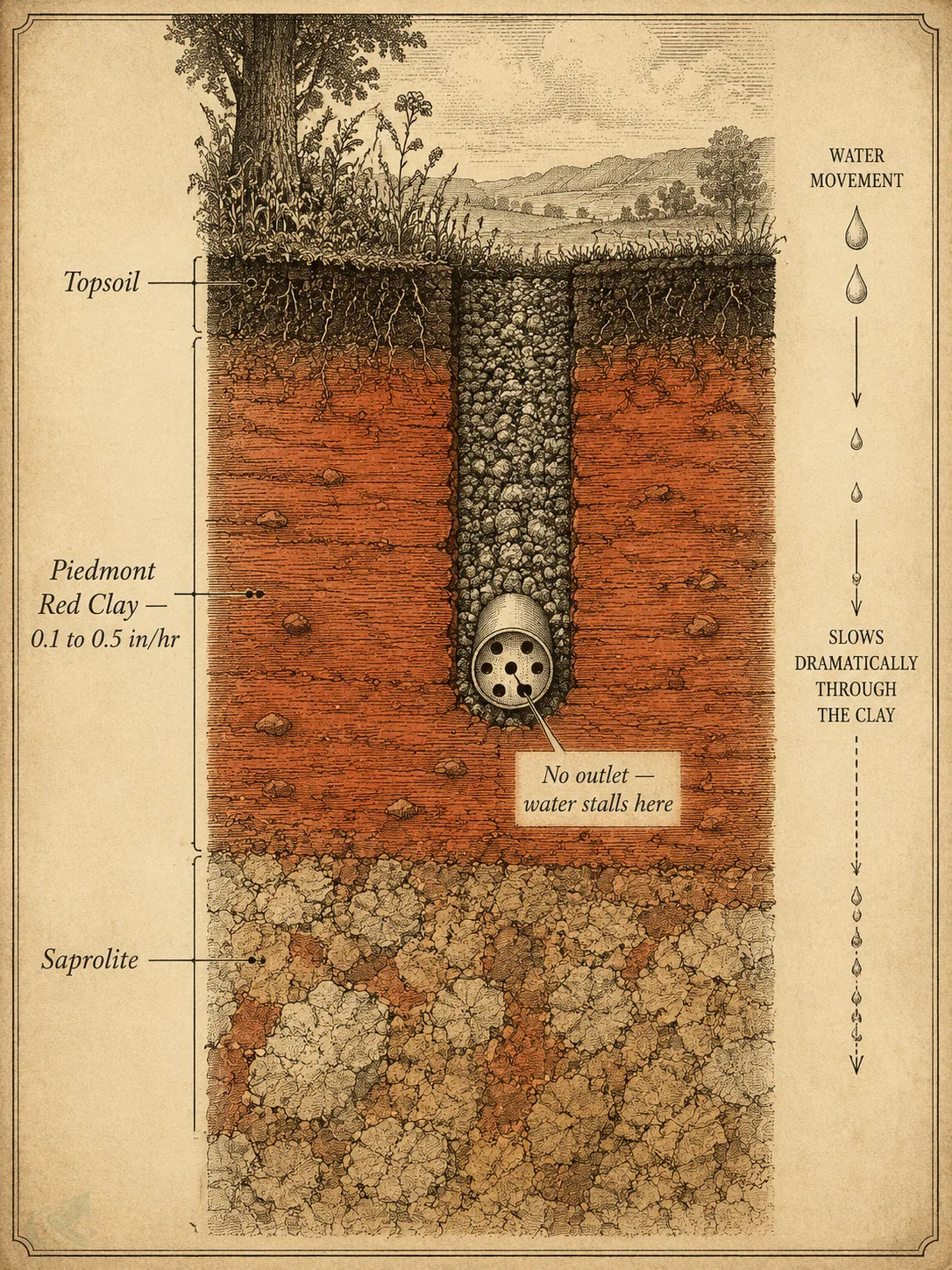
Piedmont red clay has very low hydraulic conductivity — water moves through it at roughly 0.1—0.5 inches per hour. Compare that to sandy loam at 1—3 inches per hour. The aggregate in a French drain trench can handle the water just fine; the surrounding clay cannot release it fast enough to keep up with a heavy rain event.
The design implication: aggregate size, pipe diameter, outlet location, and slope all matter more in NC clay than they do in looser soils. A trench full of the right stone connected to nowhere is still a buried pond.
Flat Raleigh subdivision lots compound this. A French drain with no positive outlet — no place for water to actually go — stores water temporarily, then saturates. The trench fills. The water finds the next low point, which is usually your foundation.
Wake County Permit Thresholds: What Triggers a Permit
Most residential French drain projects don’t trigger a permit — but the threshold in Raleigh city limits is lower than you’d expect.
Here’s how the thresholds stack in Wake County (verify current figures with the applicable authority before work starts):
- Raleigh city limits: land disturbance of 12,000 sq ft or more requires a city grading permit. That’s about 0.28 acres — smaller than many suburban lots with large yards.
- Unincorporated Wake County: the permit threshold is 1 acre.
- Typical 0.2—0.4 acre subdivision lot: usually below both thresholds. Most residential French drain installs don’t trigger a state or county E&S permit.
- HOA and stormwater overlays: can apply even when neither threshold is met. Check your subdivision’s stormwater covenant before any drainage modification.
- Neuse River buffer zones: separate review required regardless of lot size. If your lot is within 50 feet of a Neuse tributary, you need buffer authorization from . The Neuse Basin covers most of Wake County — this catch isn’t rare.
For projects that do reach the 1-acre E&S threshold, the NCDEQ AccessDEQ portal handles electronic Notice of Intent filing. See Wake County permits for French drain installation for the full permit matrix.
From our directory
Verified contractors near you
Every listing is cross-checked against the NC Licensing Board public record before it appears. Pick your city:
Or browse the full NC contractor directory.
The Design That Actually Works in NC Clay
A properly designed French drain in Raleigh needs a positive outlet — a place for water to go — not just a gravel trench.
Positive drainage is the non-negotiable design element in flat Piedmont lots. If the system has no outlet, you’ve built a holding tank. Here’s what the spec looks like when it’s done right:
- Aggregate: #57 or #67 stone, not pea gravel. Pea gravel clogs with clay fines within 2—3 years in Piedmont soil. The larger, washed stone holds void space and resists clogging.
- Pipe: 4-inch perforated wrapped in non-woven geotextile. In clay soils, use a heavier-weight fabric than you’d spec for sandy installations — the fines load is higher.
- Slope: minimum 1% grade toward outlet. 2% preferred. No slope means no flow; water sits in the pipe and eventually backs up.
- Outlet options: daylight to grade (pipe exits at a slope face or curb), connect to an existing storm drain, or discharge to a vegetated swale. All three work. The right choice depends on what’s accessible on your lot.
French drain on a flat Raleigh lot: positive outlet vs buried holding tank
Comparison. Designed with a positive outlet: 4-inch perforated HDPE pipe in #57 or #67 washed stone; Non-woven geotextile, heavier weight for the clay fines load; Minimum 1% slope, 2% preferred, toward the outlet; Daylights to grade, a storm drain, or a vegetated swale. The same trench with no outlet: Right stone, but the pipe connects to nowhere; Pea gravel option clogs with clay fines in 2 to 3 years; Surrounding Piedmont clay can't release water fast enough; Trench saturates and water re-routes toward the foundation.
- 4-inch perforated HDPE pipe in #57 or #67 washed stone
- Non-woven geotextile, heavier weight for the clay fines load
- Minimum 1% slope, 2% preferred, toward the outlet
- Daylights to grade, a storm drain, or a vegetated swale
- Right stone, but the pipe connects to nowhere
- Pea gravel option clogs with clay fines in 2 to 3 years
- Surrounding Piedmont clay can't release water fast enough
- Trench saturates and water re-routes toward the foundation
Piedmont red clay drains at roughly 0.1 to 0.5 inches per hour -- a French drain without a positive outlet is just a buried pond.
NC Homeowner Takeaway — on French Drain Man videos: His aggregate debates (sock vs no-sock, pea gravel vs #57) are genuine. In NC clay, his core instinct — use clean, washed, open-graded stone and never trust a silty aggregate — is correct. Where his content doesn’t fully translate: his outlet options and slope guidance assume soils that move water. In Piedmont clay, the outlet design is more constrained and the slope requirement is less forgiving. His fabric-wrapped pipe recommendation holds up. His assumption that any low-point outlet will work needs rechecking against your specific lot grade.
Common Mistakes on Wake County French Drains
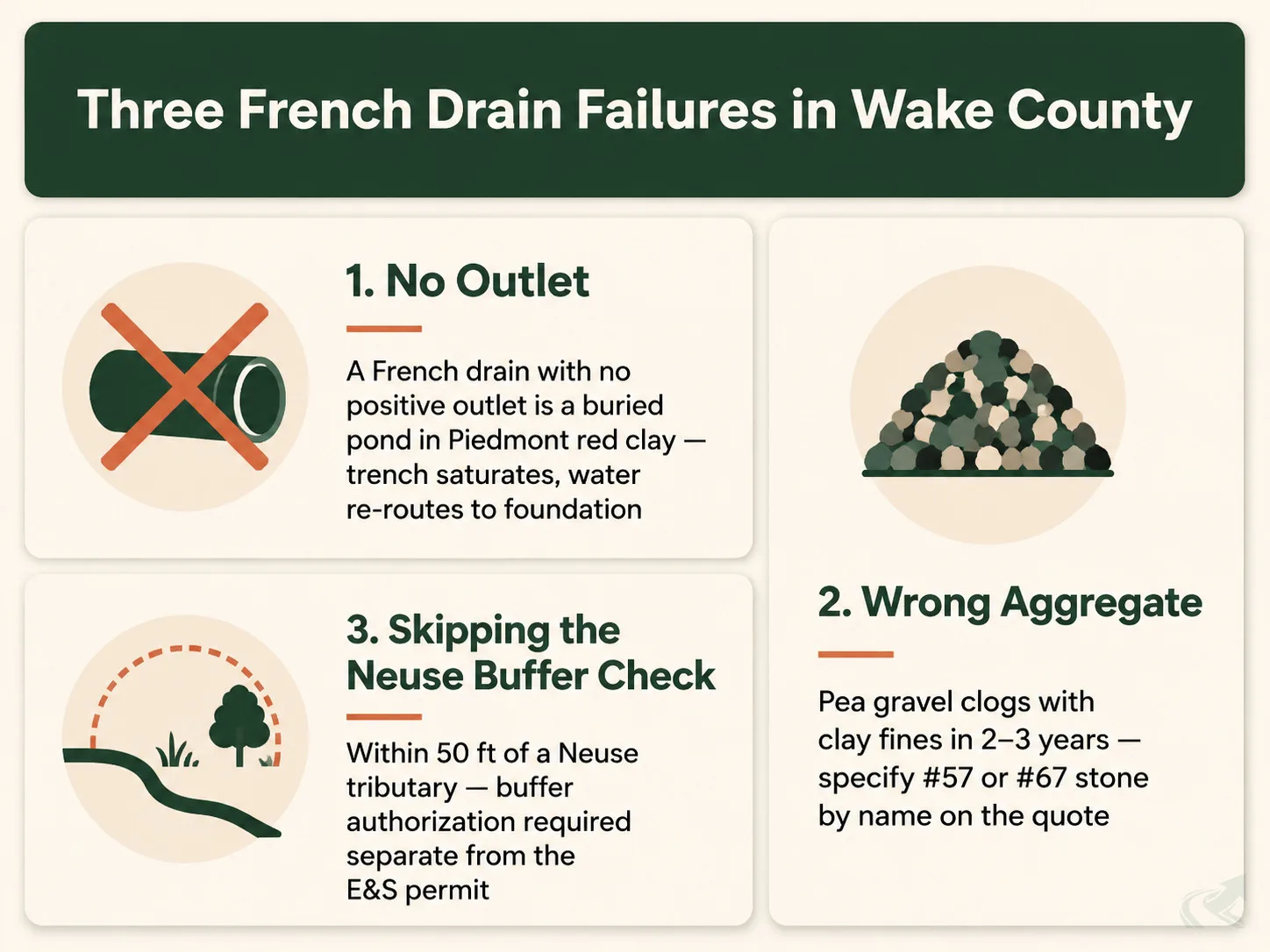
Three installation mistakes account for most of the re-dos in Raleigh subdivision work.
- No outlet. A French drain without positive drainage is a buried pond in red clay. Water fills the trench, saturates the surrounding clay, and re-routes to the nearest structure. This is the most common failure mode in flat subdivision lots.
- Wrong aggregate. Pea gravel clogs with clay fines in 2—3 years in Piedmont soil. The void ratio collapses, flow stops, and the system becomes a static water feature. Spec #57 or #67 stone and get the stone name — not just “drainage gravel” — on the itemized quote.
- Skipping the Neuse buffer check. Projects within 50 feet of a Neuse tributary require buffer authorization separate from the E&S permit. In Wake County, a significant portion of residential lots sit near Neuse basin tributaries. Check your lot boundary before the trench goes in.
Before You Hire: A Question Worth Copying
Ask your contractor this before any quote:
“Where exactly does the water outlet, and what’s the slope to that point?”
If the answer is “it depends on what we find” without an explanation of the clay design logic and outlet options, that’s a signal. A contractor who understands North Carolina clay drainage can answer this before they’ve even walked your lot.
Finding a Verified Grading Contractor in Raleigh
Not every contractor who installs French drains in Wake County designs for clay — ask three diagnostic questions before you get a quote.
These questions separate contractors who understand Piedmont drainage from those who learned their craft in a different soil zone:
- Where does the water outlet? — If they can’t name a specific outlet point, they haven’t designed the system yet.
- What aggregate size do you use in clay? — The right answer is #57 or #67 stone. Pea gravel or “drainage gravel” without a spec is a yellow flag.
- Do you provide an itemized quote with unit costs? — Materials, labor, and any permit fees listed separately. A single round number means you can’t check the math or compare bids accurately.
Hire a verified NC grading contractor in Raleigh — contractors listed in the NC Grade and Haul directory have active NCLBGC licenses verified against the state board’s public records.
What This Page Does NOT Cover
- Foundation perimeter French drains (interior vs exterior drainage for crawl spaces and basements) — see foundation drainage
- Yard regrading when the root cause is builder grading failure, not just a drainage routing problem — see Raleigh yard drainage services
- French drain design fundamentals applicable across North Carolina — see French drain installation in NC
- How Raleigh’s red clay changes French drain design at the methodology level — see how Raleigh’s red clay changes French drain design
- County permit matrix for all NC counties — see Wake County soil conditions for French drains and the county permits resource