
Two questions Wake County homeowners ask
What grading permit threshold applies to my Wake County property?
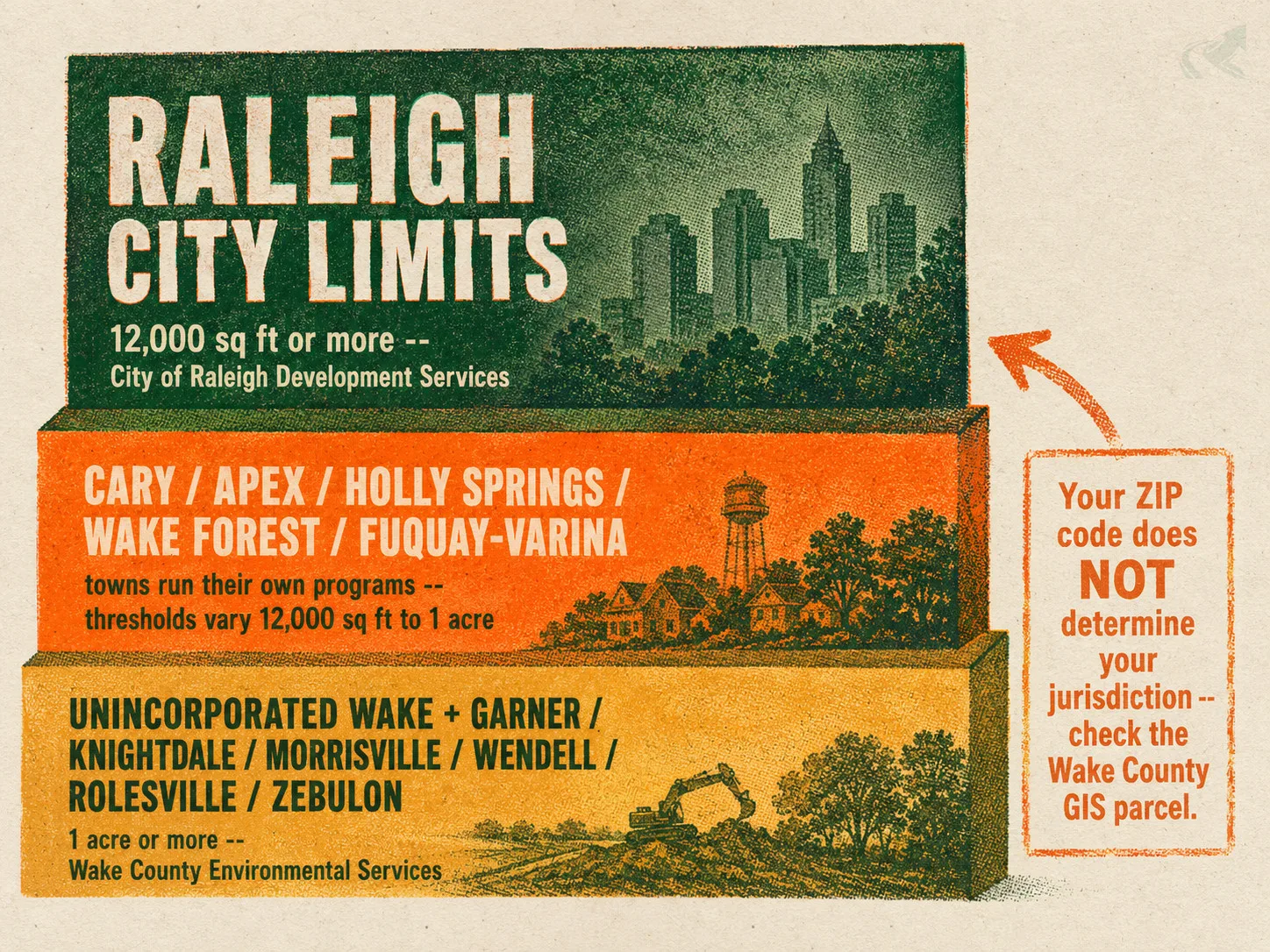
It depends on which jurisdiction your address falls in. Raleigh city limits: any land disturbance of 12,000 sq ft or more. Unincorporated Wake County: 1 acre. Cary (12,000 sq ft), Apex and Holly Springs (20,000 sq ft), Wake Forest (0.50 acre), and Fuquay-Varina (1 acre) each run their own programs with their own thresholds. Garner, Knightdale, Morrisville, Wendell, Rolesville, and Zebulon are administered by Wake County at the 1-acre threshold under interlocal agreement. If you are not sure which jurisdiction applies, look up your parcel through the Wake County GIS portal -- your address determines the answer, not your ZIP code.
How do I find a grading contractor who actually knows Wake County?
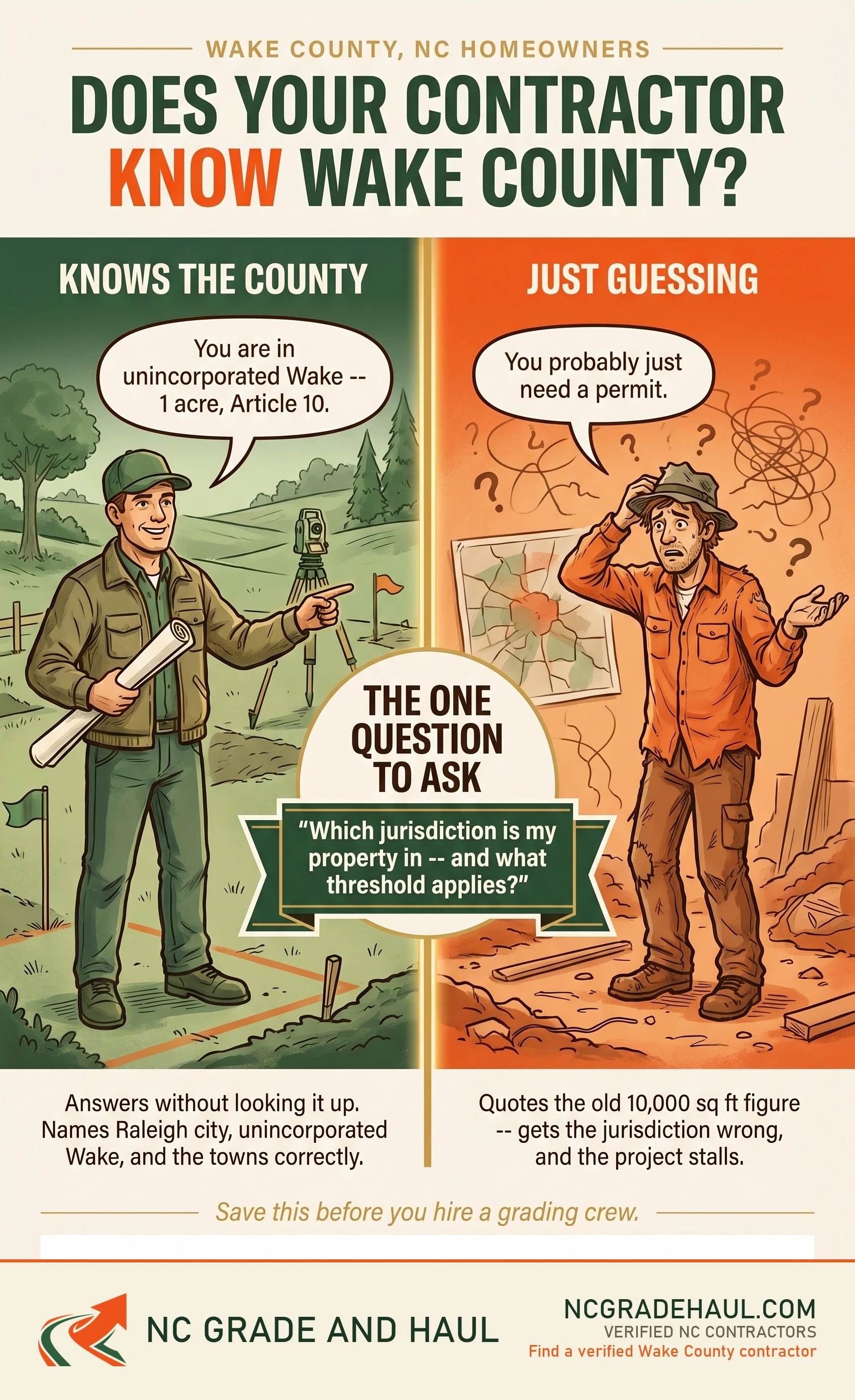
Ask them one question: 'Which jurisdiction is my property in, and what permit threshold applies?' A contractor who has worked Wake County regularly can answer without looking it up -- and correctly distinguish Raleigh city, unincorporated Wake, and town-administered rules. Then ask for their NC Licensing Board for General Contractors license number and a COI with your name added.
A Holly Springs homeowner who searches “grading contractor wake county” has already hit the first obstacle: she does not know whether her address falls under Raleigh’s rules, Wake County’s rules, or Holly Springs’s own rules. Those three are not the same. The permit threshold differs. The administering office differs. A contractor who guesses wrong sends the project sideways before the first grade stake goes in.
This page maps Wake County’s three-tier permit structure, explains what Article 10 actually requires for unincorporated Wake, lists the towns the verified contractor cohort serves, and gives you the one diagnostic question that separates a contractor who knows the county from one who doesn’t.
Wake County’s Three Permit Tiers — Which One Is Yours?
Your permit requirements depend on which jurisdiction your property sits in — and in Wake County that answer is more complicated than most homeowners expect.
Wake County contains Raleigh, eleven other incorporated towns, and a large unincorporated area. Each tier operates under a different administering body and a different land-disturbance threshold. Note that Garner, Knightdale, Morrisville, Wendell, Rolesville, and Zebulon do not run their own erosion and sediment control programs — Wake County Environmental Services administers E&S for those towns under interlocal agreement, at the 1-acre threshold.
| Jurisdiction | Land Disturbance Threshold | Administering Body |
|---|---|---|
| Raleigh city limits | 12,000 sq ft or more | City of Raleigh Development Services |
| Unincorporated Wake County | 1 acre or more | Wake County Environmental Services |
| Cary | 12,000 sq ft or more | Town of Cary |
| Apex | 20,000 sq ft or more | Town of Apex |
| Holly Springs | 20,000 sq ft or more | Town of Holly Springs |
| Wake Forest | 0.50 acre (21,780 sq ft) or more | Town of Wake Forest |
| Fuquay-Varina | 1 acre or more | Town of Fuquay-Varina |
| Morrisville | 1 acre or more | Wake County Environmental Services (interlocal agreement) |
| Garner | 1 acre or more | Wake County Environmental Services (interlocal agreement) |
| Knightdale / Wendell / Zebulon | 1 acre or more | Wake County Environmental Services (interlocal agreement) |
Raleigh city limits
- Land Disturbance Threshold
- 12,000 sq ft or more
- Administering Body
- City of Raleigh Development Services
Unincorporated Wake County
- Land Disturbance Threshold
- 1 acre or more
- Administering Body
- Wake County Environmental Services
Cary
- Land Disturbance Threshold
- 12,000 sq ft or more
- Administering Body
- Town of Cary
Apex
- Land Disturbance Threshold
- 20,000 sq ft or more
- Administering Body
- Town of Apex
Holly Springs
- Land Disturbance Threshold
- 20,000 sq ft or more
- Administering Body
- Town of Holly Springs
Wake Forest
- Land Disturbance Threshold
- 0.50 acre (21,780 sq ft) or more
- Administering Body
- Town of Wake Forest
Fuquay-Varina
- Land Disturbance Threshold
- 1 acre or more
- Administering Body
- Town of Fuquay-Varina
Morrisville
- Land Disturbance Threshold
- 1 acre or more
- Administering Body
- Wake County Environmental Services (interlocal agreement)
Garner
- Land Disturbance Threshold
- 1 acre or more
- Administering Body
- Wake County Environmental Services (interlocal agreement)
Knightdale / Wendell / Zebulon
- Land Disturbance Threshold
- 1 acre or more
- Administering Body
- Wake County Environmental Services (interlocal agreement)
The Raleigh figure often surprises people: 12,000 sq ft. Competitor content and older reference guides circulate 10,000 sq ft — that number is wrong. The correct Raleigh city threshold is 12,000 sq ft. For grading permit thresholds and the full county-by-county breakdown, see Wake County permit requirements for grading projects.
Do not assume you are in Raleigh because your mailing address says “Raleigh, NC.” Holly Springs, Apex, and Cary all use Raleigh mailing addresses in some ZIP codes but have their own jurisdictions and their own permit rules.
Wake County UDO Article 10: What It Actually Says About Grading
Wake County’s Article 10 sets the rules for land disturbance in unincorporated areas — a contractor who references it by name has worked here before.
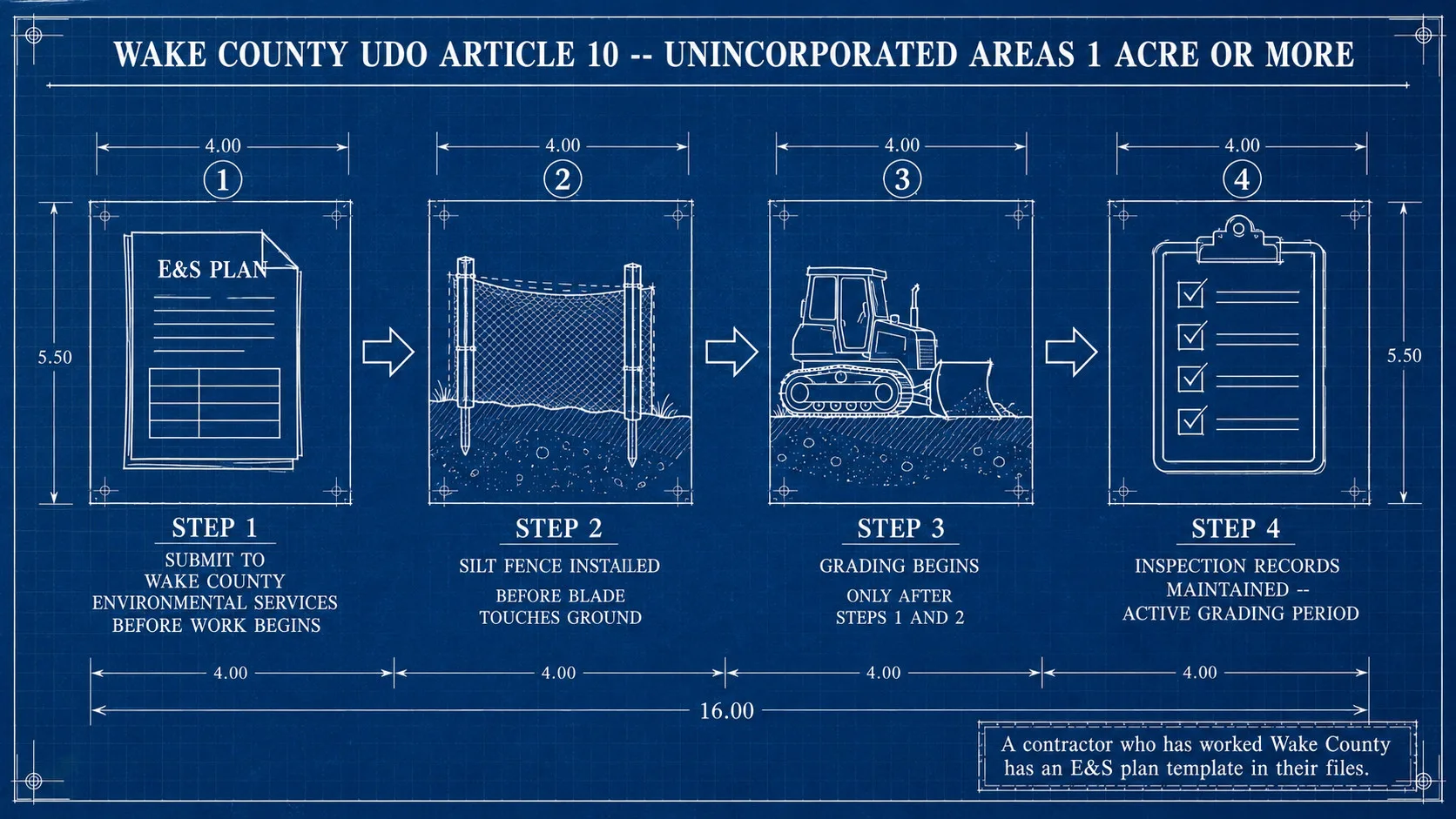
Article 10 governs requirements for projects that disturb 1 acre or more of land in unincorporated Wake County. Projects that meet or exceed that threshold must submit an erosion control plan, obtain an E&S permit, install silt fence and other best-management-practice controls, and maintain inspection records during active grading.
What this means in practice: your contractor cannot simply grade the lot and move on. The E&S plan has to be on file before work begins. Silt fence goes up before the blade touches the ground. A contractor who pulls permits regularly in Wake County has an erosion control plan template in their files and knows the Wake County Environmental Services review cycle. One who hasn’t worked here will not.
The distinction matters for your schedule. A contractor who submits an E&S plan for the first time on a Wake County project does not know how long the review takes. Ask for their most recent Wake County permit number so you can verify their familiarity with the process.
The Wake County Verified Contractor Cohort
NC Grade and Haul verifies grading contractors against three sources before listing them — active license, OSHA inspection history, and workers’ compensation certificate.
The verification process works like this: every contractor in the cohort holds an active NCLBGC license (suspended, expired, and revoked licenses are excluded), has fewer than 3 serious OSHA violations on record (3 or more demotes a contractor from verified to listed), and carries a workers’ comp certificate on file. No verified contractor in the cohort cleared all three checks at the desk — each record was confirmed through the relevant public source.
Current verified grading contractors serving Wake County are listed at grading contractor near me in NC serving Wake County. The count updates as new contractors clear verification. Not all verified contractors serve every Wake County town — the contractor filter on that page lets you specify your town.
Towns and Service Areas Within Wake County
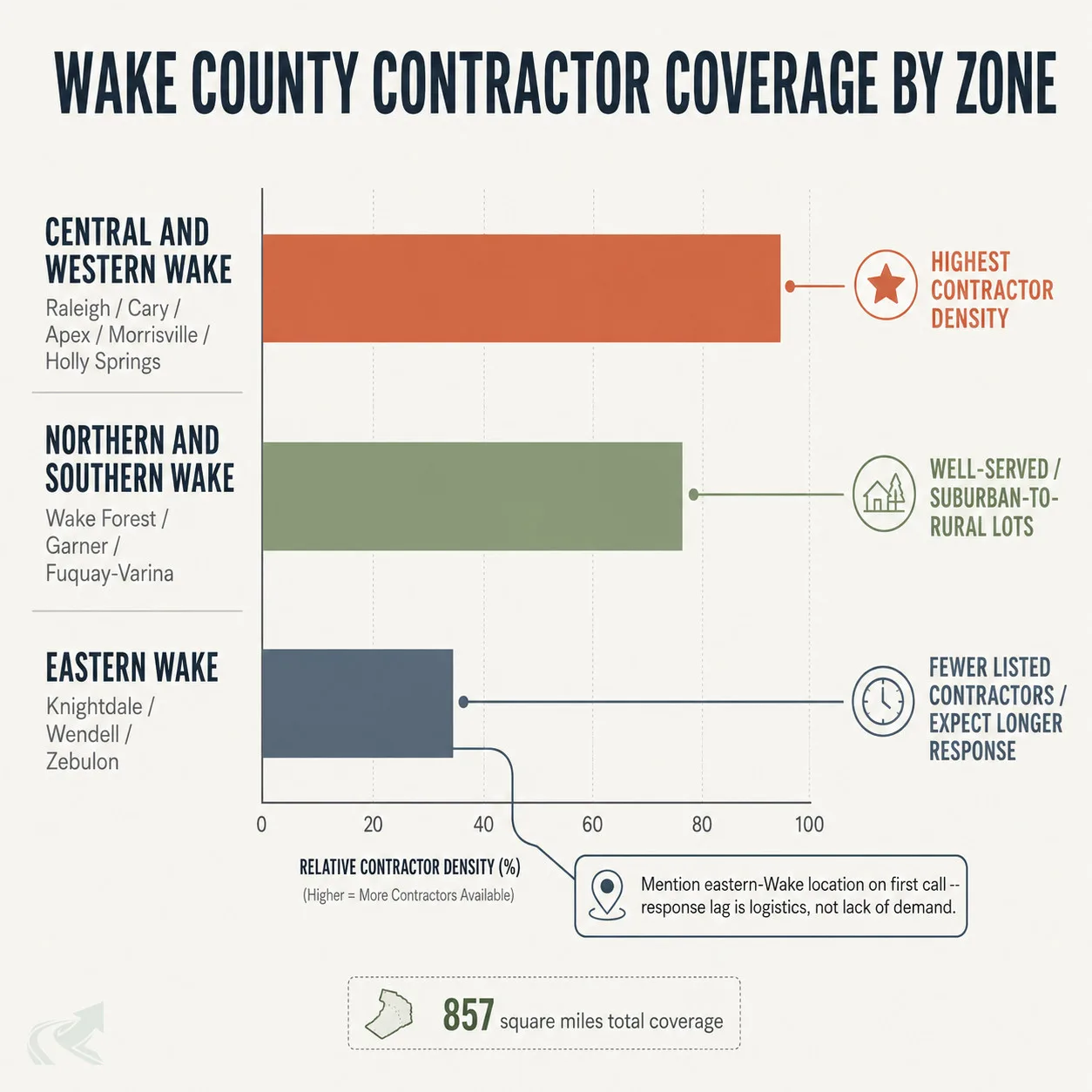
Wake County covers 857 square miles and includes twelve incorporated municipalities — “Wake County contractor” does not automatically mean they serve your specific town.
The county breaks into three rough service zones:
- Central and western Wake — Raleigh, Cary, Apex, Morrisville, Holly Springs. The largest concentration of verified contractors. Most operators in this cluster can reach any of these towns in a single mobilization.
- Northern and southern Wake — Wake Forest (north), Garner and Fuquay-Varina (south). Well-served, with some contractors specializing in the suburban-to-rural transition lots common in these areas.
- Eastern Wake — Knightdale, Wendell, Zebulon. Fewer listed contractors than central and western Wake. Expect longer response times and a smaller available cohort.
For drainage work within Raleigh specifically, the Raleigh French drain services within Wake County and Wake County standing water yard drainage pages cover the Raleigh-city service footprint. For the underlying NC yard drainage solutions for standing water methodology that applies across all Wake County towns, see the core yard drainage guide. For a grading contractor in Raleigh city specifically, see the Raleigh grading contractor within Wake County page — that page focuses on Raleigh city permit rules and the Raleigh-specific contractor cohort.
If your address is in one of the eastern towns and you are getting no responses, mention that to the contractor — response lag in eastern Wake is a known logistics issue, not a reflection of demand.
Common Mistakes Wake County Homeowners Make
Three mistakes account for most Wake County grading permit problems before the job even starts.
- Assuming “Raleigh mailing address” means “Raleigh permit rules.” Holly Springs, Apex, and Cary are not Raleigh for permitting purposes. Different jurisdiction, different administering office, different threshold. Check your parcel in the Wake County GIS system before your contractor submits anything.
- Using 10,000 sq ft as the Raleigh city threshold. The correct figure is 12,000 sq ft. The wrong number circulates in older online guides and some competitor content. If a contractor quotes you the 10,000 sq ft figure for a Raleigh city project, that is a signal they are working off outdated information.
- Hiring a contractor who cannot name your jurisdiction on the first call. A contractor who says “you probably just need a permit” without asking your address and looking up your jurisdiction is operating on guesswork. That guesswork gets expensive when the E&S plan submission is late and work has to stop.
What to Ask a Wake County Grading Contractor
One question separates a contractor who knows Wake County from one who doesn’t: “Which jurisdiction is my property in — Raleigh city, unincorporated Wake, or a town — and what permit threshold applies?”
If they answer correctly and without looking it up — distinguishing all three tiers — they have worked here before. That is the diagnostic. Everything else is secondary.
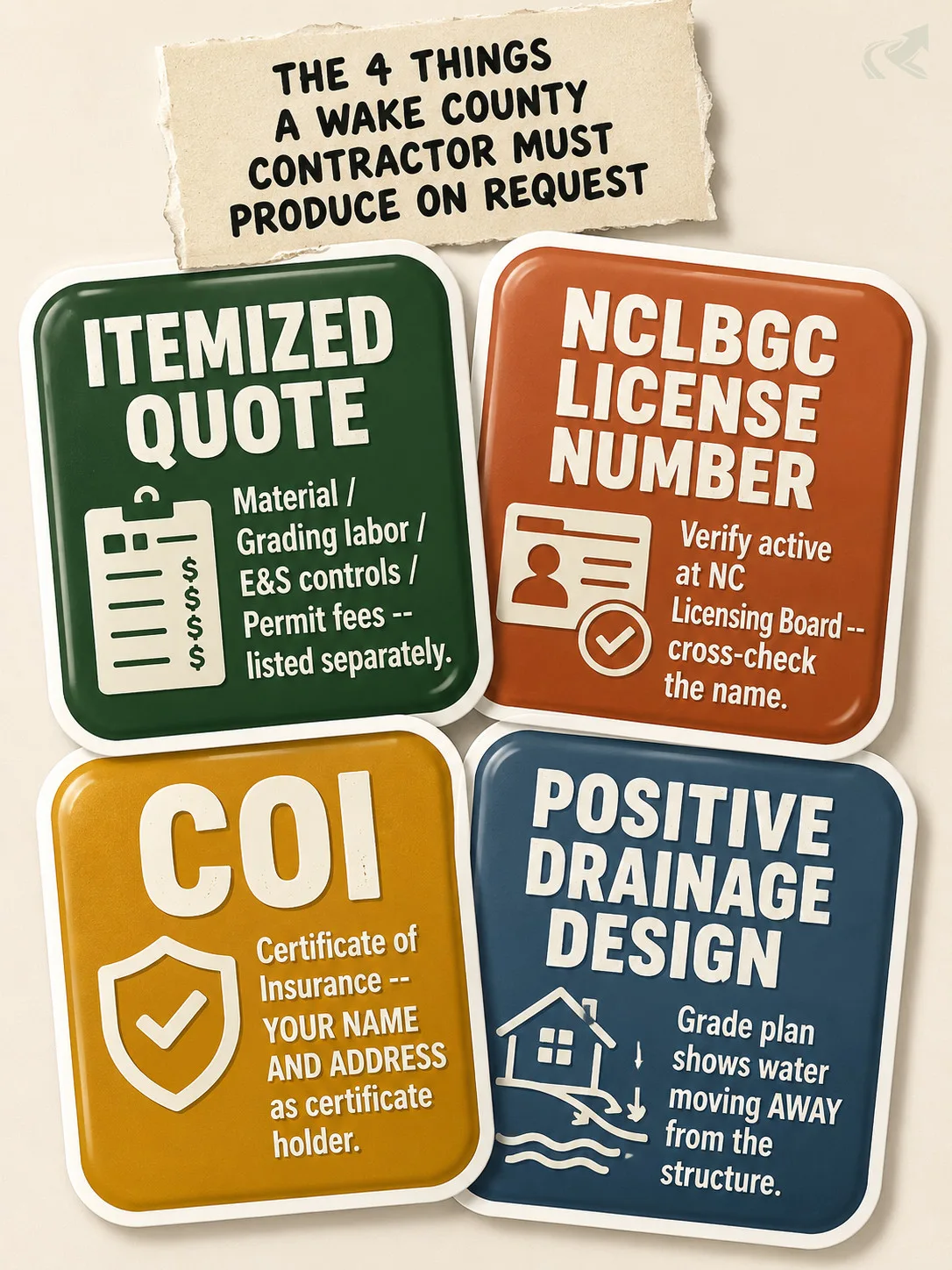
After that, ask for:
- Itemized quote — material, grading labor, E&S controls, and permit fees listed separately, not bundled into a single number
- NCLBGC license number — verify it active at the NC Licensing Board portal before signing; cross-check the name against the find a verified NC grading contractor serving Wake County directory
- COI (Certificate of Insurance) with your name and address listed as the certificate holder, not just “homeowner”
- Proof of positive drainage design — the grade plan should show water moving away from the structure, not pooling at the foundation; if the contractor has also quoted French drain installation in NC, that scope should be listed separately from the grading line
If the contractor cannot produce all four on request, ask why before you sign anything.
From our directory
Verified contractors near you
Every listing is cross-checked against the NC Licensing Board public record before it appears. Pick your city:
Or browse the full NC contractor directory.