
Your two back-corner downspouts dump water two feet from the foundation. The builder installed extensions, but the water still pools after every rain. A contractor is now proposing to tie both downspouts into 4-inch solid piped to a pop-up emitter 20 feet out in the yard.
That proposal is the right fix. This page explains why, walks through the installation sequence, and — more importantly — explains what happens when the installation is done wrong in North Carolina clay.
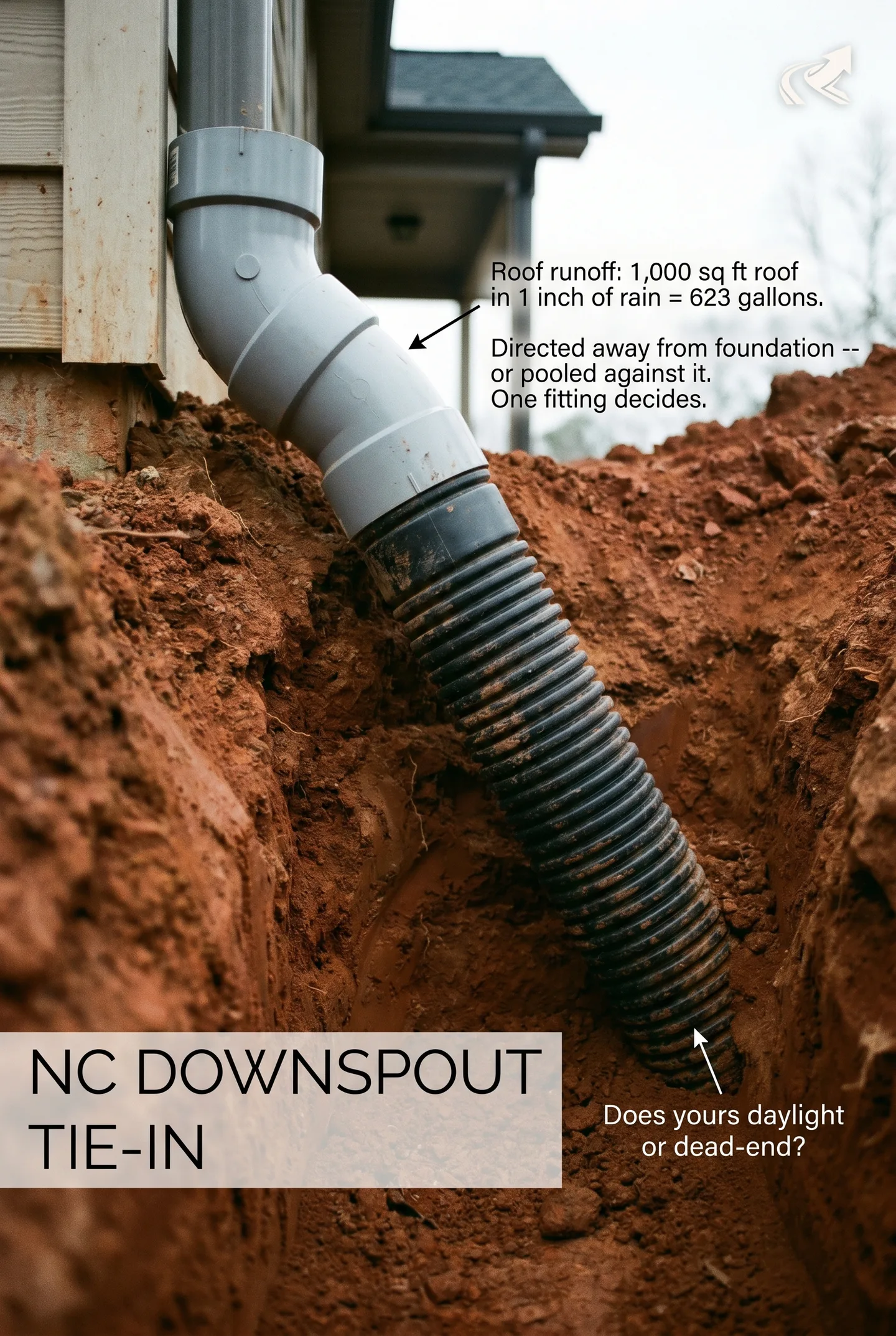
Why Extension Alone Isn’t Enough at Most NC Foundations
A surface extension moves water 6—8 feet from the house. In NC clay, that’s close enough to still saturate the foundation perimeter during a heavy rain.
Piedmont red clay barely percolates — the same NC red clay drainage engineering that complicates French drain design applies equally to roof runoff. Water landing 6 feet from the foundation doesn’t absorb — it runs along the surface, and if the grade tilts even slightly back toward the house, it follows the foundation footprint exactly where you don’t want it.
Buried solid pipe solves that by routing the water to a real outlet, not just farther from the immediate discharge point. The water stays underground until it exits at the daylight point or pop-up emitter.
When is a surface extension actually adequate? When the downspout is already far from the foundation, the grade is strongly positive away from the house, and the soil absorbs well. That last condition — soil that absorbs well — is rare in North Carolina’s Piedmont. If you’re on sandy Coastal Plain soil, the calculus changes.
The Installation Sequence
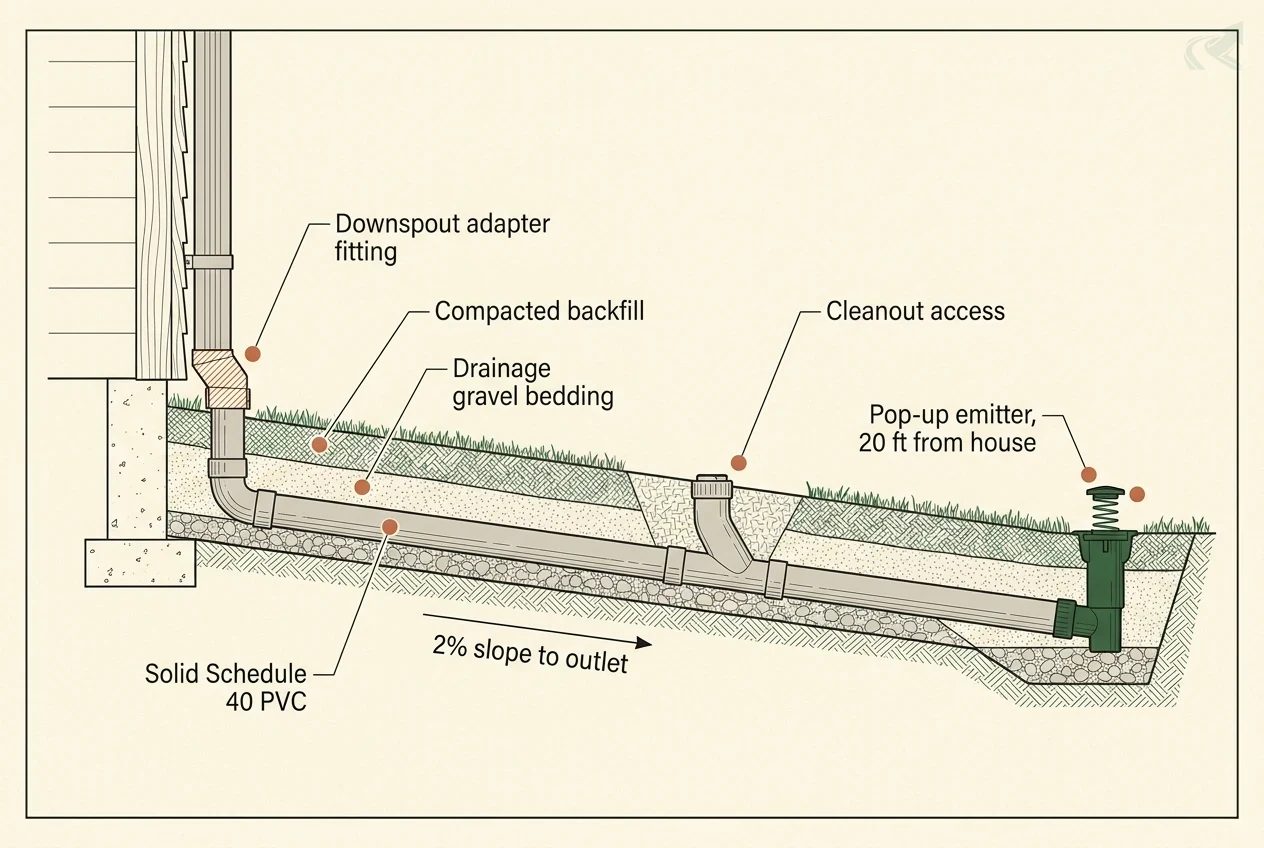
Downspout to underground pipe connection requires solid pipe, correct slope, accessible cleanout, and a functional outlet.
Here’s the full sequence:
-
Cut the downspout above grade and install an adapter fitting — a downspout elbow to round-pipe adapter that transitions from the rectangular downspout profile to 4-inch round pipe.
-
Trench to the outlet point. Minimum slope is 1% toward the outlet (1 foot of drop per 100 feet of run). A 2% slope is preferred — it keeps sediment moving and reduces the risk of the pipe settling into a low point that traps water.
-
Install 4-inch solid Schedule 40 from the adapter to the outlet. Solid, not perforated. Unlike the perforated pipe used in French drain design with downspout tie-in, which intentionally releases water into surrounding soil, a downspout run must carry water all the way to the outlet.
-
Install cleanout access at each change of direction. A Y-fitting with a cleanout cap lets a drain snake enter if sediment or clay ever blocks the line. Without cleanouts, any blockage requires digging up the pipe.
-
Connect to the outlet — a pop-up emitter, catch basin, or open-daylight pipe end at the property edge or a low point in the yard that drains away from the house. See the pop-up emitter vs daylight comparison for the outlet-type decision.
-
Backfill and restore grade over the trench. Compact the backfill in lifts so the trench doesn’t settle into a low point later. Slope the surface grade away from the house across the restored trench area.
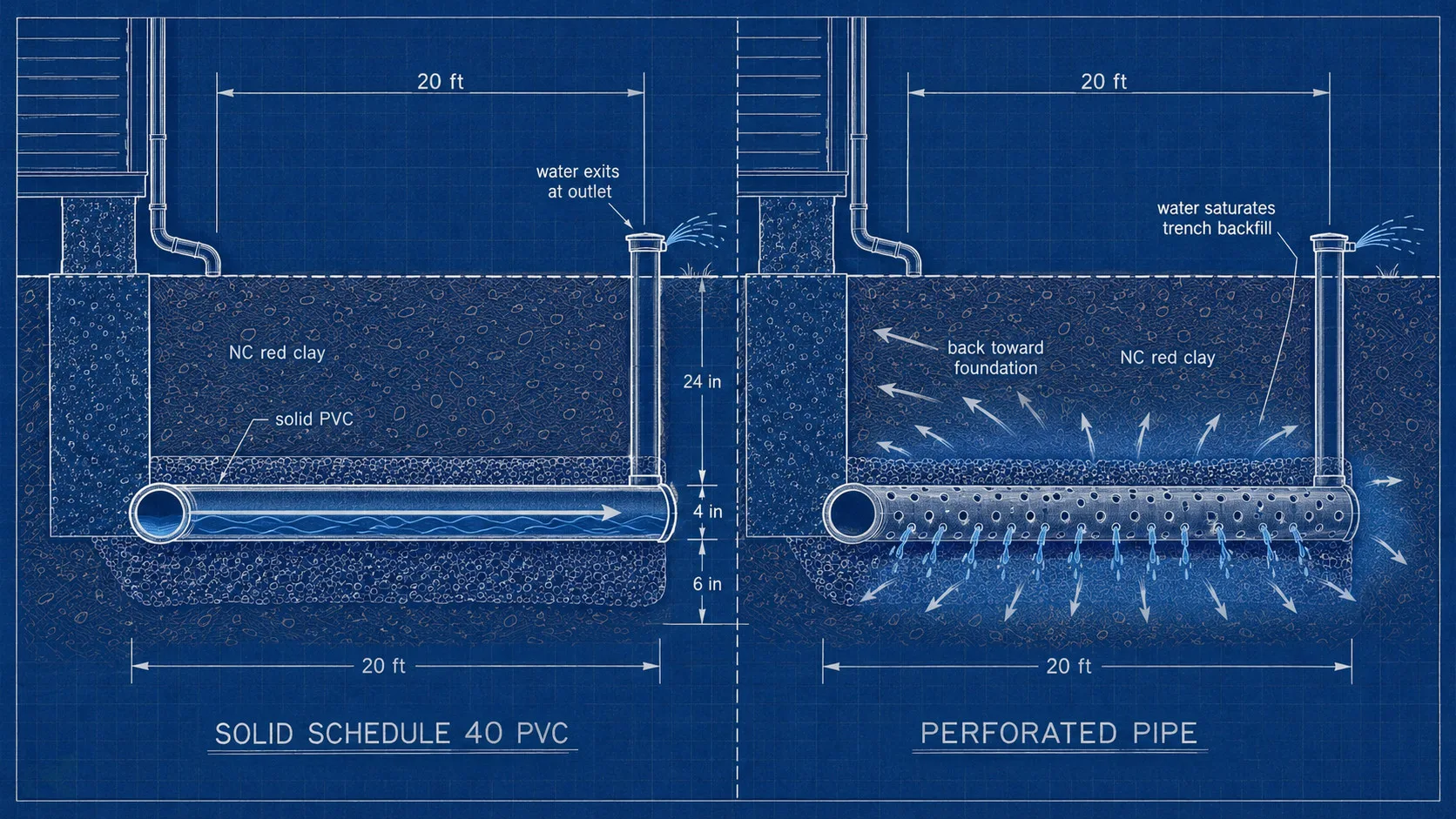
Solid Pipe vs Perforated — The Most Common Spec Error
Downspout connections must use solid pipe — perforated pipe returns water to the soil along the entire run and can direct that water back toward the foundation.
Some contractors install perforated pipe for downspout runs because it’s already on the truck or because they’re thinking about French drain logic. In sandy soil that absorbs well, the consequences are mild. In NC clay, it’s a failure waiting to happen.
Here’s why: Piedmont clay doesn’t absorb the water distributed through the perforations. That water saturates the soil around the pipe. The saturated soil follows the path of least resistance — often back toward the foundation, right alongside the trench you just dug.
What to check on any quote: if you see “4-inch perforated pipe” listed for a downspout tie-in, ask why. There is no good reason to use perforated pipe for this application in North Carolina.
The Daylight Requirement
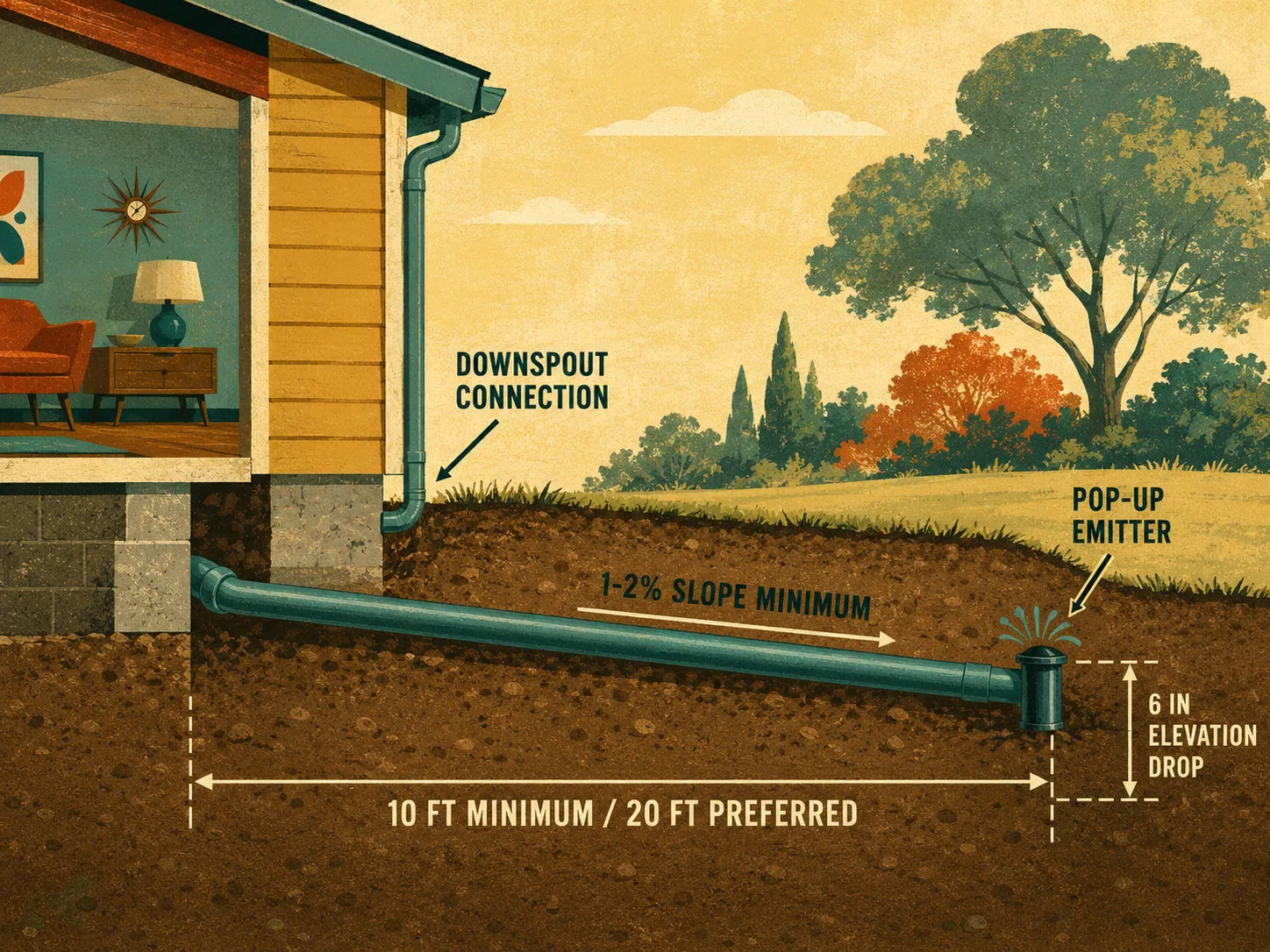
The outlet point must be at a lower elevation than the downspout connection, and far enough from the house that discharged water drains away by positive drainage.
The minimum distance guidance in North Carolina residential practice places the outlet at least 10 feet from any foundation, with 20 feet preferred where the grade allows. Check your local municipality — some jurisdictions specify discharge requirements for roof drainage on a site plan.
The elevation requirement is non-negotiable for gravity flow: the outlet must sit lower than the pipe entry point at the house. A minimum of 6 inches of elevation drop across the full run keeps the pipe draining. More slope is better — 1—2 feet of drop over a 20-foot run gives you a 5—10% slope, well above the 1% minimum.
Two outlet types work for most NC residential installs:
- Pop-up emitter — opens under flow pressure, closes when dry, prevents pests from nesting in the pipe. Best for finished yards where an open pipe end would look odd or get mowed over.
- Open daylight — pipe end terminating above grade at a low point or property edge. Simpler, cheaper, but needs protection from backfill migration and requires a grate or guard to keep debris out.
The pop-up emitter vs daylight page covers the outlet comparison in full.
What Happens When Tie-Ins Fail in NC Clay
A failed downspout tie-in in NC clay routes concentrated roof runoff directly to the foundation — usually worse than no tie-in at all.
There are three failure modes, and all three are common:
Perforated pipe returning water to the soil near the foundation. Water released through perforations in heavy clay doesn’t dissipate — it saturates the trench backfill, which is already looser than undisturbed soil. The trench becomes a water highway back toward the house.
Outlet blocked by clay sediment. Pop-up emitters and open daylight ends can accumulate clay sediment over time. When the outlet is blocked, water backs up through the pipe and eventually exits at the downspout connection — meaning concentrated roof runoff is now going straight to the foundation gap where the pipe meets the house wall. This failure mode is especially common after heavy sediment-laden runoff events, which NC clay produces regularly.
Pipe settling due to poor backfill compaction. If the trench is backfilled loosely, the soil settles over months or years. The pipe follows the settled grade — possibly forming a low point in the middle of the run that traps water. A trapped low point fills, backs up, and eventually exits wherever the path of least resistance leads.
Downspout tie-in in NC clay: built right vs the failure modes
Comparison. Built right: Solid Schedule 40 PVC carries water all the way to the outlet; Pop-up emitter set 20 ft from the foundation; 1-2% fall the whole run, with cleanout Ys at direction changes; Trench backfilled in compacted lifts so it never settles. Why it fails: Perforated pipe leaks roof runoff back into the foundation soil; Clay sediment blocks the pop-up outlet -- water backs up to the house wall; Loose backfill settles into a buried low point that traps water; A blocked or sagged line ends up worse than no tie-in at all.
- Solid Schedule 40 PVC carries water all the way to the outlet
- Pop-up emitter set 20 ft from the foundation
- 1-2% fall the whole run, with cleanout Ys at direction changes
- Trench backfilled in compacted lifts so it never settles
- Perforated pipe leaks roof runoff back into the foundation soil
- Clay sediment blocks the pop-up outlet -- water backs up to the house wall
- Loose backfill settles into a buried low point that traps water
- A blocked or sagged line ends up worse than no tie-in at all
A bad tie-in routes concentrated roof runoff straight to the foundation -- the one place you were trying to keep it away from.
Annual maintenance keeps a tie-in working: inspect the outlet every fall, clear clay sediment from pop-up emitters, and walk the trench line to check for surface settlement indicating a buried low point. If a sag or blocked outlet is confirmed, the next step is to hire a yard drainage contractor NC to camera-inspect the line and regrade the settled section before it routes water back to the foundation.
Before You Approve a Quote
Here’s a question card you can use when reviewing a downspout tie-in proposal:
Ask the contractor: “Is the pipe solid or perforated? What’s the outlet type and distance from the house? Is there a cleanout access fitting at each direction change?”
An itemized quote for a downspout tie-in should list: pipe type and diameter, pipe schedule (Schedule 40 for longevity), outlet type, distance to outlet, slope across the run, cleanout locations, and backfill method. If the quote is a single line-item number, ask for the breakdown before signing.
For a hire a grading operator in North Carolina list that includes drainage specialists in your area, NC Grade and Haul maintains verified listings with license and insurance on file.
The catch basin tie-in for downspout drainage page covers the alternative outlet strategy when a yard catch basin makes more sense than a remote daylight point. The foundation perimeter drain installation in NC places downspout routing in the broader context of foundation-perimeter drainage. And if your yard has standing water beyond the foundation zone, see the standing water in yard NC solutions hub.