
A friend in Cary paid $4,200 for her French drain last spring. Maria’s quote for a similar job came back at $6,800. Is the contractor padding? Is the cheaper job going to fail in two years?
Probably neither. Those numbers are consistent with two different depth and discharge configurations. That’s what this page explains — what each cost driver actually is, what it moves on the invoice, and how to read a quote before you sign anything.
Pricing estimates on this page reflect 2025-2026 North Carolina labor and material costs. Verify current ranges with at least two itemized quotes from licensed NC contractors.
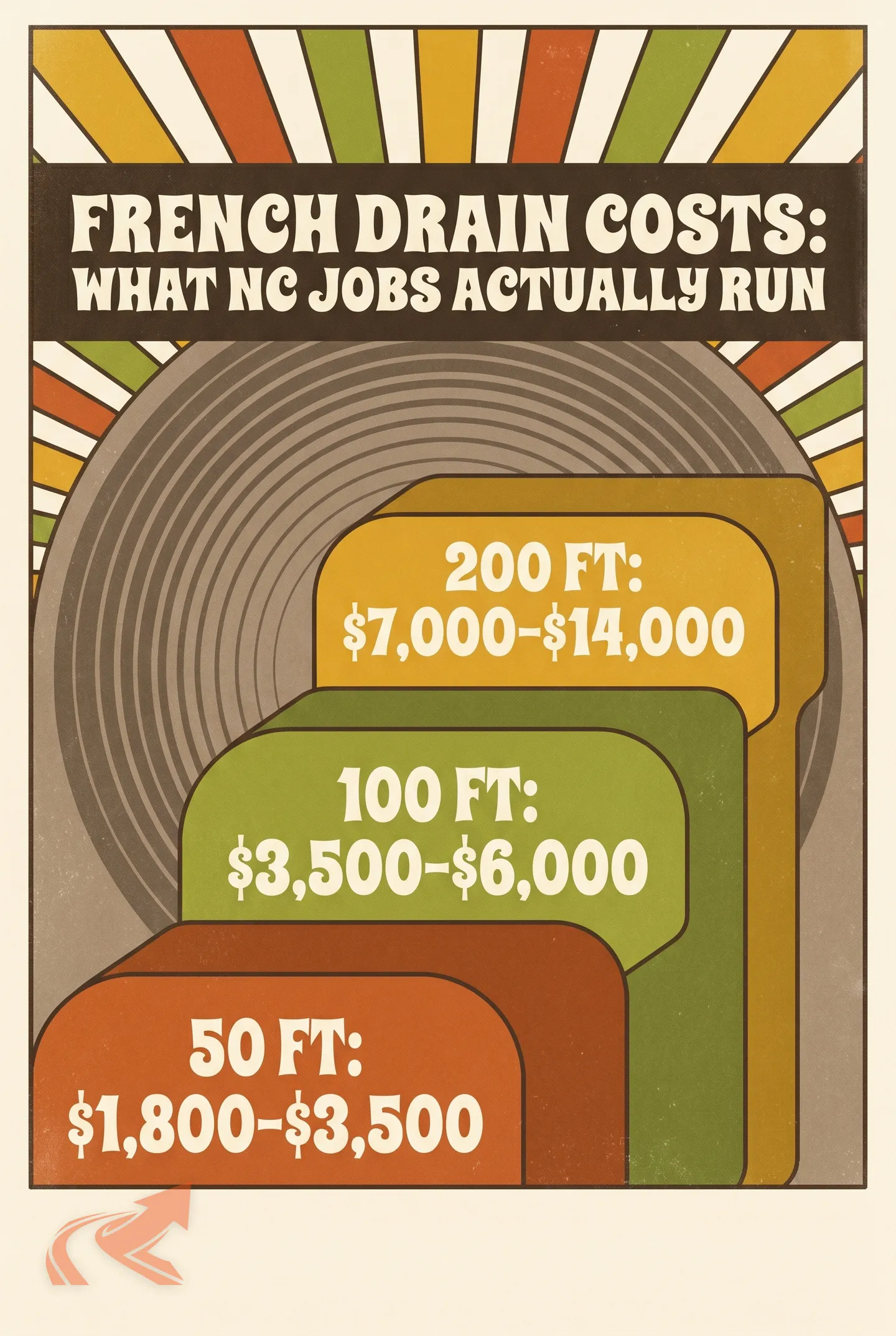
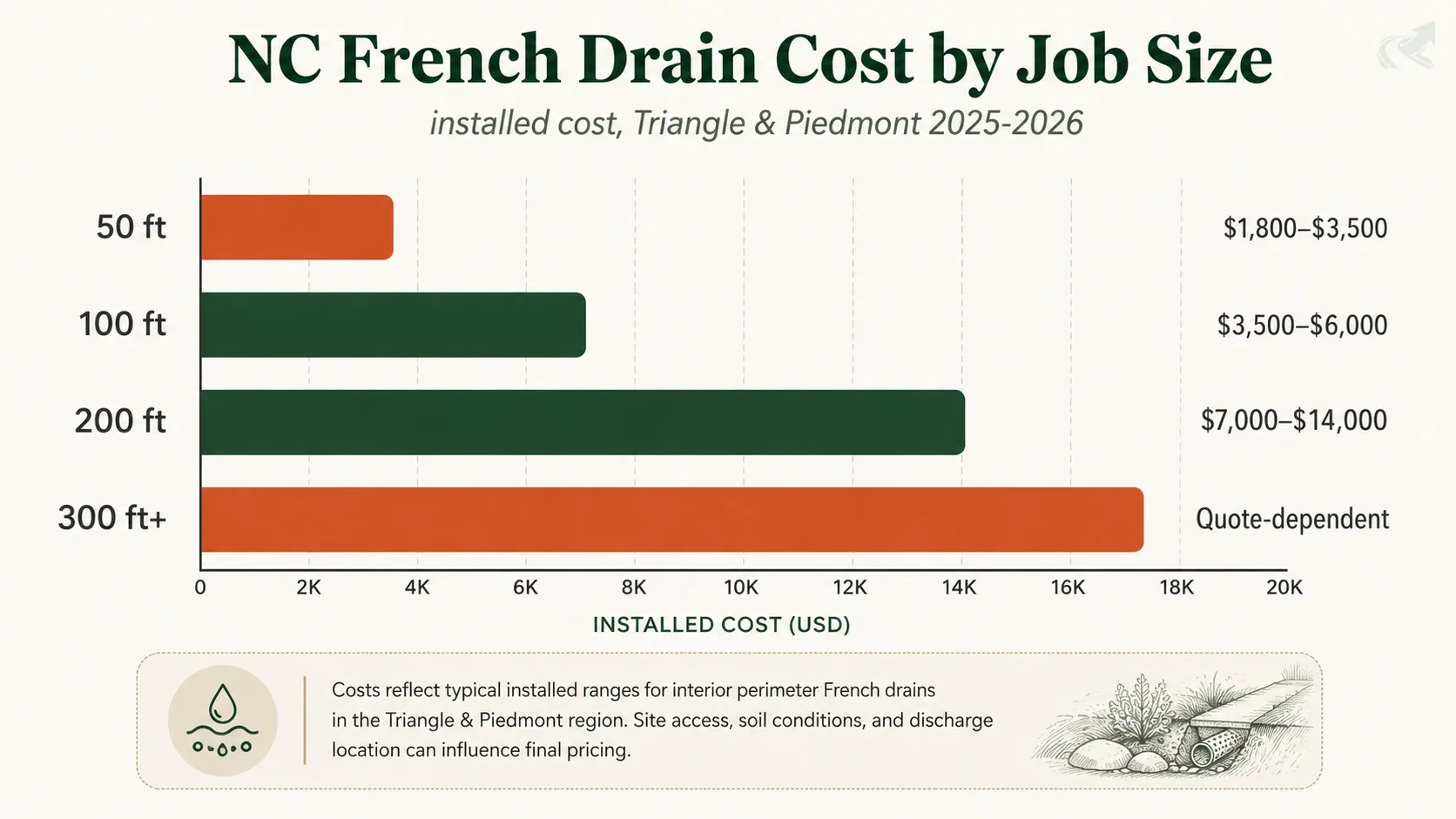
NC French Drain Cost Ranges by Job Size
A 100-ft French drain in the NC Triangle runs $3,500-$6,000 installed. A 200-ft perimeter or foundation system runs $7,000-$14,000.
These are installed costs for a French drain system in NC — trench, #67 stone, perforated pipe, fabric (if specified), discharge, and backfill. Material-only cost is roughly half that. The table below breaks it down by scope:
| Job size | Typical NC range | What that scope includes |
|---|---|---|
| 50 ft (simple yard intercept) | $1,800-$3,500 | Shallow trench, single run, natural daylight discharge to slope |
| 100 ft (standard yard run) | $3,500-$6,000 | Mid-depth trench, full stone bed, pop-up emitter or daylight outlet |
| 200 ft (perimeter or foundation) | $7,000-$14,000 | Deeper trench, catch basin or dry well discharge, possible foundation tie-in |
| 300 ft+ (full-system) | Quote-dependent | Multiple runs, engineered discharge, possible permit trigger above 1 acre disturbed |
NC French Drain Cost Quick Reference (screenshot this):
- 50 ft: $1,800-$3,500
- 100 ft: $3,500-$6,000
- 200 ft: $7,000-$14,000
- 300 ft+: Quote-dependent
Pricing verified May 2026. Ranges reflect Triangle and Piedmont labor markets. WNC mountain sites typically run 10-20% higher due to access constraints and hauling distance.
Use the French drain cost calculator NC to build a rough estimate before your first call.
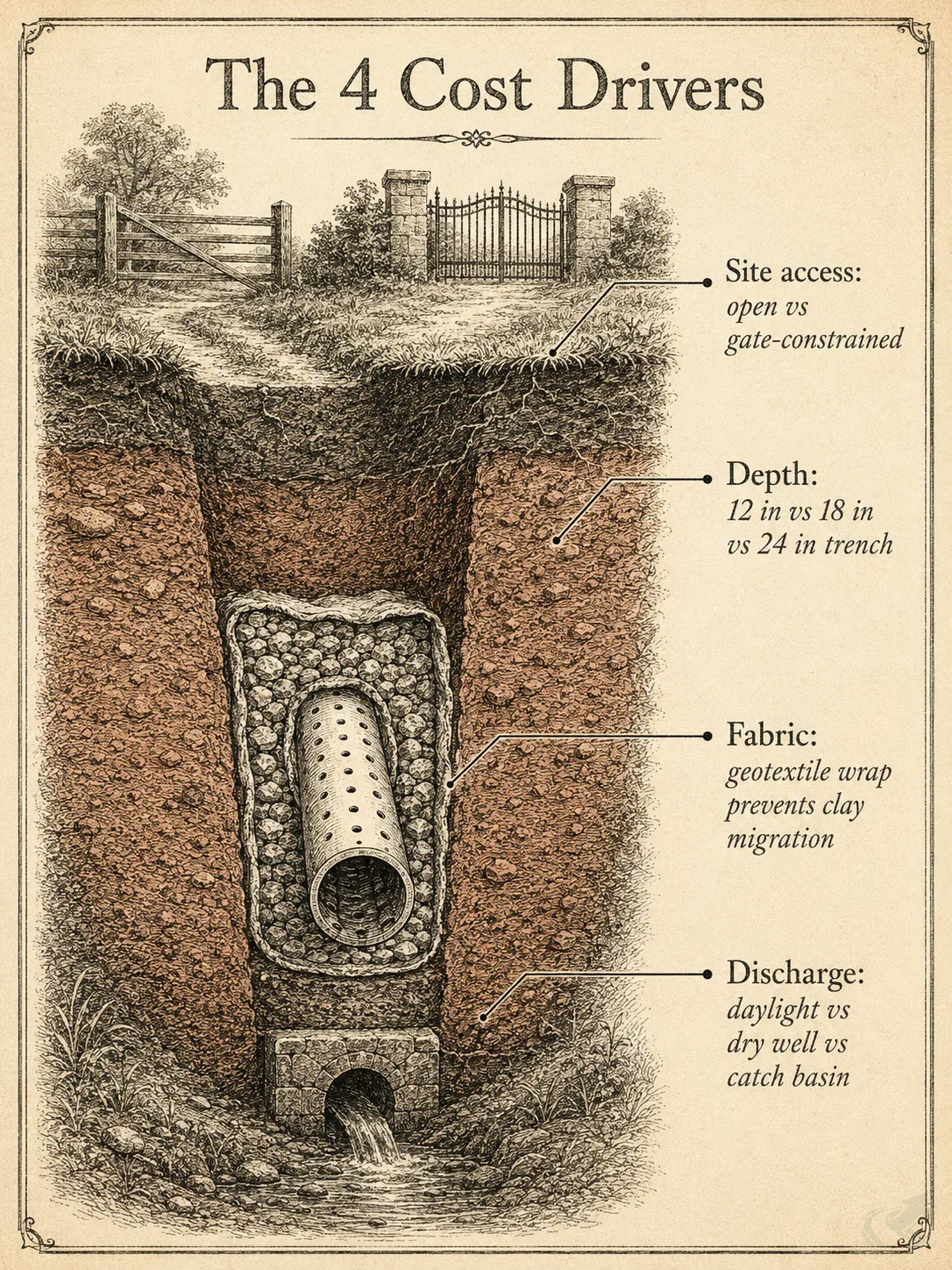
The Four Cost Drivers That Explain Every Quote Spread
Depth, fabric choice, discharge routing, and site access explain 90% of quote variation — the same variables that determine whether a project will fix a wet yard in North Carolina or just move the problem. If a contractor can’t walk through each line, ask them to.
Here’s what each one actually moves:
1. Depth. A 12-inch trench versus an 18-inch or 24-inch trench isn’t just a number — it’s excavation hours and cubic yards of stone. Each additional 6 inches of depth adds roughly 15-25% to the excavation and stone cost on a typical residential run. Piedmont red clay is heavy material to move. Deeper installs also mean more #67 stone to fill the trench bed correctly, which adds tonnage at current NC supplier pricing.
2. Fabric (geotextile wrap). Some contractors wrap the pipe and stone bed in geotextile fabric; some skip it. The price difference at install is modest — maybe $150-$300 on a 100-ft run. The long-term difference is whether Piedmont clay fines migrate into the stone voids over time and reduce drainage capacity. Neither is categorically right for every site. What matters is that the spec matches your soil type. Ask which they’re recommending and why — it matters even more if you’re weighing DIY French drain vs hiring a pro NC.
3. Discharge routing. This is the most commonly missed cost driver. Where does the water go when it exits the pipe?
- Natural daylight to slope: $0 extra. Requires a usable grade to drain to.
- Pop-up emitter: $50-$150 in materials, minimal labor. Works where you have a low-grade discharge point.
- Dry well (gravel-filled pit): $300-$600 depending on soil permeability. Used when there’s no slope to daylight.
- Catch basin tie-in: $400-$800+. Required when the drain must connect to an existing storm system.
That spread — $0 to $800+ just for discharge — explains a large chunk of why two quotes for “the same job” look different.
4. Site access. Machine access changes the labor equation entirely. An open, flat backyard with no gates is a one-day job. A backyard behind a 36-inch gate, with mature root zones from a 40-year-old oak and a soft yard from the spring rains, is a different project. Hand-digging or tight-access equipment costs more per linear foot. If your backyard has constraints, any honest quote will reflect that. See how French drain depth affects cost for the full depth-vs-access interaction.
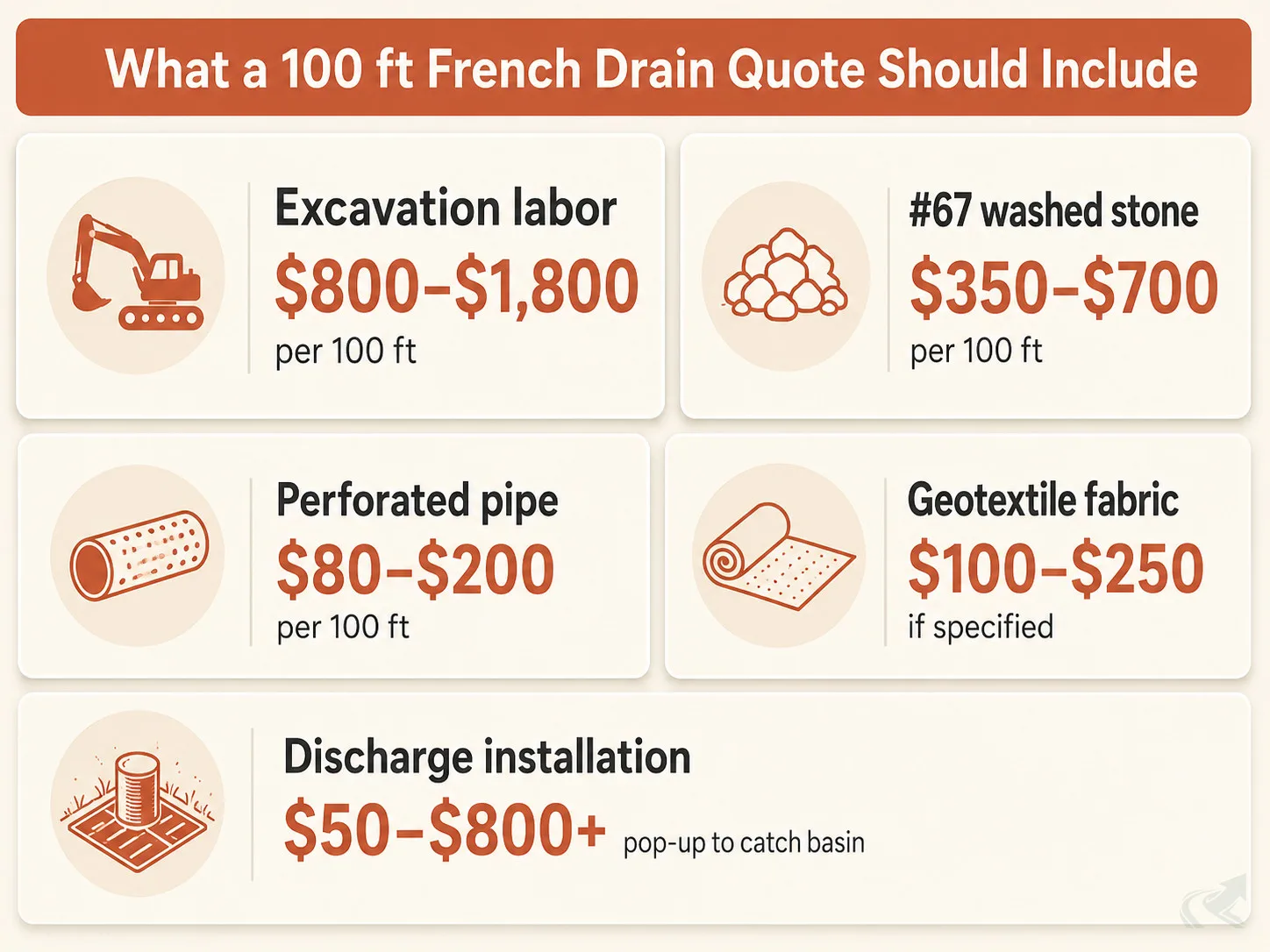
Itemized Line Breakdown: What You’re Paying For
A line-item French drain quote breaks into five buckets: excavation, stone, pipe, fabric (if used), and discharge. If your quote is a single number, ask for the breakdown.
| Line item | Typical NC cost per 100 ft | Notes |
|---|---|---|
| Excavation labor | $800-$1,800 | Varies with depth, soil, and access |
| #67 washed stone | $350-$700 | ~4-8 tons for a 100-ft run at 12-18” depth; price per ton varies by supplier and haul distance |
| Perforated pipe (4-inch or ) | $80-$200 | 4-inch adequate for most residential runs; 6-inch for high-flow or longer runs |
| Geotextile fabric (if specified) | $100-$250 | Sock-wrapped pipe or full trench liner |
| Discharge installation | $50-$800+ | Ranges from pop-up emitter to catch basin tie-in |
Stone and pipe unit costs vary with current NC supplier pricing. Ask any contractor quoting the job to name the stone spec (#67, not crusher run), the pipe diameter, and the discharge method. Those three details let you compare quotes apples-to-apples.
What Makes a $3,000 Quote Different From a $12,000 Quote
The gap is almost always depth, discharge complexity, and whether the contractor is doing the excavation themselves or subcontracting it.
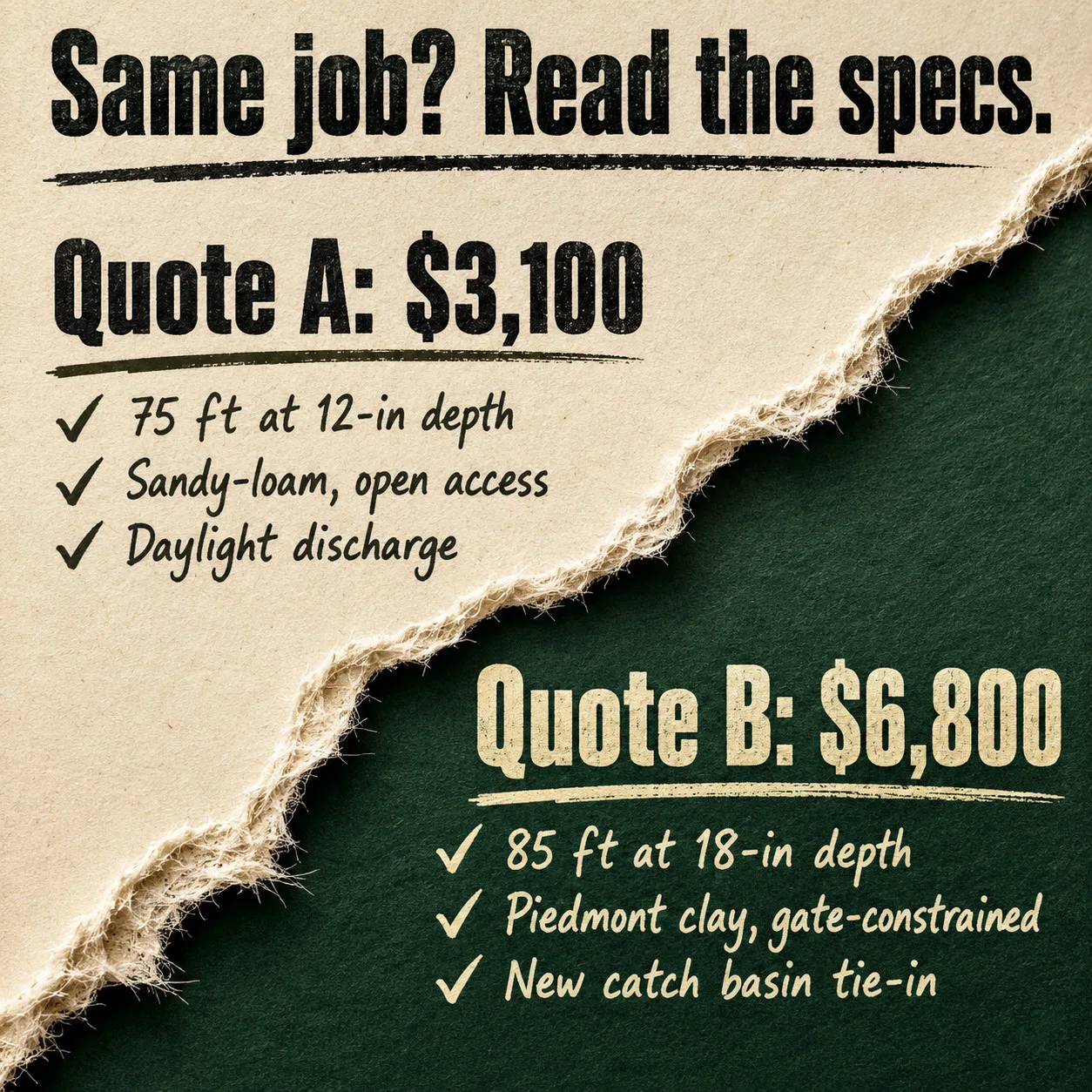
Here’s a concrete North Carolina comparison:
Quote A — $3,100. A 75-ft run at 12-inch depth. Sandy-loam soil in a Wake County backyard with a clean slope to a wooded lot line. Natural daylight discharge. Open machine access. One crew, one day. This is honest work at a reasonable rate for what it is.
Quote B — $6,800. An 85-ft run at 18-inch depth in a Piedmont clay yard. Gate-constrained backyard, partial hand-digging required around a mature dogwood root zone. Discharge routes to a new catch basin tied into an existing driveway drain. Two-day job, different crew configuration.
Both quotes are real. Neither is a rip-off. The question isn’t which is cheaper — it’s whether the spec matches your actual drainage problem. A shallow daylight drain in a yard that needs 18-inch depth to clear the water table will fail. A catch-basin tie-in where a pop-up emitter would work is money spent unnecessarily.
The spec drives the price. The drainage problem drives the spec. That’s the sequence any contractor should be able to walk you through. See hire a grading operator in North Carolina if you want contractors who will explain their specs before asking you to sign.
When to Get an Itemized Quote (and How)
Always ask for an itemized quote. Any contractor who declines to break it out is either unsure of their own costs or protecting margin you shouldn’t be funding.
Three specific questions to ask before you sign anything:
- “What depth are you trenching to, and why that depth for my specific yard?” The answer should reference your soil type, your water table, or your drainage problem — not just a standard depth they use on every job.
- “What’s your discharge plan, and what does that add to the cost?” If they say daylight, ask where the daylight point is. If they say catch basin, ask whether that’s included in the quote or add-on.
- “Are you doing the excavation in-house, or subcontracting it?” Subcontracted excavation isn’t a red flag, but it does affect who’s accountable for the trench depth and backfill compaction.
The itemized French drain quote breakdown covers what each line should include and what to do when a contractor refuses to break it out. And red flags in French drain contractor quotes covers the patterns that signal a contractor who can’t explain their work.
Copy this question and send it to your contractor before signing:
“Can you break this quote into line items — excavation labor, stone, pipe, fabric, and discharge? I want to understand what’s driving the price before I sign.”
Label: Question to send your contractor before signing.