
Two days after a 1-inch rain, Gabriela Robinson’s Holly Springs backyard is still soggy. She called two contractors. One said French drain — $4,200. The other said regrade — $13,800. Neither explained why they disagreed.
The reason: they’re diagnosing different problems. One sees a drainage system problem. The other sees a grade problem. Both may be right about the fix — for a problem the yard may or may not actually have.
You can’t evaluate either quote until you know which category your yard falls into. This page names the three categories and gives you the field tests to figure out which one applies to you.
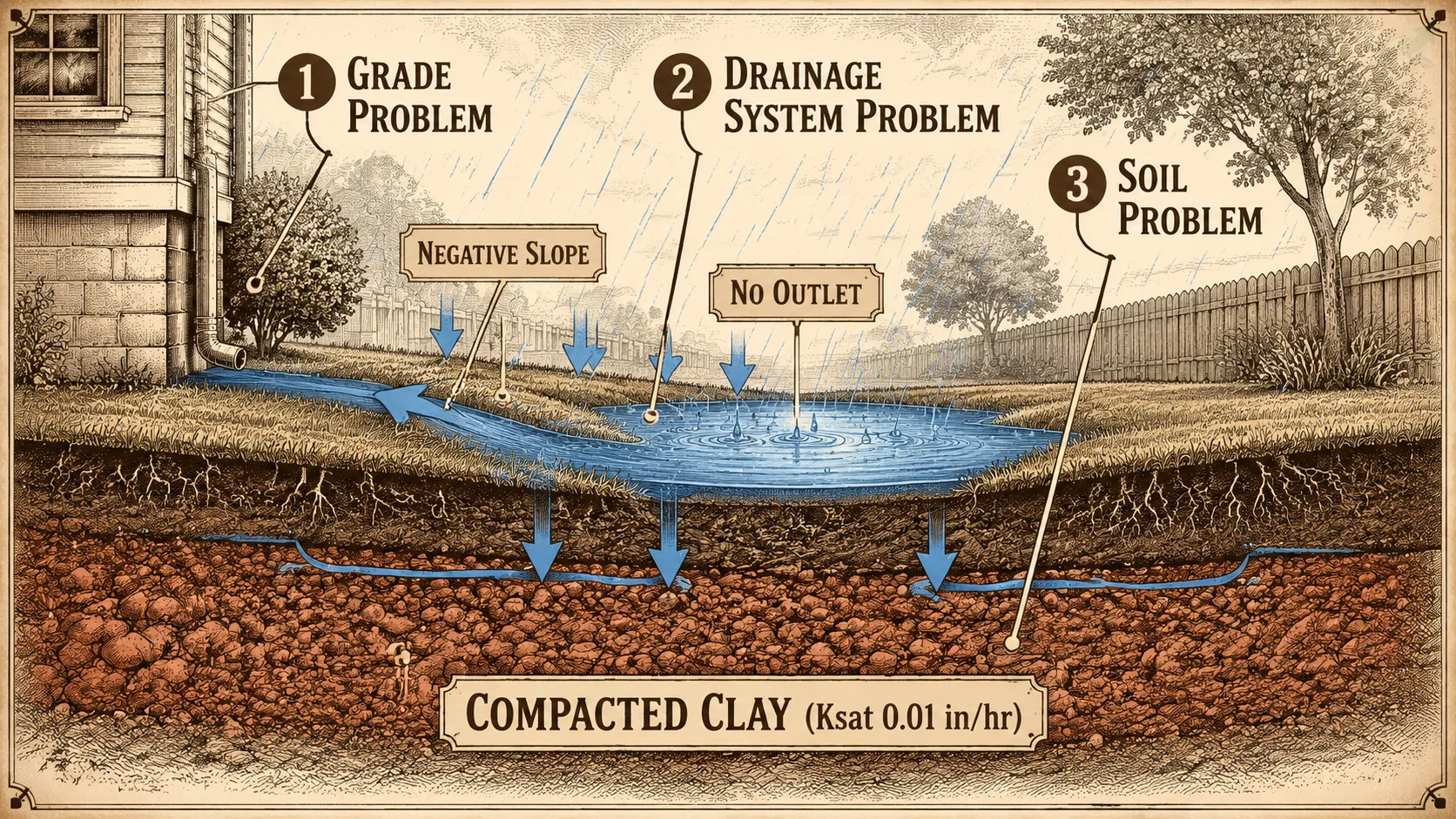
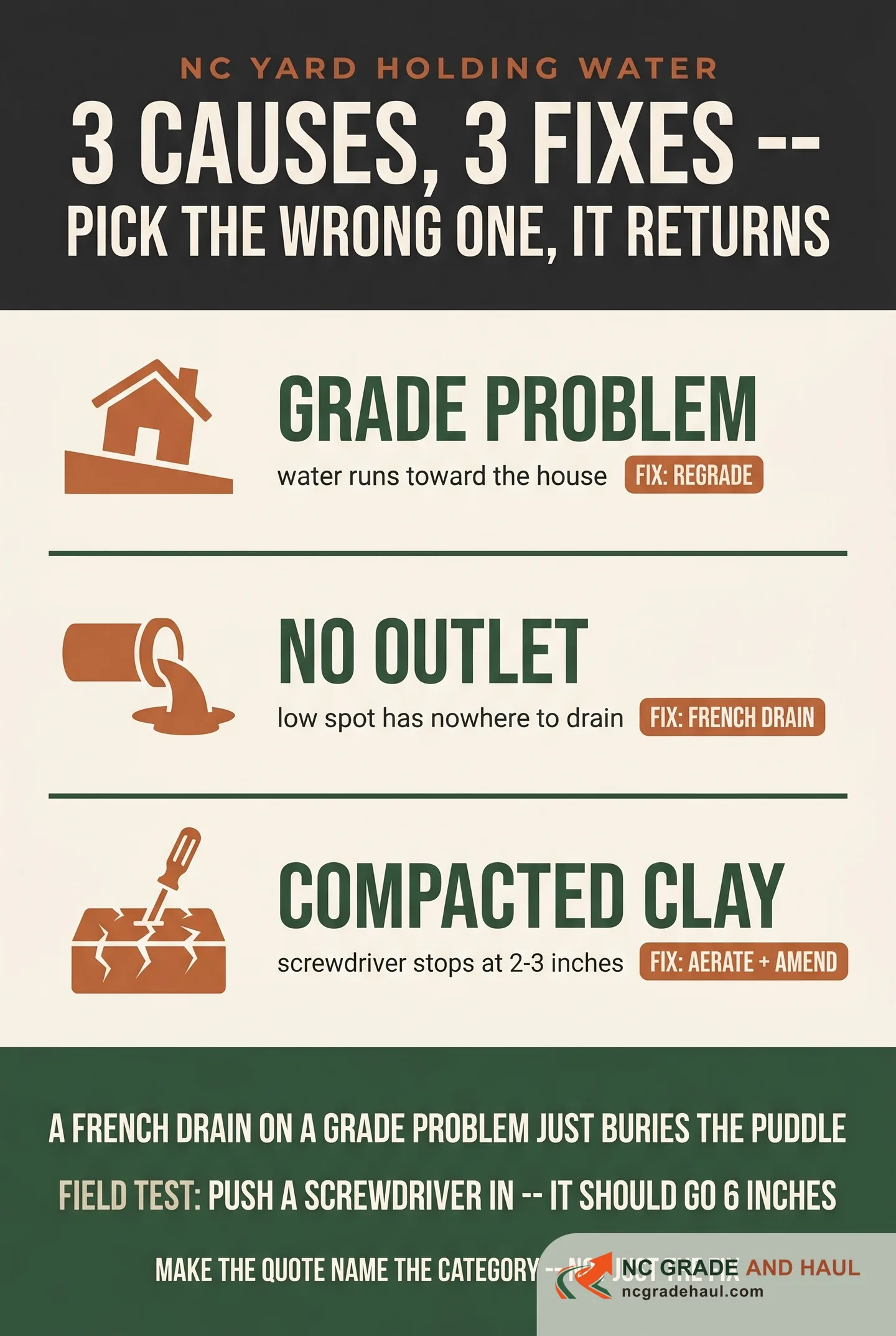
Category 1: Grade Problem (Water Doesn’t Run Away)
The ground slopes toward a low spot — or toward your foundation — instead of away.
This is the most common cause of standing water on North Carolina new-build lots. Contractors rough-grade during construction, construction traffic reroutes water flow, and the final-grade pass often leaves negative slope at the house perimeter — meaning water drains toward the foundation wall, not away from it.
Signs of a grade problem:
- Puddle location is consistent — same low spots after every rain, regardless of rain volume
- Water sits within 6 feet of the house — foundation perimeter is the most common pooling zone
- Swales that used to drain now collect water — fill has shifted or settled
- Visible backward mounding — soil grades down from the yard toward the foundation instead of away
Positive drainage requires the ground to drop at least 6 inches over the first 10 feet away from the foundation. In Piedmont clay soils, even a slightly reverse slope concentrates runoff against the foundation and holds it there.
Fix type: regrading. A contractor re-establishes correct slope and sometimes adds fill at the perimeter to achieve positive drainage away from the house. See NC yard regrading — rough vs finish grading for what that scope entails.
Foundation grade: positive drainage vs the negative-slope failure
Comparison. Positive drainage: Ground drops at least 6 inches over the first 10 feet from the house; Rain sheds away from the foundation wall; Perimeter stays dry -- no pooling within 6 feet of the house. Negative slope: Grade falls back toward the foundation; Water collects and stands against the foundation wall; Same low spots puddle after every rain, regardless of rain volume.
- Ground drops at least 6 inches over the first 10 feet from the house
- Rain sheds away from the foundation wall
- Perimeter stays dry -- no pooling within 6 feet of the house
- Grade falls back toward the foundation
- Water collects and stands against the foundation wall
- Same low spots puddle after every rain, regardless of rain volume
On NC new-build lots a rushed final grade often leaves negative slope -- water runs toward the house instead of away.
Category 2: Drainage System Problem (Nowhere for Water to Go)
The grade is fine, but the water collects faster than it can escape — there’s no outlet.
A correctly sloped yard still floods if there’s nowhere for water to go once it reaches the low point. In North Carolina’s Piedmont, this is the second-most common cause of persistent wet yards — especially on lots that sit at the bottom of a natural slope or in subdivisions where the developer didn’t install catch basins or swales.
Signs of a drainage system problem:
- Uphill edge drains quickly, low spots stay wet for days — the grade is working, but the destination has no exit
- Bottom of a slope stays wet even when the slope itself is dry — the yard is the collection point
- No visible swales, catch basins, or drainage outlets — water has nowhere to daylight
- Neighbor’s yard drains fine, yours doesn’t — the shared property line sits at the low point
Piedmont clay has extremely low permeability. Even a correctly graded lot becomes saturated during North Carolina’s spring rain pattern — 4 to 6 inches over three weeks — when there’s no active path for water to exit. The ground fills up before it can drain.
Fix type: French drain, swale, or catch basin with an outlet that can daylight to the street, a drainage ditch, or the property edge. See French drains in North Carolina for what that system looks like and when it applies.
Category 3: Soil Problem (Clay Can’t Absorb Fast Enough)
The slope is correct and there’s an outlet, but the soil itself is too dense to absorb rain at the rate it’s falling.
North Carolina’s Piedmont region sits on Cecil series red clay — one of the most hydraulically restrictive soils in the eastern United States. The saturated hydraulic conductivity ( ) for Cecil clay is extremely low. Water arrives faster than the soil can accept it.
On new-build lots, the problem is worse. Construction equipment — graders, excavators, concrete trucks — proof-roll the entire lot. That compaction reduces Ksat further, sometimes to near-zero in the top foot of soil. The surface becomes effectively impermeable.
Signs of a soil problem:
- Water pools immediately even on visibly sloped ground — the slope is there, but water runs off before it can soak in
- Lawn feels spongy underfoot after rain but dries out fast in summer
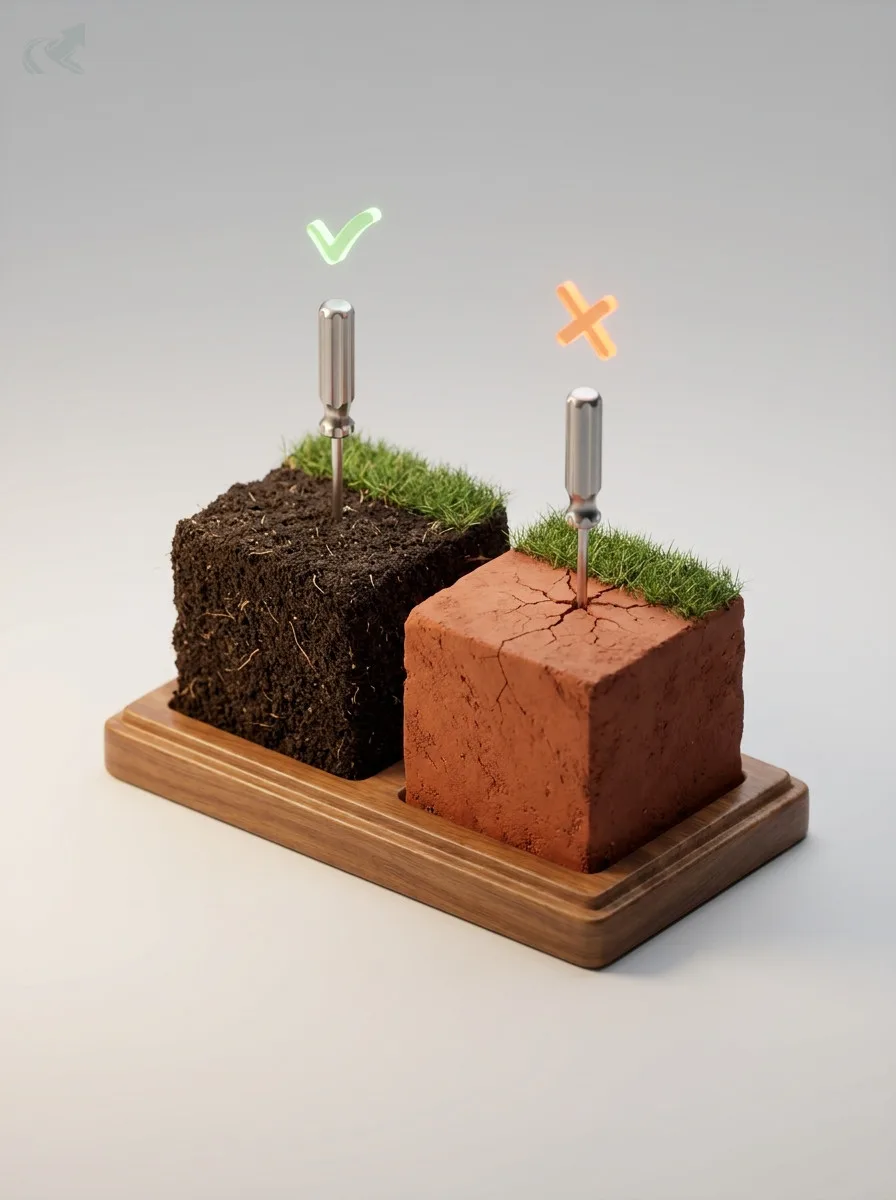
- Screwdriver test fails — push a standard screwdriver into the soil; it should go 6 inches easily in healthy soil. If it stops at 2—3 inches, you have compaction
- No visible ruts or low spots — the problem is beneath the surface, not topographic
Category 3 rarely exists alone. Construction compaction on a new Triangle production-builder lot typically combines Category 1 (negative slope from a minimum-spec final grade) and Category 3 (clay compaction from site traffic). Both need attention.
Fix type: aeration and compost amendment for mild cases. Severe compaction may require ripping the top 12 inches before amending. Category 3 alone won’t respond to a French drain — you’re not moving water, you’re amending soil. See NC Piedmont red clay and yard drainage for more on Ksat ranges and amendment options.
How to Diagnose Your Yard
Walk the yard 24 hours after a 1-inch rain and observe where water sits, whether it tracks downhill, and how fast it clears.
This is the field test. You don’t need equipment to do a first-pass diagnosis. Wait 24 hours after a measurable rain, then walk the property in this sequence:
Step 1 — Grade test. Walk the foundation perimeter. Does the ground slope away from the house or toward it? You can confirm with a 4-foot level and a tape measure: probe for whether the grade drops 6 inches over the first 10 feet. If the slope runs the wrong direction, you have a Category 1 problem.
Step 2 — Drainage path test. Stand at your lowest wet spot. Follow the water — where does it go? If you can trace a path to a ditch, swale, or street edge, the outlet may exist but be blocked. If there’s no path at all, you have a Category 2 problem.
Step 3 — Soil test. At a wet spot on visibly sloped ground, push a screwdriver into the soil. Less than 3 inches of easy penetration = compaction. Dig a 12-inch hole, fill it with water, and time how long it drains. Under NC State Extension guidelines, a healthy yard drains 1—2 inches per hour. Cecil clay at its worst drains less than 0.06 inches per hour. If it takes all day to drain, you have a Category 3 problem.
Common NC new-build result: Category 1 and Category 3 together. The rushed final grade left negative slope AND the construction equipment compacted the Piedmont clay. Both need to be named in the diagnosis — and both need to be addressed in the fix.
What the Wrong Diagnosis Costs You
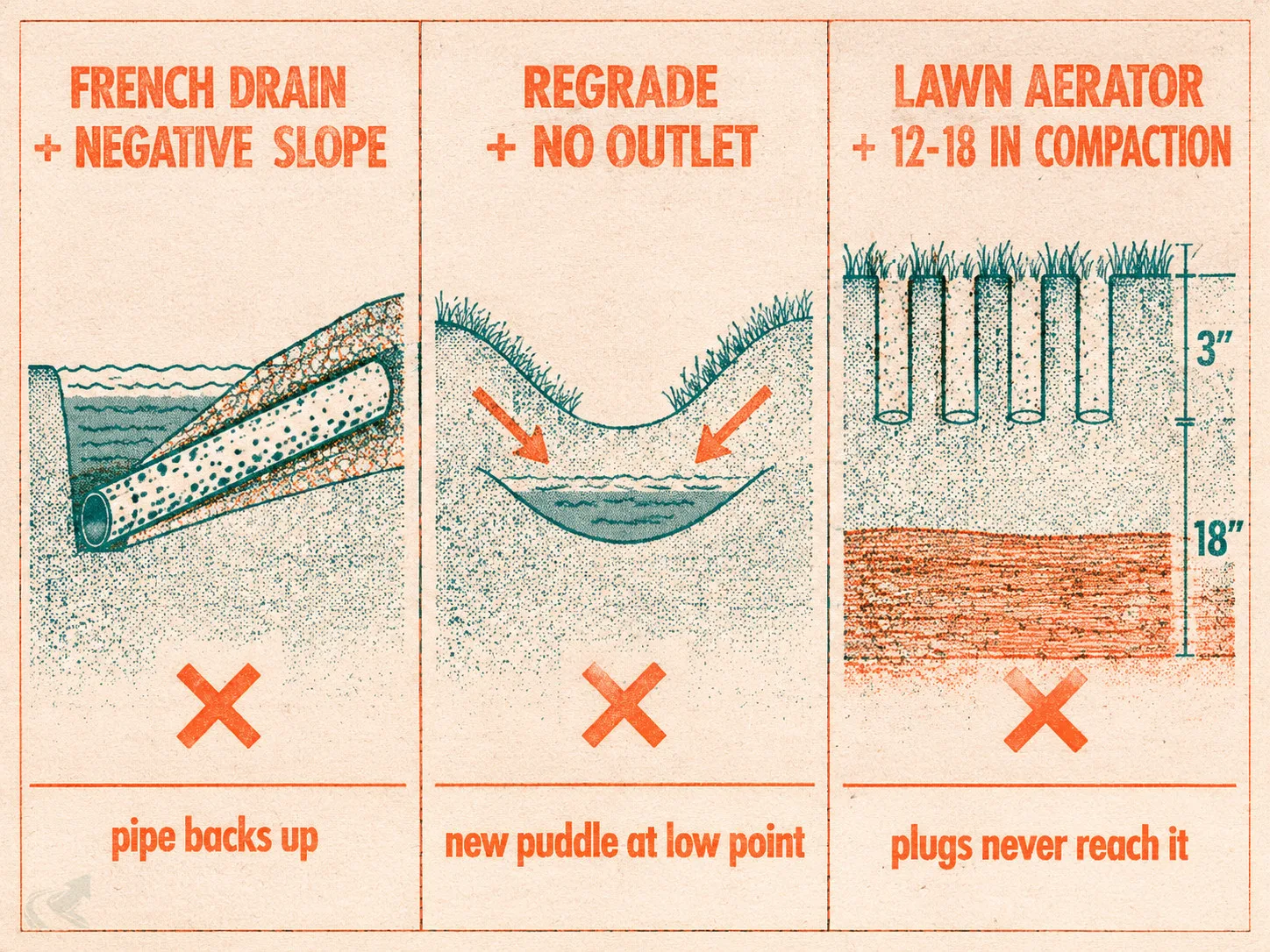
Installing a French drain when you have a grade problem just moves water underground — the puddle comes back.
Three real failure patterns:
French drain on a negative-slope lot. The drain pipe collects water but can’t daylight — the outlet is higher than the pipe inlet because the grade runs the wrong direction. Water backs up into the pipe, the system fails in the first wet season, and you’re back to the same puddle with a pipe buried under the lawn.
Regrading when the drainage system is absent. The contractor achieves positive drainage, but the water now runs correctly toward a low spot with no outlet. A new puddle forms at the new grade’s low point.
Aeration on construction-compacted clay. Surface aeration with a lawn aerator punches 3-inch plugs. Construction compaction runs 12 to 18 inches deep. The aerator doesn’t reach it. You get green plugs on a lawn that still floods.
Get an itemized quote that names the category — not just the fix. If the estimate says “install French drain” but doesn’t explain why your yard falls into Category 2 versus Category 1, ask the contractor to walk the perimeter with you and show you why they diagnosed what they diagnosed.
When to Escalate Beyond a Contractor
If your diagnostic test points to Category 2 and the ground is structurally wet year-round, that’s a different conversation.
Most NC drainage problems are fixable. Regrading fixes negative slope. A French drain or swale fixes a missing outlet. Soil amendment and aeration address surface compaction.
But some lots hold water not because of a fixable drainage condition — but because the site was built where water naturally collects. When the Category 2 diagnosis reveals no outlet and the surrounding terrain can’t provide one, you may not have a contractor problem. You may have a siting problem.
See when your NC lot may have a bigger problem than drainage for the full severity framework. That page covers the threshold where a drainage problem tips into a lot-viability question — and what you need to know before investing in either a fix or a sale.
Also, for the standing water in your NC yard — full severity triage, the QN hub covers low, medium, and high severity tiers and what each level typically costs.
3-Category Yard Drainage Diagnostic (Reviewed May 2026)
| Category | Signs You See | Fix Type |
|---|---|---|
| Grade Problem | Puddles at same spots every rain; water within 6 ft of house; no visible swale reversal; backward slope toward foundation visible with level | Regrading -- re-establish positive drainage away from house |
| Drainage System Problem | Uphill drains fast, low spots stay wet for days; bottom of slope wet when slope is dry; no visible swales or catch basins; nowhere for water to daylight | French drain, swale, or catch basin with daylight outlet |
| Soil Problem | Pools on sloped ground immediately; screwdriver stops at 2-3 in; perc hole drains all day; new build with construction traffic on site | Aeration + compost amendment (mild); subsoil ripping + amendment (severe); rarely sufficient alone without also addressing Category 1 or 2 |
Grade Problem
- Signs You See
- Puddles at same spots every rain; water within 6 ft of house; no visible swale reversal; backward slope toward foundation visible with level
- Fix Type
- Regrading -- re-establish positive drainage away from house
Drainage System Problem
- Signs You See
- Uphill drains fast, low spots stay wet for days; bottom of slope wet when slope is dry; no visible swales or catch basins; nowhere for water to daylight
- Fix Type
- French drain, swale, or catch basin with daylight outlet
Soil Problem
- Signs You See
- Pools on sloped ground immediately; screwdriver stops at 2-3 in; perc hole drains all day; new build with construction traffic on site
- Fix Type
- Aeration + compost amendment (mild); subsoil ripping + amendment (severe); rarely sufficient alone without also addressing Category 1 or 2
Ask your contractor before signing
“Which of the three categories does my yard fall into — grade, drainage system, or soil? Can you show me on the ground why you diagnosed that category?”
A contractor who can’t answer this question on the ground — not just in words — hasn’t diagnosed your yard. Get a second opinion before signing. Find a grading contractor near me in NC who will walk the lot with you.