
Beth’s quote specifies 4-inch perforated pipe. Her backyard floods noticeably after heavy rain — not just wet, but standing water for hours. Is 4-inch enough?
For most NC residential yards, yes. A single 4-inch perforated pipe at 1% slope carries more flow than the average residential drainage area generates in a heavy rain event. But North Carolina’s Piedmont clay profile creates a wrinkle that national pipe-sizing charts don’t account for: clay slows water entry into the stone column, so your system’s real-world throughput is lower than the theoretical maximum. That gap is why some NC yards need 6-inch where a national guide would say 4-inch is fine.
Here’s how to read the difference.
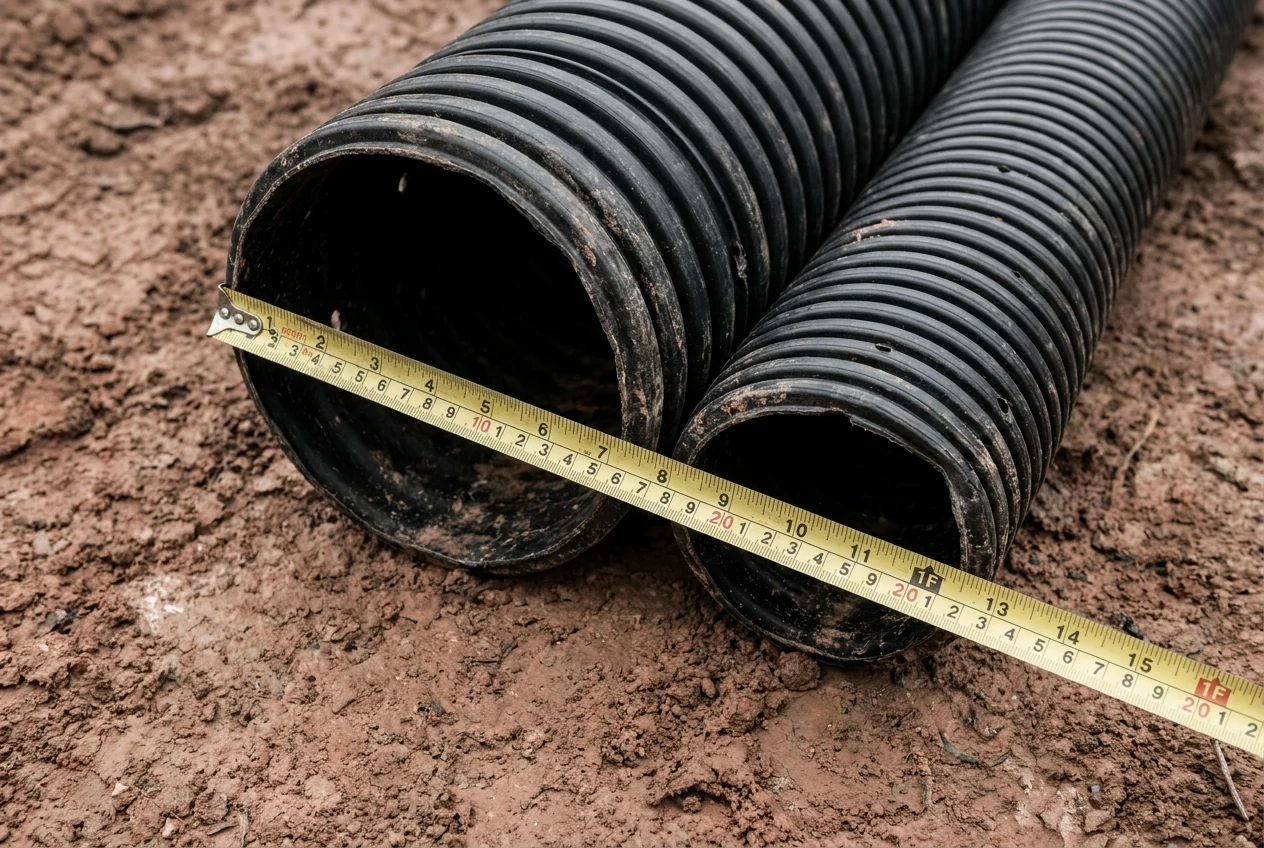
Pipe Capacity — What Each Size Handles
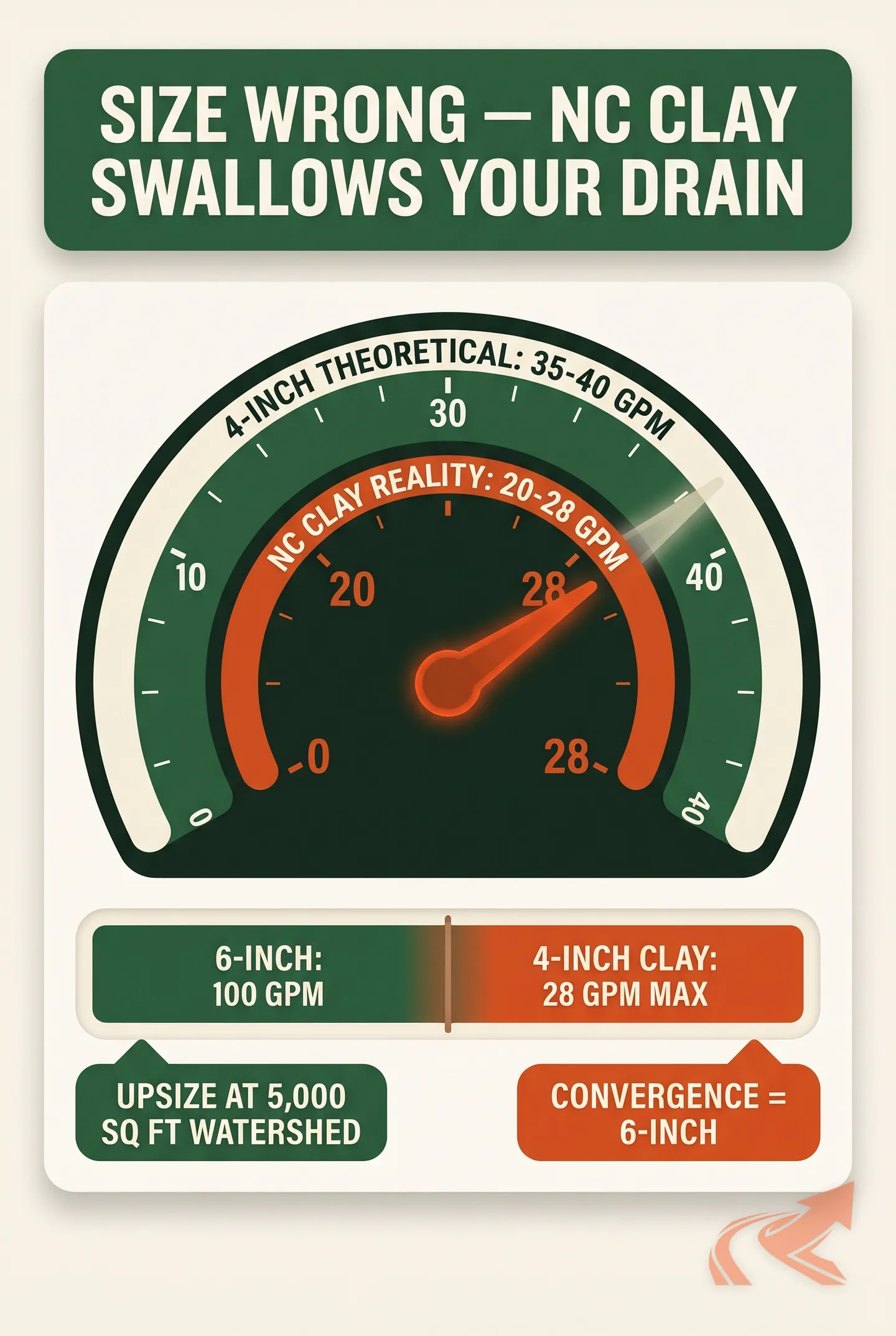
4-inch pipe at 1% slope carries roughly 35—40 under ideal conditions. 6-inch pipe at the same slope carries approximately 100—110 gpm — nearly 2.5 to 3 times as much. In NC clay, real-world field flow rates run meaningfully lower than those theoretical values.
The table below shows why the clay context matters. A pipe buried in a gravel column surrounded by Piedmont red clay doesn’t fill as fast as the same pipe surrounded by sandy loam. Water still has to migrate through the stone column and into the perforations — clay slows that migration. Contractors who work NC soil regularly account for a 30—40% reduction from theoretical capacity when sizing for clay-heavy sites.
| Pipe Diameter | Theoretical Capacity at 1% Slope | NC Clay Field Estimate | Typical NC Application |
|---|---|---|---|
| 4-inch | ~35—40 gpm | ~20—28 gpm | Yard intercept, foundation perimeter, single downspout run |
| 6-inch | ~100—110 gpm | ~60—75 gpm | Large yard, multiple convergence points, collector trunk |
| Two parallel 4-inch | ~70—80 gpm combined | ~40—55 gpm combined | Split-route large yards; easier routing than single 6-inch |
Field estimates based on Manning’s equation at n=0.012 (smooth corrugated), adjusted for observed clay-entry reduction in Piedmont residential installations. Get a hydraulic calculation from your contractor for any drainage area over 5,000 sq ft.
When to Upsize from 4-Inch to 6-Inch
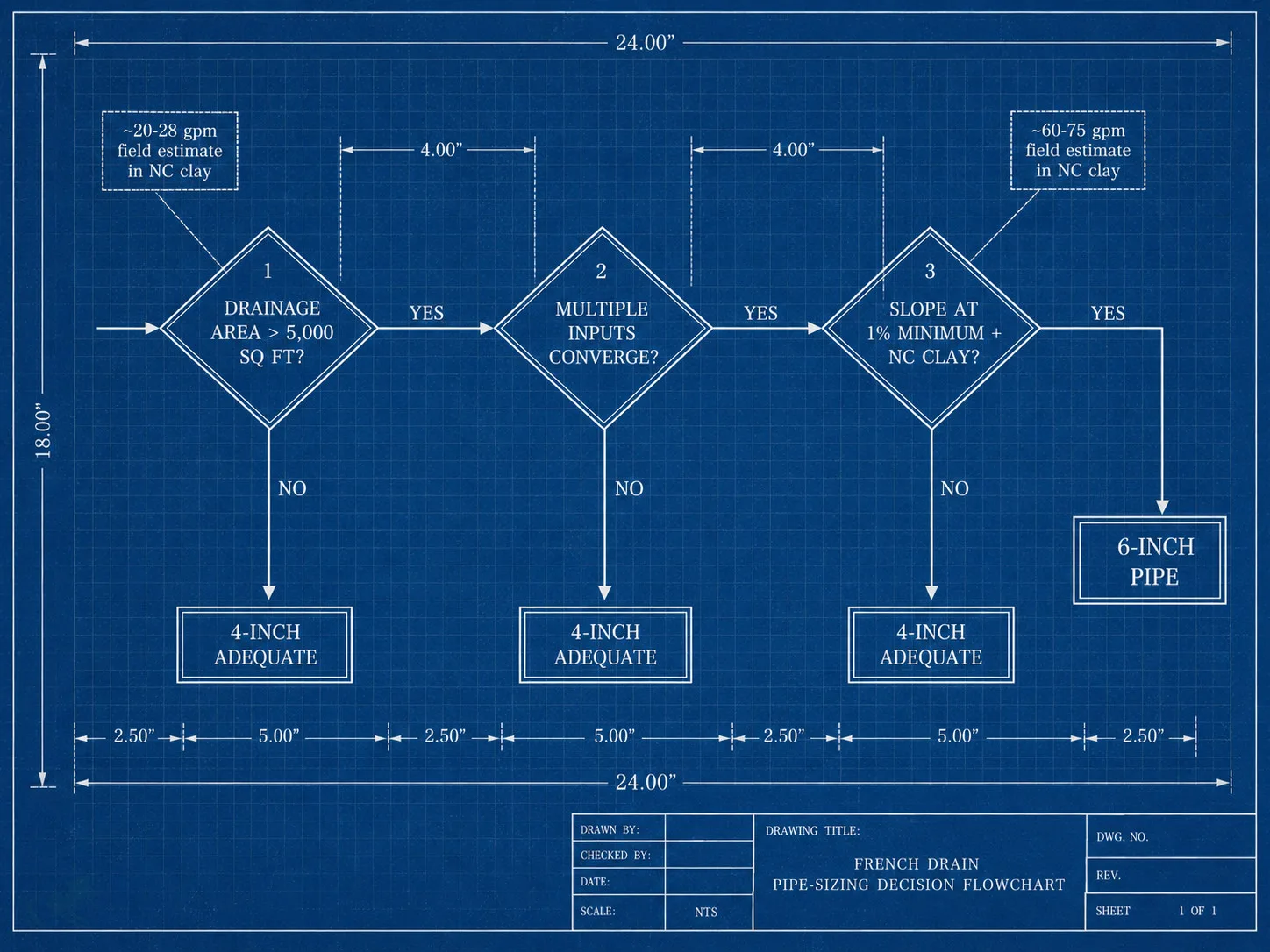
Upsize when the drainage area is large, multiple inputs converge, or the slope is at its minimum. The NC clay reduction factor pushes these thresholds earlier than national guides suggest.
Three specific triggers:
Trigger 1 — Large drainage area. A typical single-family yard in the Piedmont with one roof section draining toward the French drain usually falls under 5,000 sq ft of watershed. Once you combine a large rear yard, a significant portion of roofline, and a driveway runoff component, that number climbs toward 8,000—10,000 sq ft. That watershed load is exactly the territory where yard drainage solutions NC contractors design for 6-inch from the start — 4-inch in NC clay is at its limit. 6-inch is the safer call.
Trigger 2 — Convergence points. This is the most common NC scenario that pushes from 4-inch to 6-inch. Two downspouts feeding into the same French drain trench, plus yard surface flow, means the pipe downstream of that junction needs to carry everything. Sizing the entire run at 4-inch because the upstream sections are small misses the convergence load. The pipe downstream of any convergence point — where two or more inputs join — gets sized for the combined flow, not the individual runs.
Trigger 3 — Minimum slope at 1%. 1% is the minimum grade for a French drain to drain in NC. At minimum slope, the pipe is already running near its capacity ceiling under design conditions. Adding the NC clay reduction factor removes the margin. North Carolina’s clay profile is not Florida sand or Michigan loam — national guides that say “4-inch is fine at 1% slope” were not calibrated against Piedmont red clay backfill. If you’re installing at exactly 1% because the terrain gives you no choice, move to 6-inch.
One-Pipe vs Two-Pipe Parallel Systems
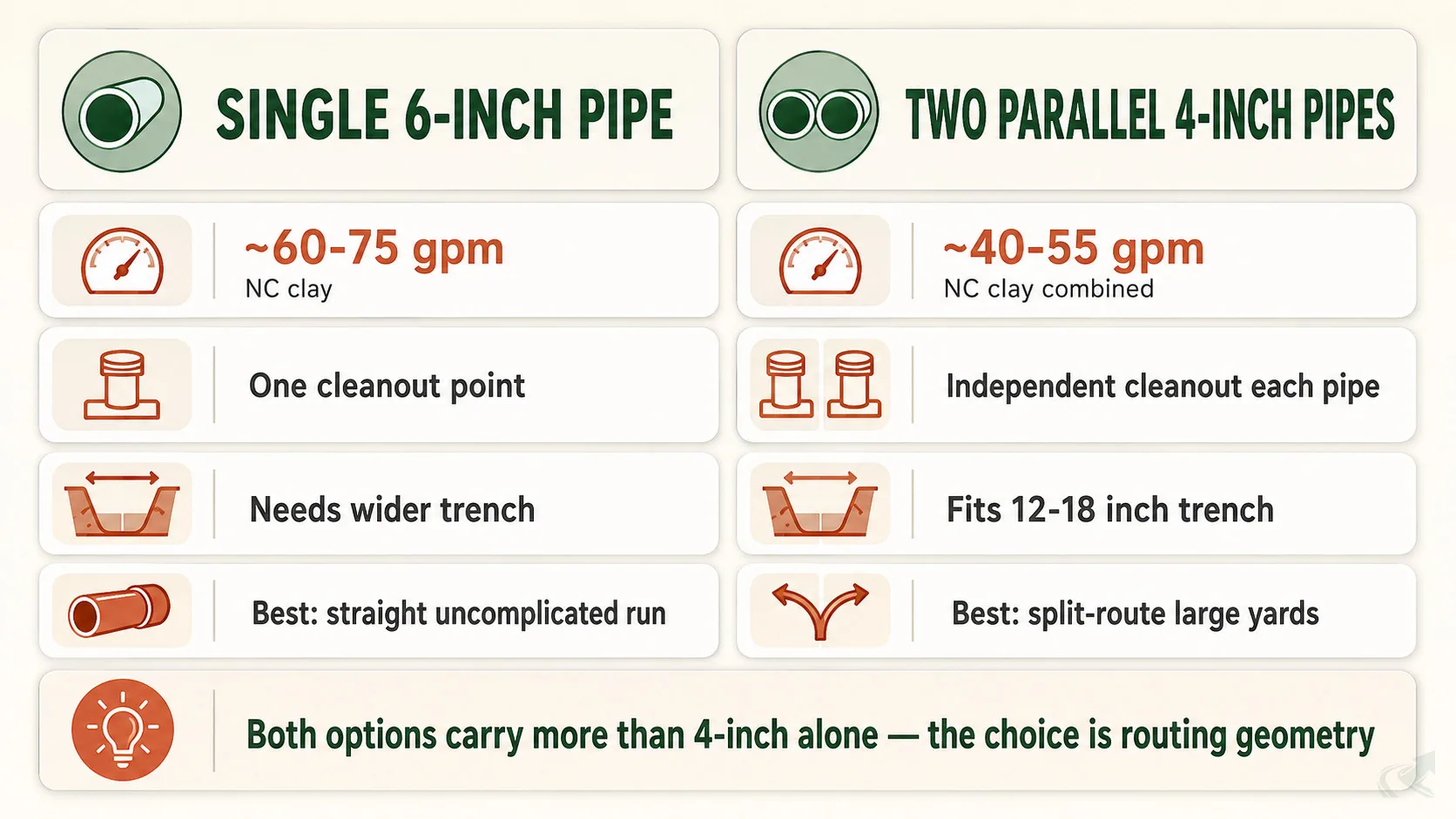
For very large drainage areas, two parallel 4-inch pipes often outperform a single 6-inch pipe — they’re easier to route, comparable in cost, and the combined capacity scales.
Two parallel 4-inch pipes in a standard French drain trench give you roughly 70—80 gpm theoretical capacity (40—55 gpm in NC clay) and let you run each pipe with its own cleanout access. They fit in a standard 12—18 inch wide trench. A single 6-inch pipe needs a wider trench and a larger cleanout fitting at each end.
Where one 6-inch pipe beats two parallel 4-inch pipes: a single straight trunk run where you want one cleanout point and the trench is already at 6-inch width. Simpler to verify the system is clear, simpler to inspect. If the route is uncomplicated, single 6-inch is cleaner.
The split-route case — where the yard geometry forces the French drain to branch around a structure — naturally accommodates two 4-inch runs that each stay within their capacity range. This is a design consideration worth raising with your contractor before digging begins.
What to Ask Your Contractor About Pipe Sizing
Ask: “How did you calculate the pipe size for my drainage area, and did you account for NC clay’s reduced entry rate?”
A contractor who can answer that question — even informally — is showing you they sized the system rather than defaulted to 4-inch because that’s what’s on the truck. The answer should name the drainage area in square feet, acknowledge the convergence points, and reference slope.
An itemized quote that specifies pipe diameter with a line of rationale (“6-inch collector at convergence point; 4-inch laterals”) is the mark of a designed system. A quote that just says “French drain” with a price is not.
You can also reference the quick-guide below when comparing quotes.

NC French drain pipe sizing quick reference — screenshot this.
- Small yard intercept (under ~2,500 sq ft watershed): 4-inch adequate
- Standard residential yard and foundation perimeter: 4-inch adequate in most cases
- Multiple downspouts converging into one pipe plus yard run: 6-inch or two parallel 4-inch
- Large drainage area (8,000+ sq ft watershed) or minimum slope with NC clay: 6-inch required
- Unsure? Ask your contractor how they sized the pipe and whether the NC clay entry rate is in their calculation.
More on PVC vs corrugated pipe material NC French drain and using a stormwater runoff calculator for pipe sizing.
Back to NC French drain installation guide or French drain system layout and design.
Hire a verified NC grading contractor to get an itemized quote that specifies pipe diameter and rationale.