
You got a quote that used the phrase “fundamental drainage problem.” Your builder says it’s fine. Your neighbor’s yard on the same street drains normally. You’re Googling at 11pm because the gap between “this is fixable” and “this lot shouldn’t have been built here” feels enormous — and you can’t evaluate the quote without knowing which side you’re on.
This page names the three categories. Most NC homeowners are in Category 1 or 2. Once you know which one, you know what to do next.
The Fear Is Real — Here’s Why It’s Showing Up
If your yard floods chronically and your builder has been dismissive, your instinct that something is wrong is correct. The question is what.
Triangle new-build drainage failures are a documented pattern. Production builders rush final grade on tight timelines — especially in the last 60 days before a North Carolina Certificate of Occupancy. The result is yards that drain poorly not because the lot is bad, but because the finish grading job was done wrong.
Piedmont red clay compounds the problem. Unlike sandy Coastal Plain soils, red clay has almost no natural drainage capacity when compacted by heavy equipment. A lot that drains adequately on paper — in the engineer’s pre-development model — can fail visibly after grading crews compact the topsoil into the subgrade.
This isn’t a lot problem. It’s a grading problem. And grading problems are fixable.
Category 3 (a structurally unbuildable lot) exists. It’s real. But it’s the minority, not the default.
The Three-Category Comparison
Before the details: here’s the full picture in one table.
| Category | What It Looks Like | Who You Call First |
|---|---|---|
| Category 1: Grade Problem (most common) | Standing water within 6 ft of foundation; water clears in 2-5 days; neighbor’s same-topography lot drains better | Grading contractor — itemized quote for regrading |
| Category 2: Drainage System Problem (fixable, more complex) | Water sits 72+ hours; uphill runoff concentrates on your lot; no visible drainage outlet or easement | Grading contractor + possibly a civil engineer for outlet design |
| Category 3: Structural Lot Problem (rare) | Ground stays wet year-round without rain; perc test fails; lot in a FEMA flood zone; hydric soils present | Geotechnical engineer first; real estate attorney if builder misconduct is suspected |
Category 1: Grade Problem — Fixable, Usually Mid-Cost
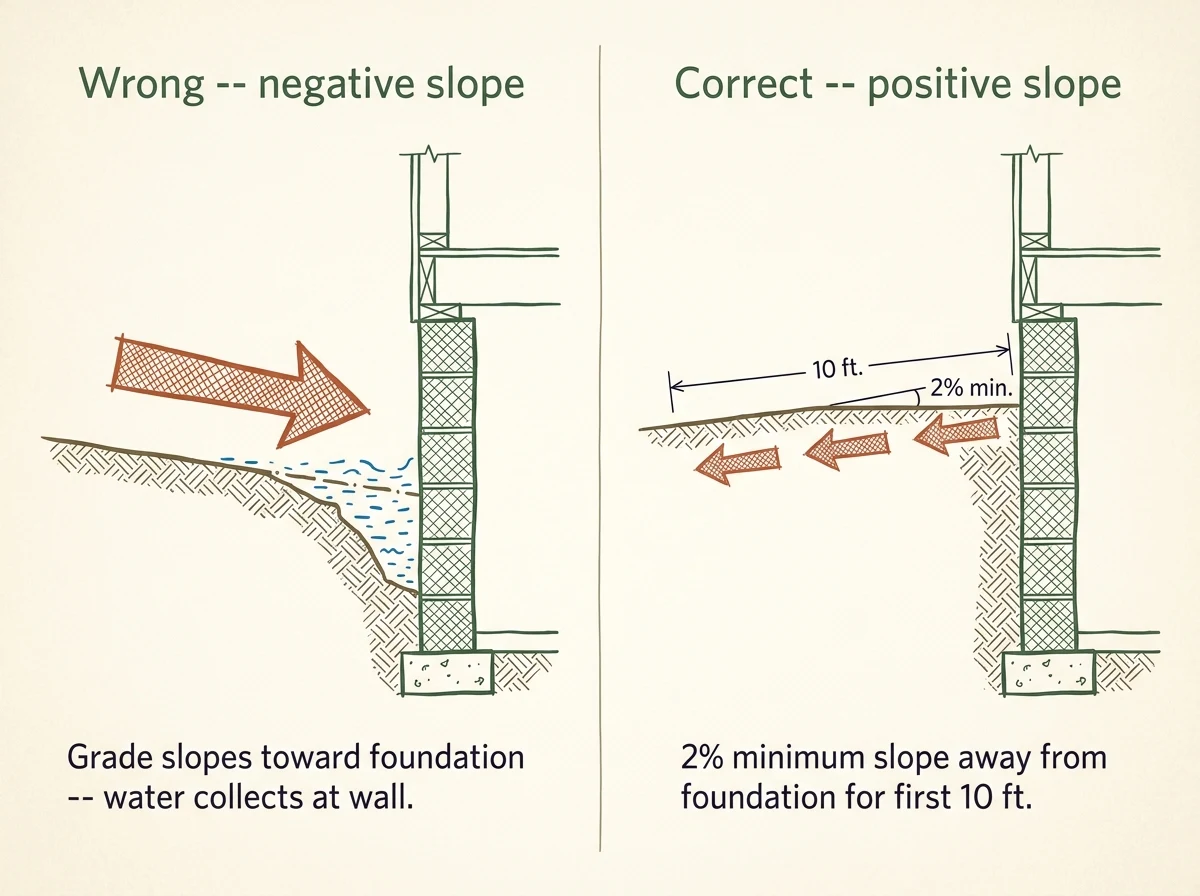
The lot is fine. The finish grading job is not.
This is the most common finding on Triangle new-builds. The builder’s grading crew established rough grade correctly, then finish grading compressed the schedule — and the final six inches slope toward the house instead of away from it.
Signs you’re in Category 1:
- Standing water within 6 feet of your foundation after a significant rain
- Negative slope — the ground grades toward the house rather than away (positive drainage requires at minimum a 2% slope away from the structure for the first 10 feet)
- Water clears in 2-5 days but returns identically after every rain of similar size
- Your neighbor’s yard drains better — same soil, same subdivision topography, different result
The fix is regrading: rough if severe, finish grade if the subgrade is sound. In North Carolina, residential lot regrading typically runs $2,000-$8,000+ depending on scope, access, and how much material has to move. Get an itemized quote that breaks out labor, equipment, and any fill material separately — not a round number.
Who to call: a grading contractor with verifiable NC work. Find a grading contractor in North Carolina and ask for references from similar subdivision lots.
Category 2: Drainage System Problem — Fixable, Engineering Required
The grade may be correct, but the water has nowhere to escape — the lot sits in a low area with no outlet.
Category 2 looks worse than Category 1 because the water sits longer, but it’s still fixable. The problem isn’t the slope. It’s that water concentrates on your lot from uphill neighbors and there’s no drainage path to carry it away.
Signs you’re in Category 2:
- Water sits 72+ hours in the same low area after every significant rain
- Uphill neighbor runoff concentrates on your lot — you’re collecting water from adjacent properties
- No visible drainage outlet — no daylight point where a French drain could discharge, no swale carrying water to a road or drainage easement
- HOA drainage easements on the plat — some subdivision plats restrict what homeowners can build to manage cross-lot drainage
The fix involves engineering: a French drain system that daylights somewhere (a road, a drainage easement, a downhill swale), or a swale that carries water out of the low point. These systems cost more than a Category 1 regrade because they move water, not just direct it.
Important: before any work, pull the subdivision plat and check for drainage easements. Some restrict fill or grading that could affect neighboring lots. A grading contractor who doesn’t ask about the plat isn’t thinking about Category 2.
Who to call: start with a grading contractor who does drainage system design, and budget for the possibility that a civil engineer will need to stamp the outlet design.
Category 3: Structural Lot Problem — Rare, But Real
A small percentage of residential lots should not have been approved for the building that sits on them.
This is the fear. It’s legitimate — but it’s the minority case.
Category 3 describes a lot with an underlying condition that grading and drainage systems can’t resolve without significant geotechnical intervention. The most common causes in North Carolina:
- Seasonal high water table at or near the surface — ground stays saturated for weeks without rain; a perc test fails even in dry season; soil has a gray, mottled appearance with a sulfur smell when disturbed (field indicators of hydric soils, per Web Soil Survey)
- FEMA flood zone siting — lot in a Zone AE or Zone X500 with base flood elevation issues; the structure’s finished floor elevation may be below what requires for the flood zone
- Pre-existing wetland or former stream channel — hydric soils, organic matter layers, or historical aerial imagery showing the lot was a drainage feature before the subdivision was platted
- NC Floodplain Mapping Program designation — check ncfloodmaps.com before concluding the lot has no regulatory issue
NC yard flooding: a Category 1 grade problem vs a Category 3 lot problem
Comparison. Category 1 -- fixable: Finish grade slopes toward the foundation; Builder rushed the final six inches of grading; Water clears in 2-5 days after each rain; Regrading corrects it -- $2,000-$8,000 typical. Category 3 -- structural: Lot sits in a topographic depression; Seasonal water table at or near the surface; Hydric soil layer, no viable drainage outlet; Needs a geotechnical engineer, not a contractor.
- Finish grade slopes toward the foundation
- Builder rushed the final six inches of grading
- Water clears in 2-5 days after each rain
- Regrading corrects it -- $2,000-$8,000 typical
- Lot sits in a topographic depression
- Seasonal water table at or near the surface
- Hydric soil layer, no viable drainage outlet
- Needs a geotechnical engineer, not a contractor
Most NC yard flooding is Category 1 and fixable -- a genuine structural lot problem is real but rare, and only a geotech can confirm it.
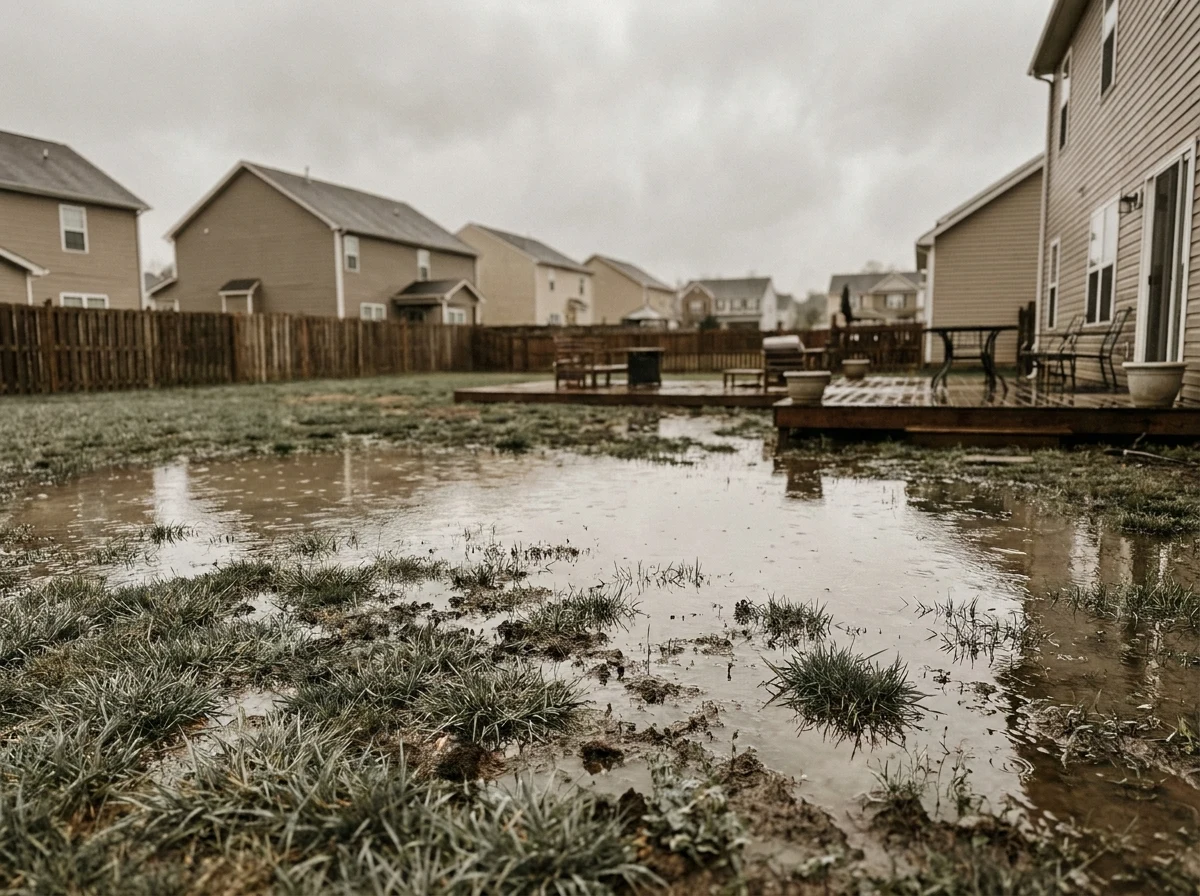
Category 3 is not automatically a total loss. It may require geotechnical engineering analysis, engineered fill with a designed drainage system, or — in the most severe cases — legal remedies if a builder or seller concealed known conditions.
But Category 3 requires a geotechnical engineer’s opinion before any contractor work. Don’t let a contractor diagnose Category 3 — that’s outside their lane. And don’t let a builder dismiss what may be Category 3 without a geotech report in hand.
Who to call: a licensed geotechnical engineer for a residential site assessment (typically $1,000-$3,500 for a residential report in the Carolinas — verify with local firms, as scope and site complexity drive significant variation). If you suspect the builder or seller knew and concealed the condition, consult a real estate attorney after you have the geotech report.
The Diagnostic Steps: How to Place Yourself
Walk your lot with a level after a 1-inch rain and ask three questions.
You don’t need a contractor for the first pass. These three questions place most lots into their correct category.
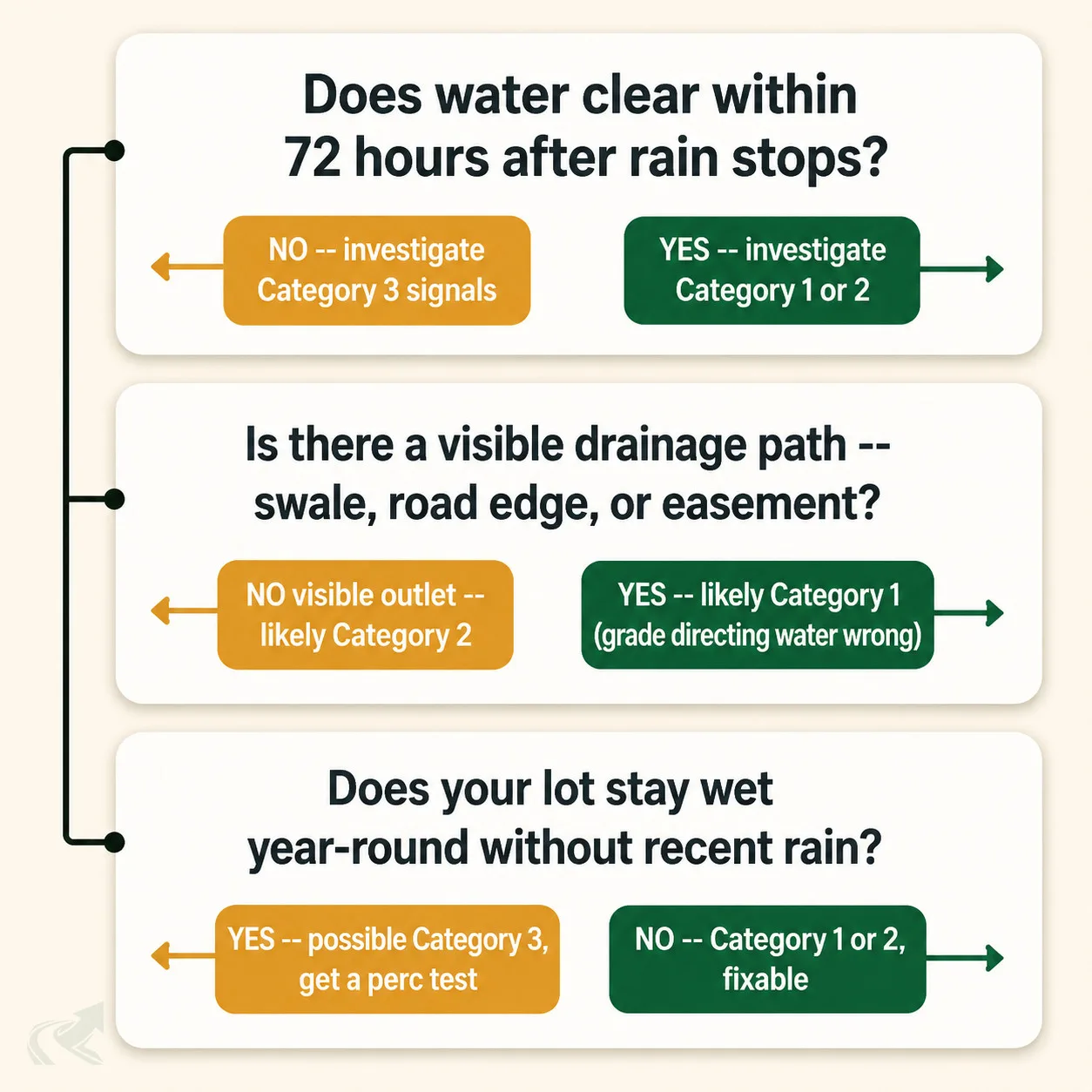
Step 1: Does water clear in 24-72 hours after rain stops?
- Yes, within 48-72 hours — investigate Category 1 or 2
- No, water remains a week or more after rain, or the yard is wet even without recent rain — investigate Category 3 signals
Step 2: Is there a visible drainage path for water to exit your lot?
- Yes, there’s a swale, road edge, or easement the water runs toward — Category 1 (the grade may be directing water incorrectly, but there’s an outlet)
- No visible outlet, water concentrates in a low spot with no exit — Category 2
Step 3: Does your lot stay wet year-round, not just after rain?
- Only wet after significant rain, clears eventually — Category 1 or 2
- Wet zones that persist year-round — possible Category 3; get a perc test or geotech site visit
For Step 2, you can verify slope direction without a contractor. Use the yard slope calculator — verify your lot’s drainage direction to check whether your finished grade actually slopes away from your foundation at the required minimum.
The 3-category diagnostic for why your yard holds water goes deeper on the physical causes. If you’re not sure after the 3-question screen, that page gives you more resolution.
The Contractor Disagreement Problem
Two quotes disagree because they’re diagnosing different categories — and one of them may be right.
When contractor A says “regrade” and contractor B says “French drain,” they may both be wrong about the fix while naming the same category (Category 1 or 2). That disagreement is solvable: get the scope itemized and compare line by line against what the NC yard drainage severity guide describes for each situation.
When one contractor says “fundamental lot problem” and the other says “regrading will fix it,” that is a different situation. They’re diagnosing different categories. At that point, you don’t need a third contractor quote — you need a geotechnical engineer’s site visit. The engineer isn’t going to sell you a French drain or a regrade. Their job is to tell you which category you’re actually in.
For guidance on reading a bid spread and knowing what “itemized” should look like, see how to evaluate yard drainage contractor quotes.
When to Stop Calling Contractors and Call an Engineer
If two qualified contractors give you opposite Category diagnoses, you need a geotechnical engineer, not a third contractor.
A geotechnical engineer does what contractors can’t: they drill test borings, assess the seasonal high water table, look for hydric soil indicators, and produce a written report with a professional seal. In North Carolina, residential geotech site assessments typically run $1,000-$3,500 depending on the scope, number of borings, soil complexity, and report detail — verify current pricing with licensed firms in your market.
What a geotech report tells you that contractor quotes cannot:
- Whether the seasonal high water table is a structural factor
- Whether the soils can drain adequately with engineered intervention
- Whether the lot’s baseline conditions match what the builder represented
If your situation involves a builder who dismissed a legitimate drainage failure, or who you believe graded the lot in a way that violated the site plan, the path is: geotech report first, then consult a real estate attorney about holding your NC builder accountable for lot drainage. The certification letter from the engineer is the foundation for any legal step — without it, you’re arguing on opinion against a builder’s attorney.
For Triangle-specific builder drainage patterns, see the Triangle NC production builder drainage pattern page.
Pre-Contractor Question Card
Use this before any contractor visit or quote.
A contractor who can answer that question — naming the category, citing the evidence — is diagnosing your lot correctly. A contractor who pivots straight to their solution without naming the category may be solving the wrong problem.