
Crystal booked a driveway grading for a Tuesday in March. Monday night it rained an inch. The contractor called and pushed to Thursday. Thursday morning it rained again. Now she’s three days behind and frustrated.
Here’s what the contractor should have told her. NC Piedmont clay at field capacity — the point where pore spaces are fully saturated — behaves like a smearable paste under a grading blade. The surface compacts to a false density, dries in a flat crust with no particle interlock, and fails the first time it gets wet again. The reschedule was legitimate.
This page explains the physics, the seasonal pattern, and how to tell a real rain delay from a contractor making excuses.
The Dual Nature of NC Piedmont Clay
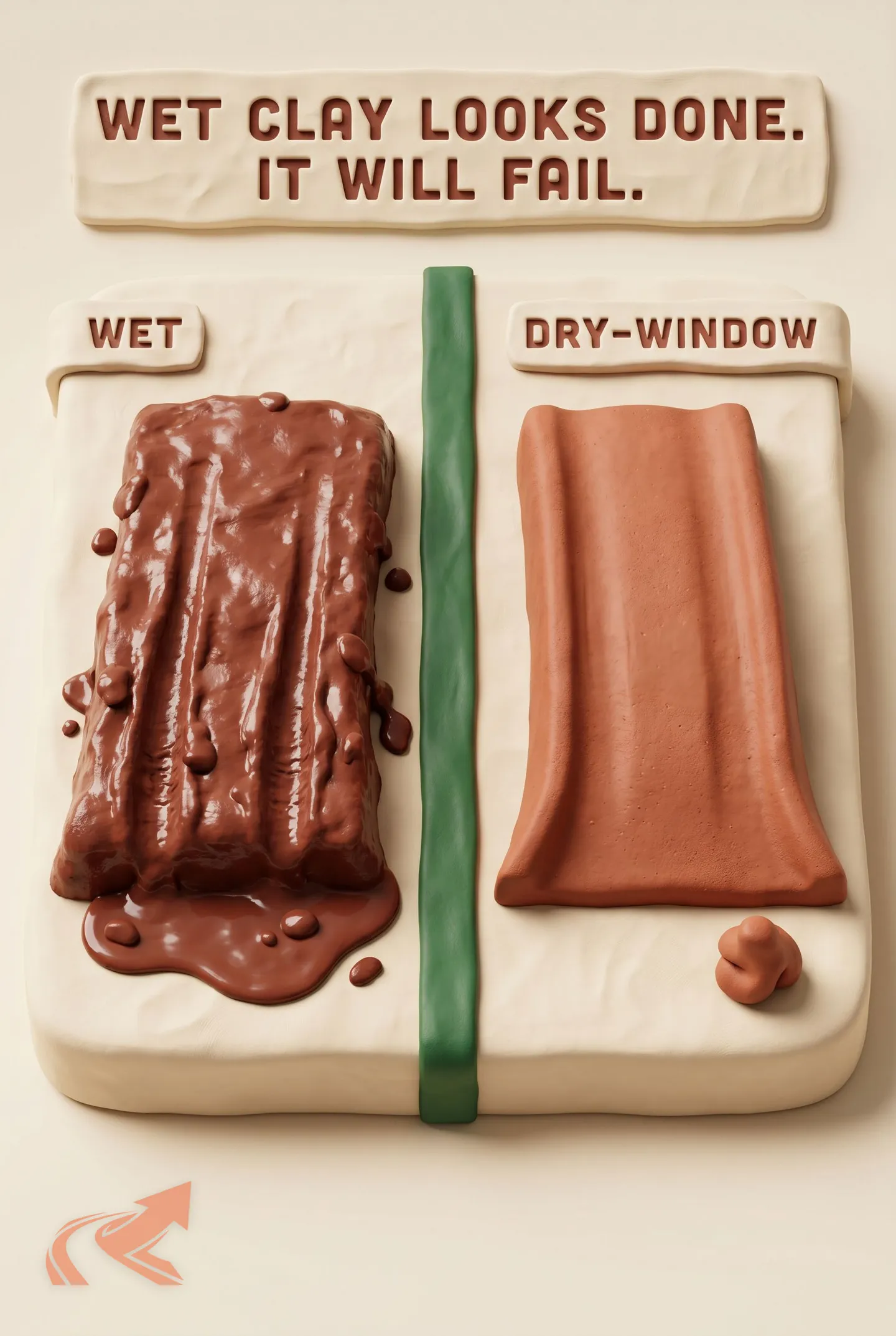
NC Piedmont red clay has two opposite failure modes: slippery paste when wet, and concrete-hard when dry. Both make driveway grading difficult. The window between them is where good work happens.
Understanding why starts with the clay particles themselves. Piedmont red clay is high in kaolinite and iron oxides — fine-grained particles that respond dramatically to moisture changes. That’s what gives NC clay its characteristic behavior — and why how red clay affects driveway grading matters long before the blade touches the ground.
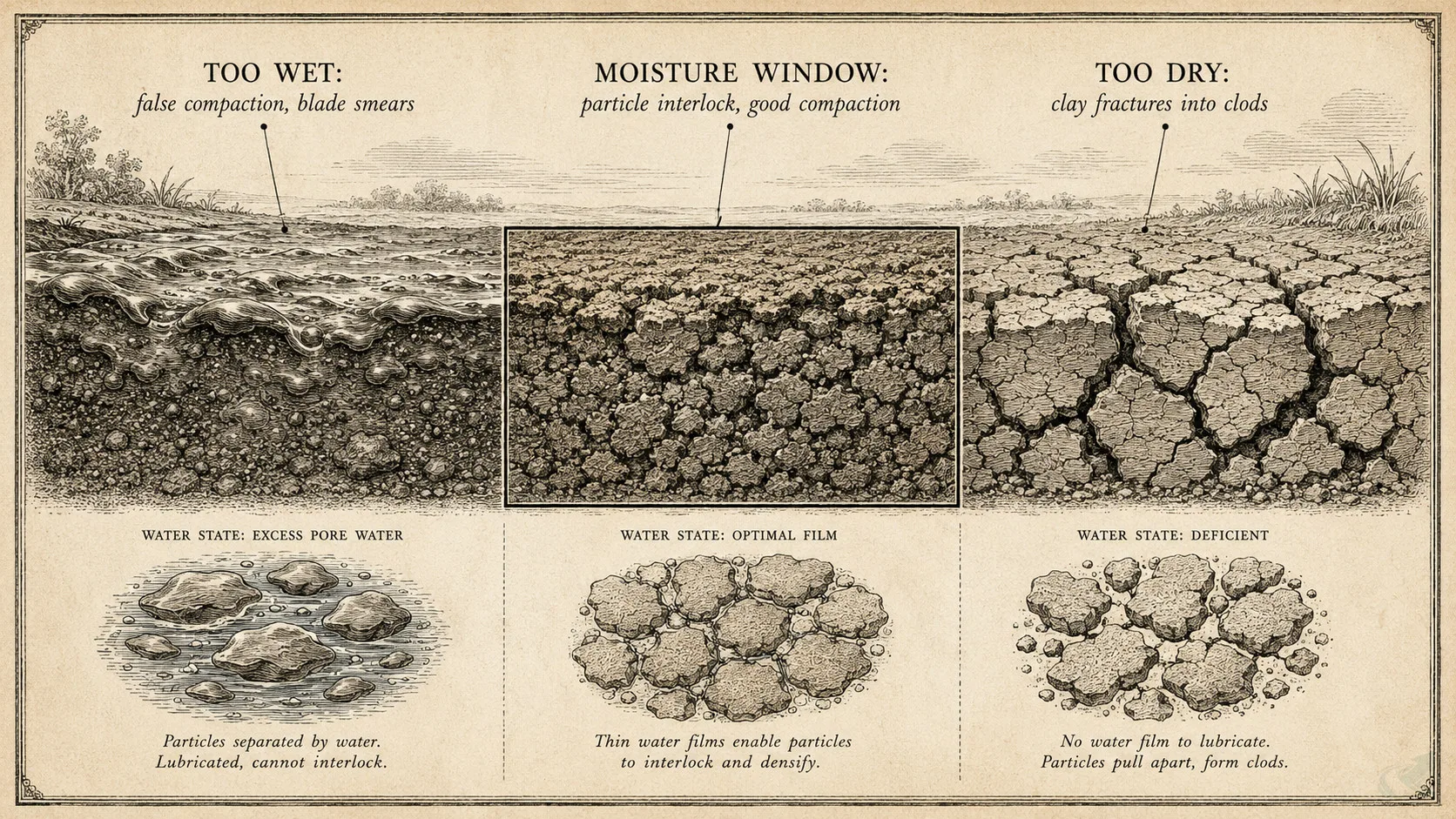
Too wet (above field capacity): clay particles are surrounded by free water. The grading blade pushes the slurry rather than shaping it. The compacted surface looks smooth but has no particle-to-particle contact — it’s a mud cake that holds shape until the next rain, when it re-saturates and flows. Any compaction achieved in this state is false compaction. It looks done. It isn’t.
Too dry (below hygroscopic moisture): the clay surface is cracked and hard — think late-August North Carolina after three weeks without rain. The blade either skims the surface without cutting or fractures it into clods that don’t consolidate. Compaction at this state produces a loose clod layer rather than a bound surface.
The window: slightly moist clay — often described as slightly damp play dough, or lightly moist but not staining your hand — compacts correctly. Particles have enough water to lubricate surfaces and allow alignment under compaction pressure, but not enough to create a continuous water film that prevents contact.
This is why NC grading contractors watch weather forecasts 48-72 hours out, not just day-of. A job that starts Monday in good conditions can be ruined by Sunday-night rain if nobody checked the forecast.
Optimal Seasons for NC Driveway Grading
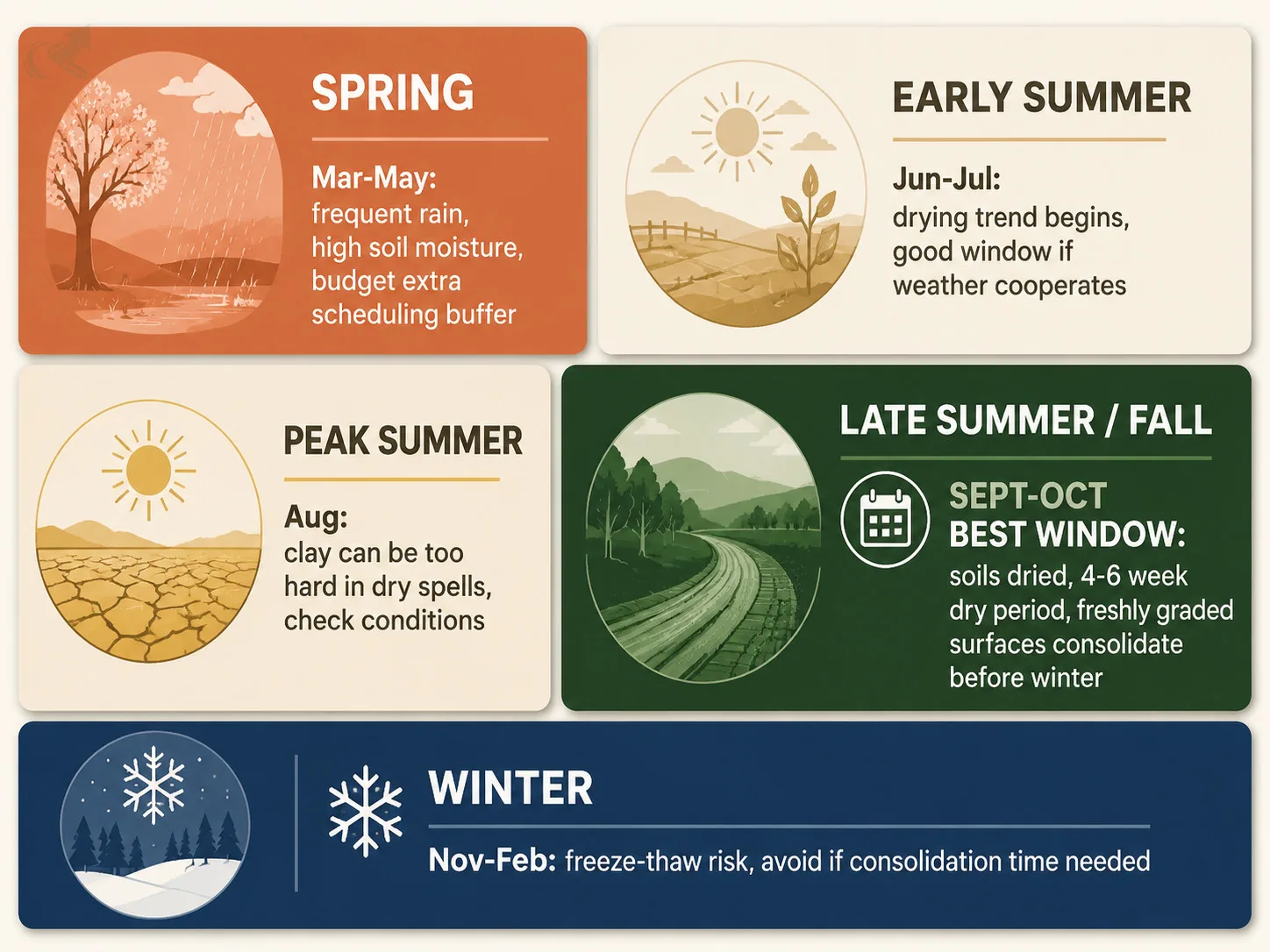
Late summer to early fall is generally the best season for NC driveway grading — soils are at lower moisture content, rainfall typically drops, and the autumn dry spell gives freshly graded surfaces time to consolidate before winter.
North Carolina’s seasonal breakdown matters for scheduling:
- Spring (March-May): frequent rain, high soil moisture. NC averages some of its highest monthly rainfall totals in spring. Jobs get pushed multiple times. Possible — many NC driveways are graded in spring — but not ideal. Budget extra scheduling buffer.
- Early summer (June-July): the drying trend begins. North Carolina typically sees a brief dry period before summer thunderstorm season ramps up. A good window if weather cooperates and you’re not in a wet-spring carry-over year.
- Peak summer (August): hot and often very dry in NC Piedmont. Clay can be too hard to work in prolonged dry spells. Extended dry-season heat accelerates gravel surface set — can be good for new gravel consolidation, but grading the clay subgrade first requires checking conditions.
- Late summer to early fall (September-October): generally the best window. Piedmont soils have dried from summer, tropical storm risk is present but typically manageable, and the fall dry period in North Carolina often runs 4-6 weeks of favorable conditions.
- Winter (November-February): freeze-thaw risk. Freshly graded clay can heave if it freezes before consolidating. Avoid scheduling grading that requires weeks of consolidation time heading into late fall or early winter.
The rain-check clause matters here: a legitimate contractor who understands how driveway grading works in NC includes a rain-check policy in their quote. It specifies when conditions are too wet to work and what the reschedule process is. Ask for this in writing before you sign.
How Wet Clay Ruins a Grading Job — The Physics
Wet clay compaction is the failure mode you can’t see on the day. The job looks done. The base is a mud cake that will fail at the first rain.
Here’s what happens when a contractor grades wet NC clay:
- The blade pushes water-saturated clay into smooth shapes. The surface looks perfect — flat, shaped, crowned.
- A roller pass produces visible density. But what’s actually happening: the roller squeezes water to the surface while clay particles slide past each other rather than locking. No real interparticle bond forms.
- The surface dries and crusts. It looks compacted.
- First rain event: the clay surface re-saturates. The false crust dissolves. The surface behaves as if it was never compacted — ruts appear, gravel migrates, crown flattens.
This is why a contractor who won’t work wet clay is not making excuses. They’re protecting the quality of the work. A contractor who grades wet clay for you “to get it done” is charging you for a job that will fail — because how red clay changes with moisture is not a matter of opinion; it’s soil physics. That’s a worse outcome than waiting three days for conditions to dry.
The tell-tale sign that false compaction has occurred: the driveway looks great for 2-3 weeks after completion, then the first significant rain produces rutting and surface migration that shouldn’t be possible in “freshly compacted” material.
Grading NC clay in the moisture window vs grading it wet
Comparison. Clay at the right moisture: Slightly damp -- like play dough, not mud; Blade cuts a clean shaped surface; Roller produces real particle interlock; Surface holds through the next rain. Clay graded too wet: Blade smears saturated clay into a paste; Roller squeezes water up -- no interlock forms; False compaction layer looks done but isn't; First rain re-saturates it and the surface fails.
- Slightly damp -- like play dough, not mud
- Blade cuts a clean shaped surface
- Roller produces real particle interlock
- Surface holds through the next rain
- Blade smears saturated clay into a paste
- Roller squeezes water up -- no interlock forms
- False compaction layer looks done but isn't
- First rain re-saturates it and the surface fails
NC Piedmont clay only compacts in a narrow moisture window -- grading it wet buys a driveway that fails at the first storm.
See driveway compaction and moisture timing NC for the full breakdown of how compaction verification works and what a proof-roll actually tests.
How to Tell a Legitimate Rain Reschedule from an Excuse
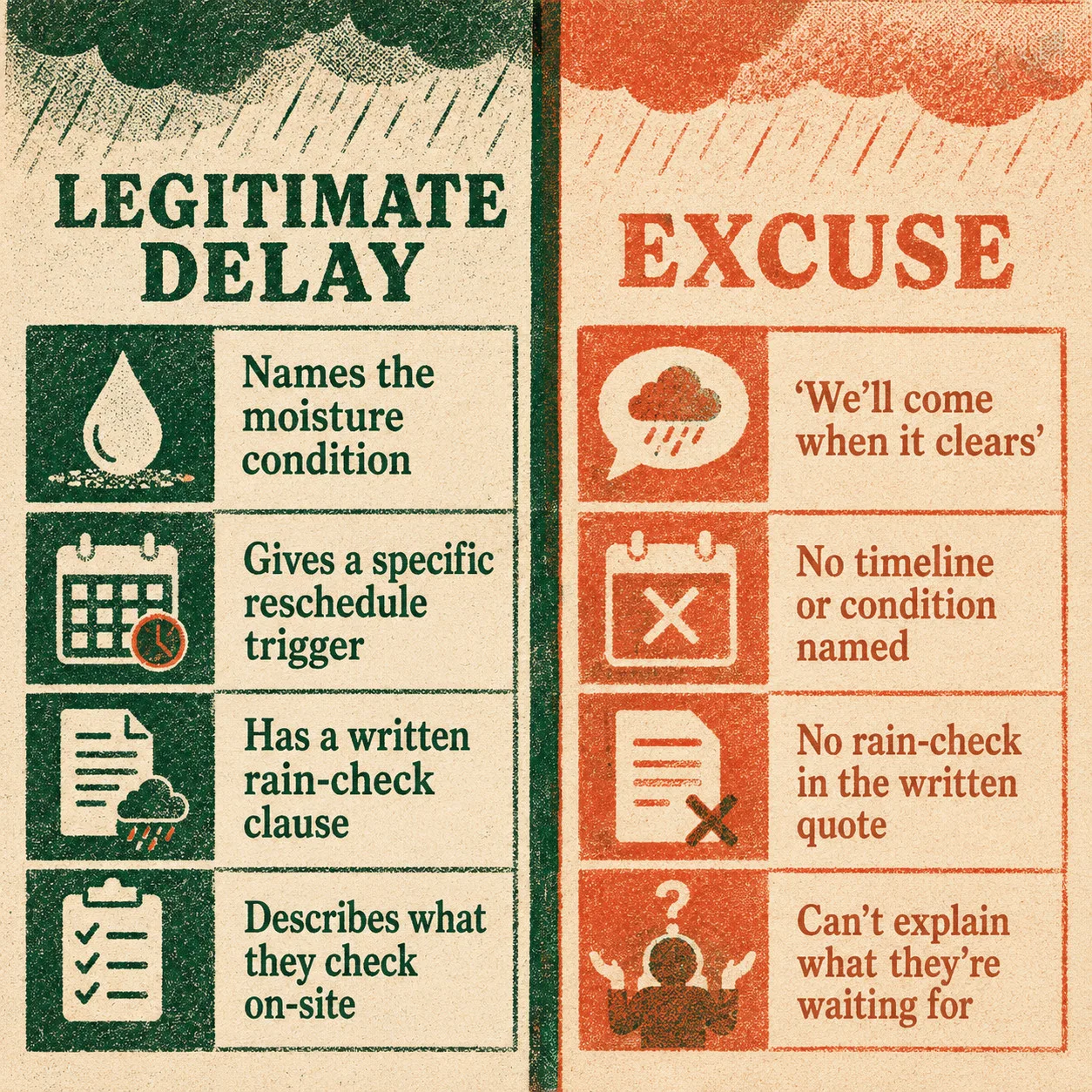
A legitimate rain delay has a specific reason and a specific condition that must be met before work resumes. A vague reschedule with no explanation is a different problem.
Legitimate delay signals:
- Contractor says: “Clay moisture is too high right now. We need 48 hours of dry weather at minimum after rain before we can produce proper compaction.”
- Contractor specifies the reschedule condition: “I’ll check the site Thursday morning and call you if conditions are good.”
- Contractor has a written rain-check policy in the original quote.
- Contractor can describe what they’re checking for when they assess the site.
Excuse or avoidance signals:
- “We’ll come when the weather clears” — no specific condition named, no timeline.
- Reschedule without a call — you find out when the crew doesn’t show.
- Multiple rescheduled jobs at the same time with the same vague answer — the contractor is booking more work than they can staff and rain is the cover.
- No rain-check clause in the written quote — they haven’t thought through the question or don’t want to be held to an answer.
The test: ask your contractor what moisture condition they’re waiting for. “Not raining” isn’t the answer. “Clay at or below field capacity and 48 hours since last significant rain” is the answer. If they can’t tell you the condition, they may not know the reason. That’s a contractor knowledge problem, not a weather problem.
The Rain-Check Clause in Your Quote
Ask for a rain-check policy in writing before you sign — it should specify what constitutes a weather-delay condition and what the reschedule process is.
What a rain-check clause should include:
- Definition of weather delay — e.g., significant rain within 48 hours of scheduled start, or soil moisture assessment at site determines conditions unworkable.
- Reschedule process — who initiates contact, what the expected timeline is, whether you can request a site moisture check before new date is confirmed.
- Payment terms — whether a delay extends payment terms or deposit holds.
A contractor who doesn’t include this in their quote is either planning to work wet clay or hasn’t thought through the scheduling question. Ask for it before signing. If they push back, that’s information.
For more on how NC grading contractors handle weather and scheduling: rain delay policy for NC grading work and best time to book NC driveway grading.
What to Ask Your Contractor About Rain Delays
Use this question card when you’re evaluating quotes or when a contractor calls to reschedule.
Before you sign:
- Does your quote include a rain-check policy?
- What moisture condition are you waiting for before you can grade?
- How will you communicate when conditions are right and when my job is back on schedule?
When a contractor calls to reschedule:
- What specifically makes conditions unsuitable today?
- What’s the condition you need to see before rescheduling?
- When will you check my site and call me with an update?
A contractor who answers these clearly is protecting your investment. One who can’t answer is not.
NC clay behavior — the slippery-wet, concrete-dry dual failure pattern — is well-documented in soil science, but most NC driveways fail because no one explained it to the homeowner before the job started. Get the policy in writing, in the quote, and get an itemized scope that includes what compaction verification looks like after the work is done.
Hire a verified NC grading contractor who can walk you through their rain-check process before you commit.
Learn more about how driveway grading works in NC and NC Piedmont red clay behavior.