
What NC requires for a stabilized construction entrance
What does an NC gravel construction entrance require?
NC spec: #57 or #4 washed stone, 6 inches deep minimum, at least 50 feet long and 12 feet wide at every truck entry and exit point, with geotextile fabric underlayment to prevent mixing with subgrade. Not a pile of gravel -- a pad. On NC clay sites, mud tracking starts immediately if the entrance is not built to spec.
Why does it matter what kind of gravel is used?
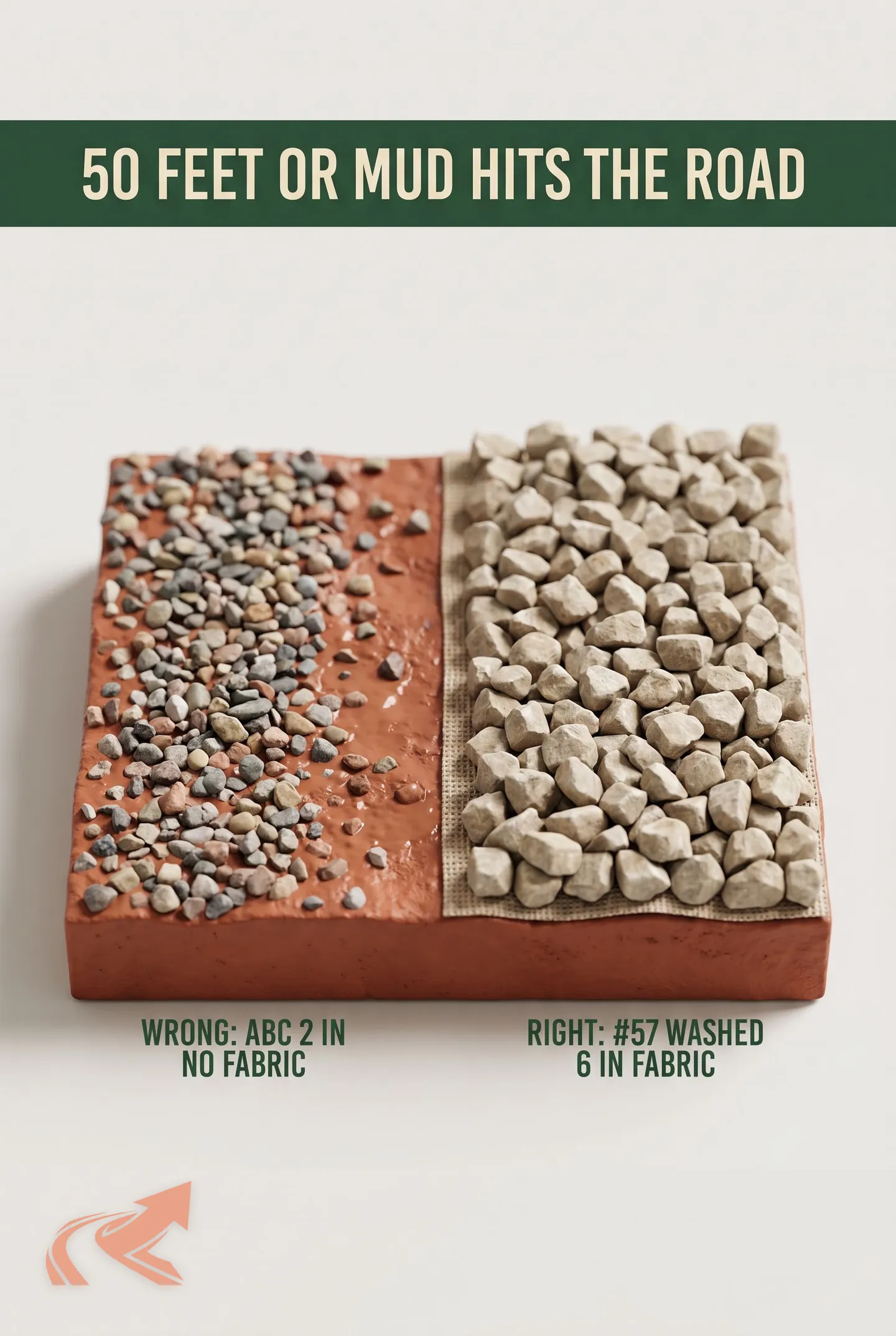
ABC stone compacts -- the fines fill the voids and the surface stops cleaning truck tires after the first few passes. #57 washed stone stays open because the fines are rinsed out, so each tire pass knocks clay off into the stone bed instead of onto the road. Wrong stone type is the most common entrance failure on NC residential sites.
A stabilized construction entrance is the first E&S control that goes in on a North Carolina building site — in place before land clearing in NC for construction begins, before the first truck rolls, before any other sediment barrier. Inspectors look for it on day one.
Most homeowners have seen what passes for a construction entrance: some gravel scattered near the driveway edge, maybe 8 feet deep, wrong stone type, no fabric underneath. That is not a stabilized entrance. That is gravel at an apron. The distinction matters because NC Piedmont clay tracks to the road in volume, and a muddy road is a Notice of Violation trigger.
This page explains what the NC spec actually requires, why NC clay sites specifically need the entrance built right, and what the common shortcuts look like so you can spot them.
What a Stabilized Construction Entrance Does
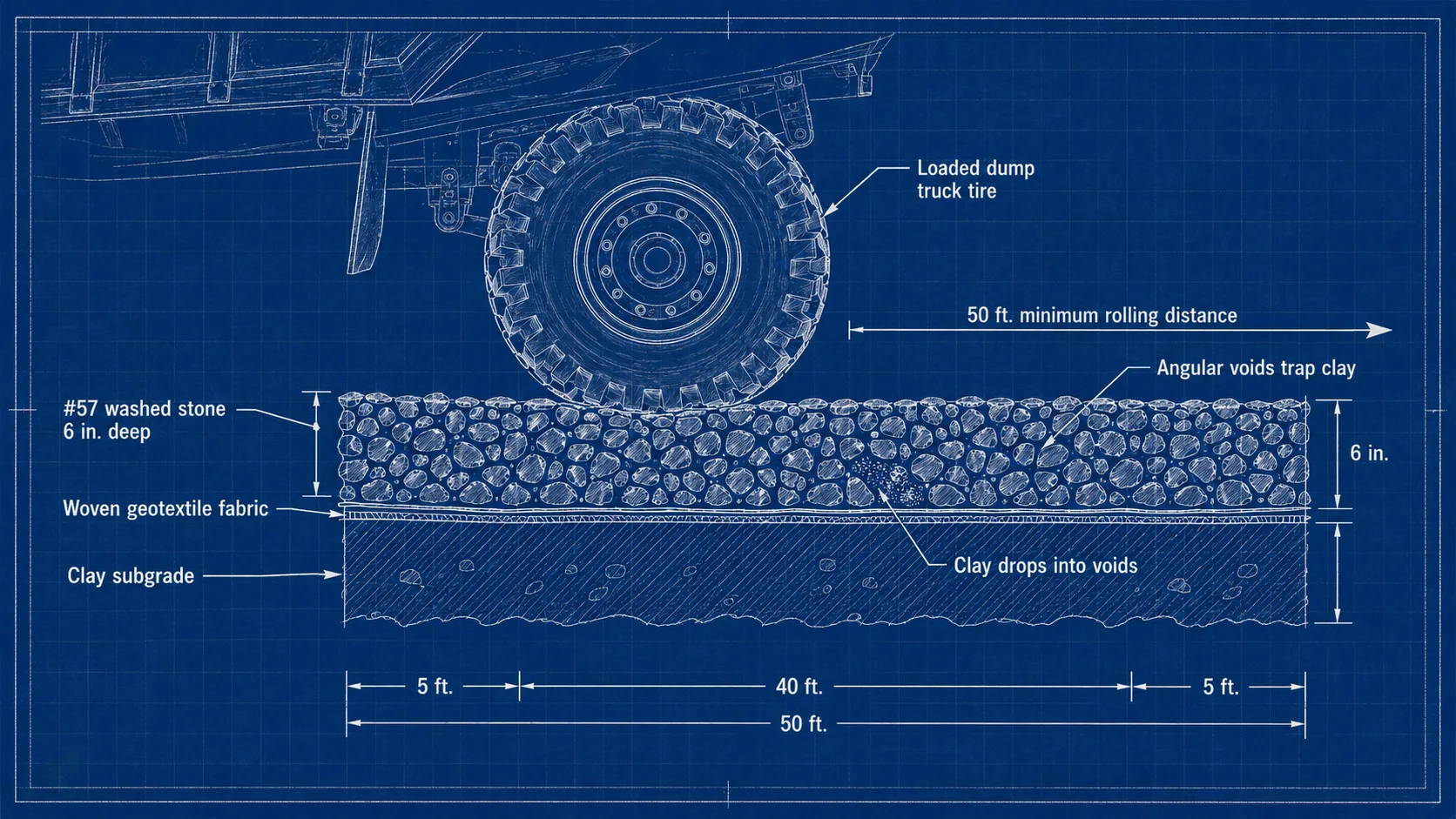
A construction entrance works by giving truck tires something angular to roll over — the motion knocks clay and mud loose before the truck reaches the road.
The mechanism is mechanical, not chemical. When a loaded dump truck rolls across a properly built stone pad, each tire compresses and releases against the angular faces of the stone. Clay separates from the tread and drops into the void spaces in the stone bed. After a few passes the stone bed fills with captured clay — which is expected. At that point the entrance needs replenishment, not replacement.
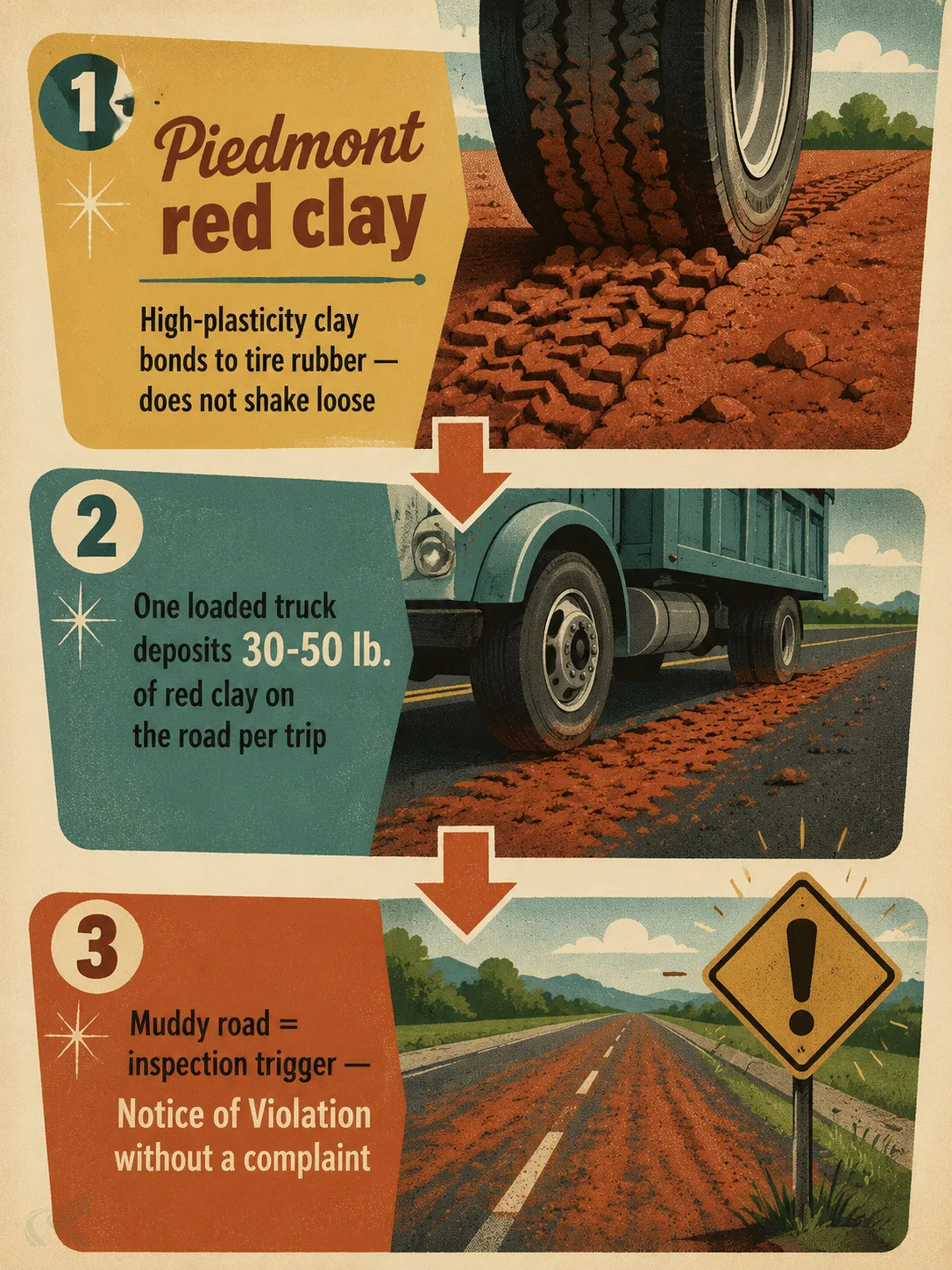
On NC Piedmont sites, a single truck can carry 30 to 50 pounds of red clay on its tires after crossing bare subgrade. Without an entrance, that clay deposits on the road surface. Rain turns it into a slick film. County inspectors cite muddy roads as a visual confirmation that sediment is leaving the site — which triggers a site visit and potentially a Stop Work Order.
The entrance serves a second function: it signals to inspectors that the operator knows what an E&S plan looks like. It is the most visible control on a residential site — more immediately apparent to a passing inspector than straw wattles and erosion blankets installed at the slope face.
The NC Spec
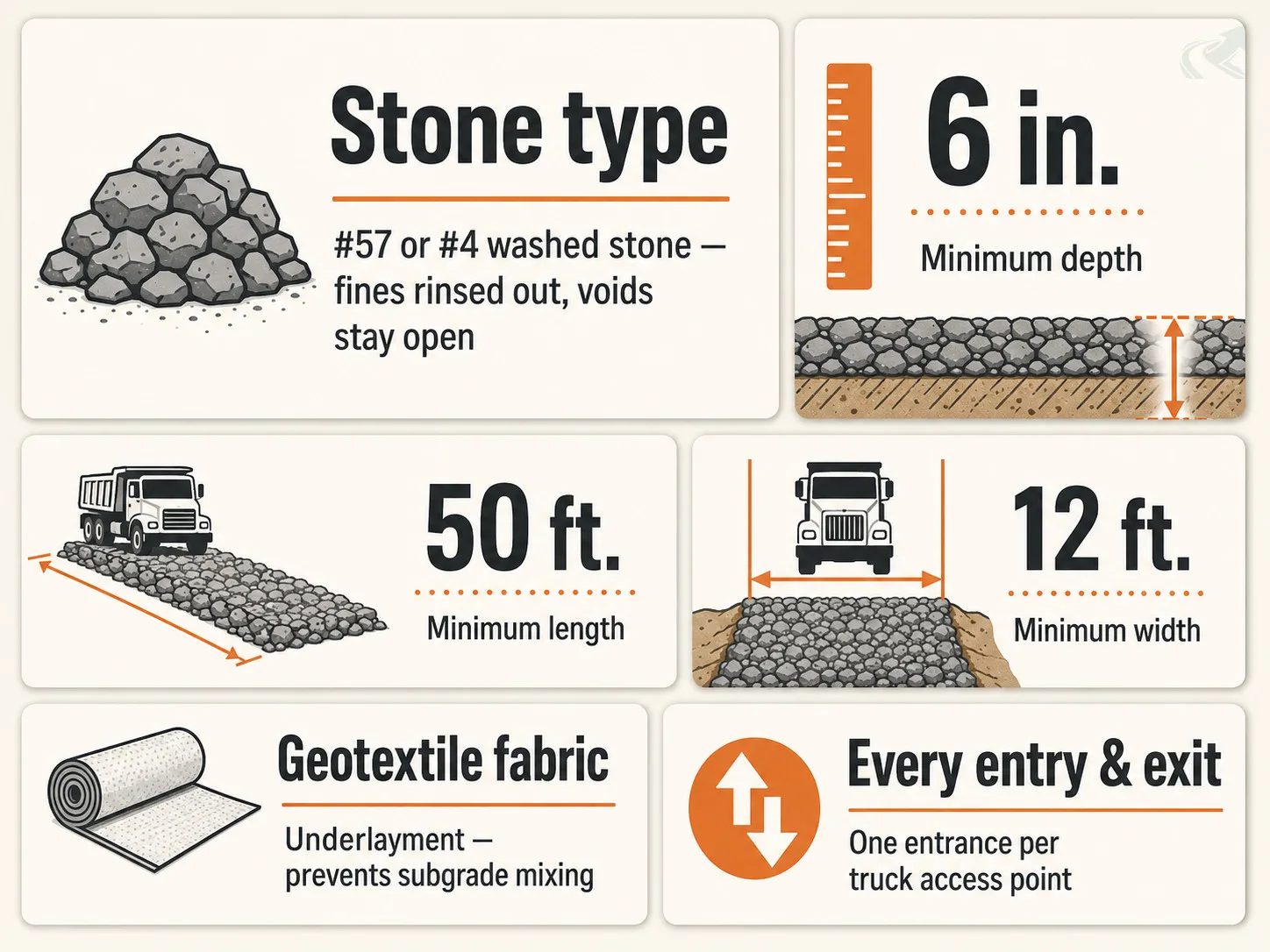
North Carolina’s specifies: #57 or #4 washed stone, 6 inches deep, at least 50 feet long, at least 12 feet wide, with geotextile fabric underlayment, installed at every truck entry and exit point.
The full spec breakdown:
- Stone type — #57 or #4 washed stone. Both are angular crushed stone with the fines washed out. #57 is 1 to 1.5 inches; #4 runs slightly larger. Either works. The key is “washed” — rinsed of fines so void space stays open and tires can be cleaned. Do not substitute ABC (Aggregate Base Course) — it contains fines that compact and fill voids, turning the pad into a hard surface that stops cleaning tires within days.
- Depth — 6 inches minimum. This is the spec floor. On heavy-haul sites or sites with soft subgrade, 8 inches is a reasonable field upgrade. Less than 6 inches and the stone presses through to subgrade under load, mixing with clay and losing void capacity quickly.
- Length — 50 feet minimum. This is the critical dimension most skimped-on entrances get wrong. A 10-foot or 15-foot pad does not give the tire enough contact distance to scrub clean. The 50-foot minimum ensures enough rolling distance for most commercial truck tire sizes.
- Width — 12 feet minimum. Wide enough for a single truck lane. Dual-lane entrances on active sites need proportional width.
- Geotextile underlayment. A woven geotextile fabric goes down before the stone. It prevents the stone from mixing with the clay subgrade under repeated loading cycles — which would otherwise cause the pad to degrade into a mud-clay-stone slurry from the bottom up. The fabric is a spec requirement, not an optional upgrade.
- Every entry and exit point. A site with two access points needs two compliant entrances. One entrance at the primary drive does not cover a secondary access the concrete trucks use.
The source is the NC ESCM, which is the state-level reference document for all permitted grading work in North Carolina. Your contractor’s E&S plan references it; your permit references it; county inspectors cite it on violation notices.
Why NC Clay Sites Specifically Need a Real Entrance
NC Piedmont red clay is hydrophilic — it bonds to tire rubber and stays there through normal road vibration. Sandy coastal soils shake loose; clay does not.
If you are in the Triad, Triangle, or Charlotte metro, your site sits on Piedmont red clay. The color is the signal — that deep brick-red subgrade is high-plasticity clay with a surface charge that attracts water and bonds to most materials it contacts. A truck tire crossing bare Piedmont clay picks up a clay pack in the tread that does not shed on the road the way sandy soil does.
Three weeks of truck traffic on a clay site without a proper entrance produces a recognizable road condition: a red-orange clay film on the asphalt that turns slick in light rain and stains permanently in dry weather. Neighbors notice. County inspectors notice.
The muddy-road visual is an explicit inspection trigger in NC. An inspector driving past your site does not need a complaint to stop — the road condition is sufficient cause. A site visit at that stage typically results in a Notice of Violation and a required corrective-action timeline. The cost of retroactively building a compliant entrance and clearing a NOV is significantly higher than building it right before the first truck rolls.
Sandy Coastal Plain sites have more latitude. Clay sites do not. If your project is in the Piedmont, the entrance is not optional and the spec is not a suggestion.
What “Scattered Gravel at the Apron” Gets Wrong
A short stone apron fails on three dimensions simultaneously: wrong stone type, insufficient depth, and insufficient length — any one of which defeats the cleaning mechanism.
A spec NC construction entrance vs scattered gravel at the apron
Comparison. Built to NC ESCM spec: 50 ft long, 12 ft wide, 6 inches deep minimum; #57 or #4 washed stone -- open voids stay clear; Geotextile fabric underlayment below the stone; Truck tires scrub clean before reaching the road. Scattered gravel at the apron: Under 10 ft long -- less than one tire rotation; ABC instead of washed stone -- fines compact shut; 2-3 inches deep, presses into the clay subgrade; Mud reaches the road -- a Notice of Violation trigger.
- 50 ft long, 12 ft wide, 6 inches deep minimum
- #57 or #4 washed stone -- open voids stay clear
- Geotextile fabric underlayment below the stone
- Truck tires scrub clean before reaching the road
- Under 10 ft long -- less than one tire rotation
- ABC instead of washed stone -- fines compact shut
- 2-3 inches deep, presses into the clay subgrade
- Mud reaches the road -- a Notice of Violation trigger
On an NC Piedmont clay site, an entrance that is too short, too shallow, or built with the wrong stone tracks mud to the road -- which inspectors cite on sight.
The three failure modes in detail:
- Wrong stone type — ABC instead of #57. ABC is the right material for driveway base and pad construction. It is the wrong material for a construction entrance. ABC contains fines that compact under repeated loading. After 5 to 10 truck passes the ABC surface is essentially paved — no void space left, no cleaning happening. The truck carries clay to the road on every exit.
- Insufficient depth — 2 to 3 inches instead of 6. A thin stone layer compresses completely under a loaded dump truck. The stone presses into the subgrade, clay migrates up through the voids, and the pad surface becomes a clay-coated stone mix that cleans nothing. This failure mode is visible quickly — the stone “disappears” into the mud after a few passes.
- Insufficient length — less than 50 feet. If the stone pad is only 8 to 15 feet long, the truck tire makes contact with the stone for less than one full rotation. One rotation is not enough to dislodge a full clay pack from the tread. The tire exits the stone still loaded with clay. The road gets it.
The failure pattern on most under-built NC residential entrances is all three at once: ABC at 2-inch depth, 10 feet long. It looks like a construction entrance. It does not function as one.
Maintenance Through the Build
A properly built entrance needs replenishment when the stone surface shows clay contamination — typically every 2 to 4 weeks on an active site, sooner in wet weather.
The stone pad is not permanent — it is a consumable. Each truck pass deposits a small amount of clay into the void spaces. When the voids fill, the cleaning efficiency drops. The visible sign is a clay-coated surface that no longer looks like loose stone.
Replenishment means adding a fresh layer of #57 washed stone on top of the degraded pad. On most NC residential sites, one or two yards of #57 per replenishment event is enough to restore function. Some contractors pull the contaminated stone and replace entirely; others top-dress. Either works if the depth is restored to spec.
At the end of the project, the entrance comes out. The stone is typically buried under the finished driveway base — a step that connects to how NC driveway grading works if the contractor is also doing finish-grade work on the drive — or removed to a spoil area if the site has no paved surface. Either way, the stone is too clay-contaminated to reuse as clean drainage stone.
NC Spec Checklist — Copy and Send to Your Contractor
Before the first truck rolls, confirm your site’s construction entrance meets every item:
- Stone type: #57 or #4 washed stone (not ABC, not crusher run, not unspecified gravel)
- Depth: 6 inches minimum (measure with a stake after install)
- Length: 50 feet minimum from the road edge
- Width: 12 feet minimum (full truck lane)
- Geotextile fabric underlayment installed below the stone
- Entrance installed at every truck entry and exit point (not just the primary drive)
- Replenishment plan — who orders more stone and when
If your E&S plan is required by permit, the entrance location and spec should appear on the plan drawing. Ask your contractor to show you where the construction entrance is marked.
Find a NC Grading Contractor Who Does This Right
Grading contractors who understand construction entrance as part of NC erosion control treat the entrance as the first indicator of how they run a site — not an afterthought. A contractor who skips or shortcuts the entrance is showing you how they approach E&S compliance generally.
Silt fence and construction entrance together in NC are often installed on the same day as site mobilization — they are the opening moves of a compliant site setup.
For #57 stone delivery for NC construction entrances, the stone should be spec’d by name (#57 washed stone, not “gravel”) in the delivery order. Get the delivery ticket — it names the material and quantity.
If you need an itemized quote from a verified NC grading contractor, the NC erosion law that governs construction entrance requirements gives you the statutory basis when a contractor pushes back on the spec. And to hire a grading operator in North Carolina who works in your county, use the NC Grade and Haul directory.