The question contractors keep using three different words to answer
What is the difference between a curtain drain, footing drain, and French drain?
Curtain drain: installed uphill to intercept groundwater before it reaches your house. Footing drain: runs at foundation footing depth to collect water at the wall. French drain: collects surface and shallow subsurface water anywhere on the property. Three different problems, three different installs -- and a contractor who uses these terms interchangeably usually doesn't know which one you need.
How do I know which drain type my NC yard actually needs?
Walk the property after a heavy rain. Water coming in from one uphill direction = curtain drain. Water seeping uniformly through the foundation wall = footing drain. Standing water or soggy low spots in the yard = French drain. Each one goes in a different location, at a different depth, for a different reason.
You asked three contractors what they recommend. You got three different answers — and three different names for what might be the same system or might be completely different ones. That’s not a coincidence. These terms get used interchangeably in the field even though they describe distinct systems solving distinct problems.
Before you can evaluate any quote, you need to know which drain type you’re being sold and whether it matches your actual water problem. This page gives you a decision matrix to answer that.

The Three-Way Definition Table
Each drain type targets a different water problem. Matching the drain to the problem is the only way to know if a quote makes sense.
If a contractor quotes a “French drain” for a foundation seepage problem that actually needs a footing drain, they may not be wrong — but they may be installing the wrong system at the wrong depth for a lower price that doesn’t solve your problem.
Curtain drain vs footing drain vs French drain -- NC Piedmont comparison
| Drain type | Where installed | What water it stops | NC Piedmont application | Typical cost range |
|---|---|---|---|---|
| Curtain drain | Uphill from the house, across the slope | Lateral groundwater flowing downhill toward the foundation | Clay-heavy Piedmont slopes where uphill saturation drives water toward the foundation | $2,500--$8,000+ depending on trench length and slope |
| Footing drain | At foundation footing depth, around the perimeter | Hydrostatic pressure against the foundation wall | Older NC homes with no original perimeter drainage; basement or crawl space wall seepage | $5,000--$15,000+ depending on excavation depth and perimeter length |
| French drain | Anywhere surface or shallow subsurface water collects | Standing water, soggy low spots, surface runoff pooling | Low spots in NC yards, driveway edges, downhill areas receiving roof discharge | $1,500--$6,000 depending on length and discharge options |
Curtain drain
- Where installed
- Uphill from the house, across the slope
- What water it stops
- Lateral groundwater flowing downhill toward the foundation
- NC Piedmont application
- Clay-heavy Piedmont slopes where uphill saturation drives water toward the foundation
- Typical cost range
- $2,500--$8,000+ depending on trench length and slope
Footing drain
- Where installed
- At foundation footing depth, around the perimeter
- What water it stops
- Hydrostatic pressure against the foundation wall
- NC Piedmont application
- Older NC homes with no original perimeter drainage; basement or crawl space wall seepage
- Typical cost range
- $5,000--$15,000+ depending on excavation depth and perimeter length
French drain
- Where installed
- Anywhere surface or shallow subsurface water collects
- What water it stops
- Standing water, soggy low spots, surface runoff pooling
- NC Piedmont application
- Low spots in NC yards, driveway edges, downhill areas receiving roof discharge
- Typical cost range
- $1,500--$6,000 depending on length and discharge options
Cost ranges above are field estimates for North Carolina residential work as of 2025—2026. Get an itemized quote that specifies which drain type is being installed and why.
Curtain Drain — Intercepting Uphill Water
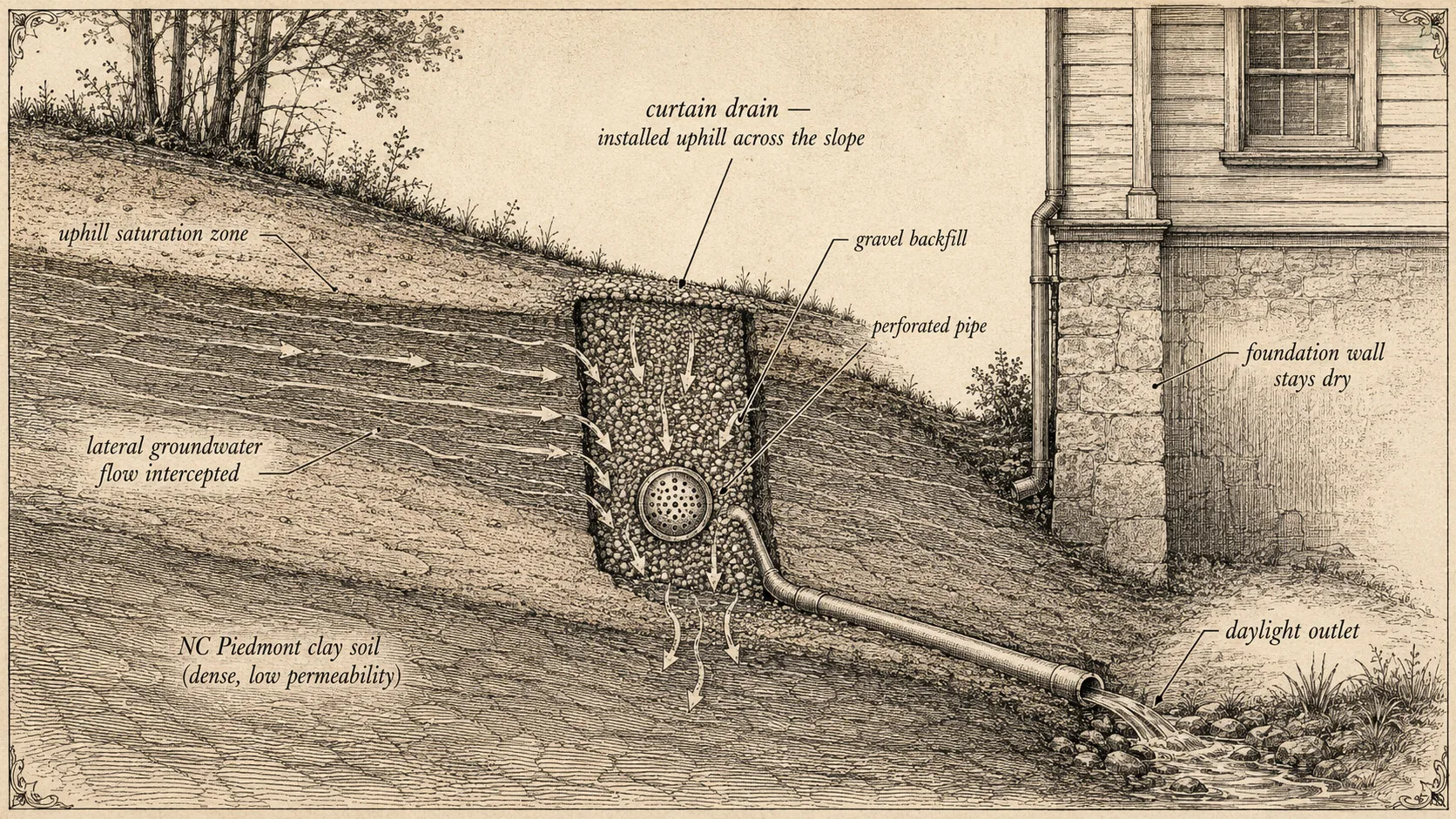
A curtain drain goes uphill from the house, across the slope, to intercept lateral groundwater flowing toward the foundation before it gets there.
It is not a foundation drain. It does not go next to the foundation. It goes across the hill above the problem, cutting off the water’s path before it has a chance to build hydrostatic pressure against your walls.
In NC Piedmont clay, uphill saturation is the dominant failure mode. Clay doesn’t drain — it holds water and transmits it laterally, a pattern explained in the surface drainage vs subsurface drainage NC breakdown. A curtain drain intercepts that flow and redirects it to a daylight point away from the house.
Diagnostic cue: water comes in from one direction. The problem worsens in wet periods when the uphill area saturates but settles quickly when the rain stops. The yard on the high side stays wet longer than the low side.
A curtain drain that daylights properly — meaning the outlet pipe has a free-draining terminus below the system — can pull a significant volume of lateral flow away from the house. An outlet that can’t daylight turns the drain into a collection basin.
Footing Drain — Foundation-Level Perimeter
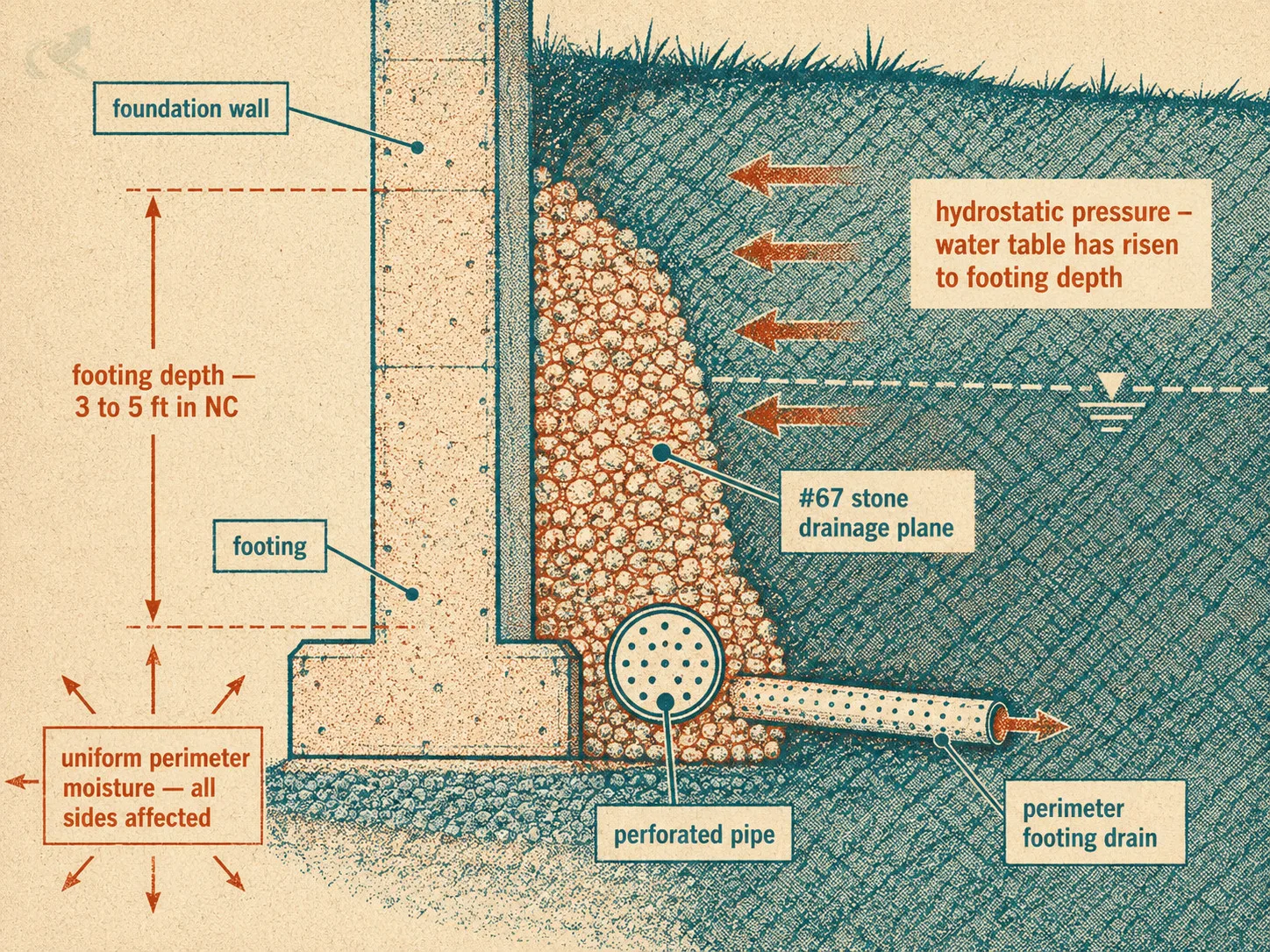
A footing drain runs at the depth of the foundation footing, around the perimeter, collecting water that has already reached the foundation wall.
This is a different problem from lateral uphill flow. Footing drain installation requires excavating down to footing depth — typically 3 to 5 feet in North Carolina — and backfilling with properly graded #67 stone to create the drainage plane.
The install is more invasive than a curtain drain or surface French drain because you are working at the base of the foundation wall, not across the yard.
Diagnostic cue: water migrates uniformly through the foundation wall — not directionally from one side. Multiple walls show moisture. Hydrostatic pressure is building against the entire perimeter. Curtain drains uphill do not solve this because the water table itself has risen to footing depth.
Footing drains are the correct fix for crawl space moisture driven by perimeter groundwater pressure in NC’s high-clay soils. They are not a first resort — they’re what you use when the water source is at the wall itself, not approaching from uphill.
French Drain — Surface to Subsurface Anywhere
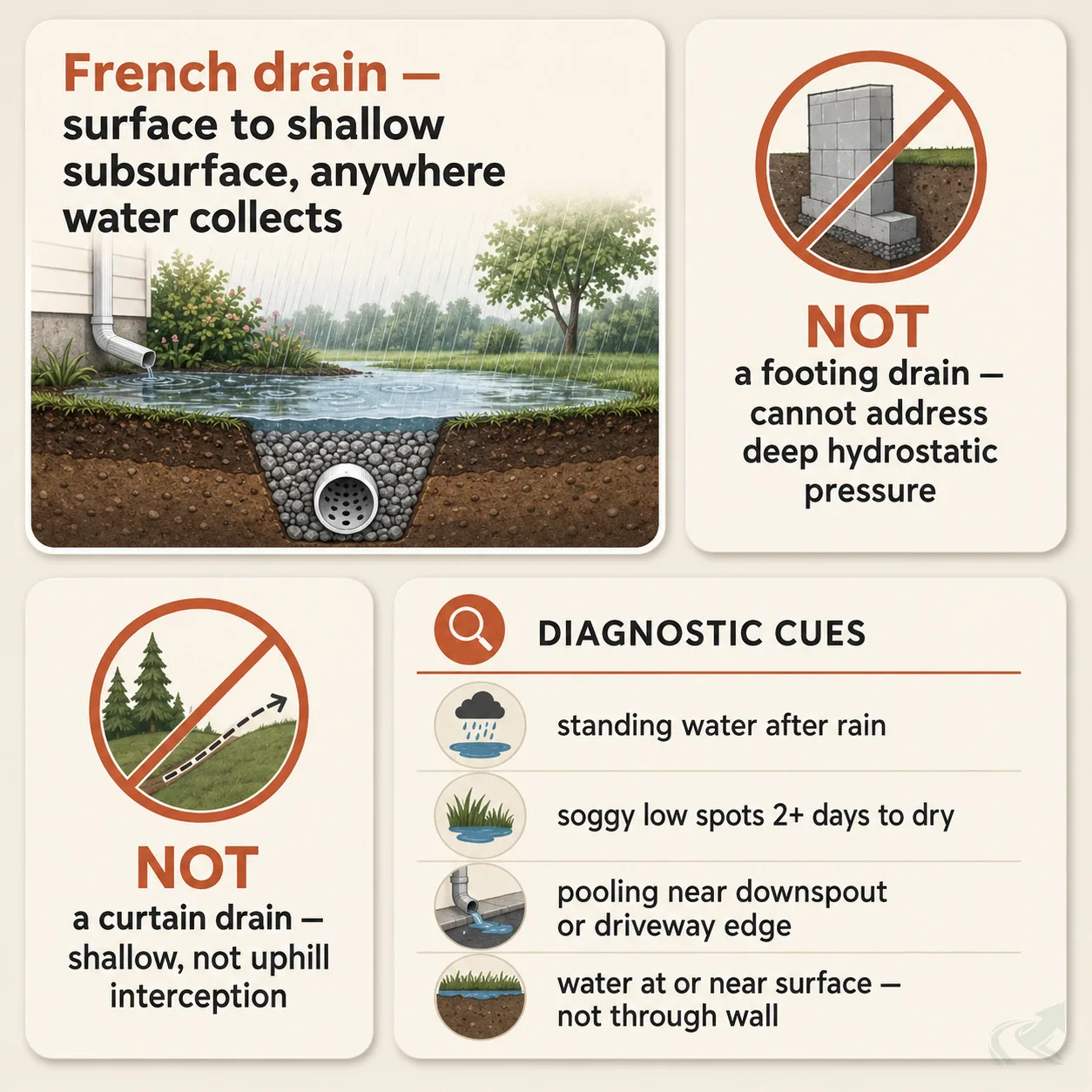
A French drain collects surface and shallow groundwater anywhere on the property — not just at the foundation. It is the most versatile of the three.
The term “French drain” is also the most overloaded. Contractors use it as a catch-all for any perforated-pipe-in-gravel system. That’s why a French drain quote can sound like the answer to problems that actually need a curtain drain or footing drain.
A French drain is the right tool when water is pooling on the surface or in shallow subsurface layers and needs to be conveyed to a daylight point. It is not designed to intercept deep lateral groundwater coming off a hillside (that’s a curtain drain) or to address hydrostatic pressure at the footing (that’s a footing drain).
Diagnostic cue: standing water in your NC yard after rain. Soggy low spots that take days to dry out. Runoff pooling near a downspout or along a driveway grading edge. The water is at or near the surface, not coming through the foundation wall.
For more on French drain specifics in North Carolina clay — including how the wrong gravel spec causes premature failure — see NC French drain installation guide.
The NC Piedmont Diagnostic — Which One Do You Have?
Walk the property after a heavy rain. Note where water appears first, which direction it flows, and how long it takes to clear. That determines the system.
This is the actual diagnostic workflow. No specialized equipment required.
Step 1 — Locate the water source:
- Water coming toward the house from one direction (upslope): curtain drain territory
- Water seeping through the foundation wall on multiple sides: footing drain territory
- Water sitting in the yard, low spots, or along edges: French drain territory
Step 2 — Check the timing:
- Appears fast during rain, clears fast after: surface issue, French drain
- Appears during and after rain, slow to clear, worsens in wet season: lateral groundwater, curtain drain
- Appears independent of single rain events, tied to seasonal water table rise: hydrostatic pressure, footing drain
Step 3 — Check the direction:
- Directional (comes from uphill side): curtain drain
- Uniform across the perimeter: footing drain
- Localized to a specific low area: French drain
Uphill groundwater problem: drain type matched vs mismatched
Comparison. Curtain drain -- matched: Installed uphill, across the slope, above the problem; Intercepts lateral groundwater before it reaches the wall; Foundation wall stays dry through wet periods; Daylights the intercepted flow to a low point away from the house. French drain -- mismatched: Installed in the yard, at the symptom, not the source; Deep uphill groundwater flows underneath it to the foundation; The wall keeps seeping -- the water source was never cut off; Drain installed correctly, just aimed at the wrong problem.
- Installed uphill, across the slope, above the problem
- Intercepts lateral groundwater before it reaches the wall
- Foundation wall stays dry through wet periods
- Daylights the intercepted flow to a low point away from the house
- Installed in the yard, at the symptom, not the source
- Deep uphill groundwater flows underneath it to the foundation
- The wall keeps seeping -- the water source was never cut off
- Drain installed correctly, just aimed at the wrong problem
A French drain in a yard that needs a curtain drain treats the symptom -- uphill lateral water simply bypasses it and reaches the foundation anyway.
Multiple problems can coexist. A sloped NC lot can have both uphill lateral flow (curtain drain) and a yard low spot (French drain) — two systems, two different installs, two line items on a properly scoped quote. If a contractor quotes one system for both problems, ask them to explain why.
For the full comparison of French drain at foundation interior vs exterior, including when a footing drain is the correct call and a French drain is not, see that page. The NC foundation drainage hub covers the full range of foundation-level options including interior vs exterior foundation drainage.
What to Ask Before Signing
Ask any contractor to name which drain type they are quoting, explain why it matches your specific water problem, and walk you through where it will go on the property.
If they say “French drain” without specifying depth, gravel spec, or discharge point, you do not have enough information to evaluate the quote. Same if they say “drainage system” as a catch-all.
Three questions that separate a contractor who has diagnosed your problem from one who is guessing:
- “Which of the three drain types are you quoting — curtain drain, footing drain, or French drain?”
- “Where on the property does it go, and how does that location match the water source you identified?”
- “Where does the water daylight — and is that discharge point getting it far enough from the house?”
Get an itemized quote that names the drain type and explains the rationale for that choice given your specific water problem. That’s the minimum bar for a quote you can evaluate.
To hire a verified NC grading contractor who can diagnose and install the correct system — not just the most common one — use the directory. Listings include license numbers, verification tier, and the services each contractor has confirmed.
For drainage problems involving standing water and swales, see swale vs French drain — which solves your problem.