
Before you sign anything
Do I need a French drain at my foundation?
Depends on the water source. French drains fix surface runoff and shallow lateral groundwater. They don't fix hydrostatic pressure from a high water table. A perimeter drain intercepts water before it reaches the wall. A curtain drain intercepts water flowing toward the house from uphill. The water source is the variable that determines which answer is correct.
What does exterior foundation drainage cost in NC?
Full perimeter excavation to footing depth runs $8,000-$20,000 for most NC homes. Interior systems cost less but treat the symptom, not the source. A contractor who skips the diagnosis and quotes the same solution for every job is not a contractor you want making that call.
Water showed up at your foundation wall. Contractor #1 says perimeter French drain. Contractor #2 says interior curtain drain. Contractor #3 says the water table is the problem — drainage won’t fix it.
All three might be right. All three might be wrong. The variable that determines the correct answer is not which contractor you like better. It’s where the water is coming from.
This page maps the three most common foundation water scenarios in North Carolina, names the right tool for each, and tells you exactly when a French drain is not the answer — so you don’t spend $6,000 on a system that doesn’t fix the problem.
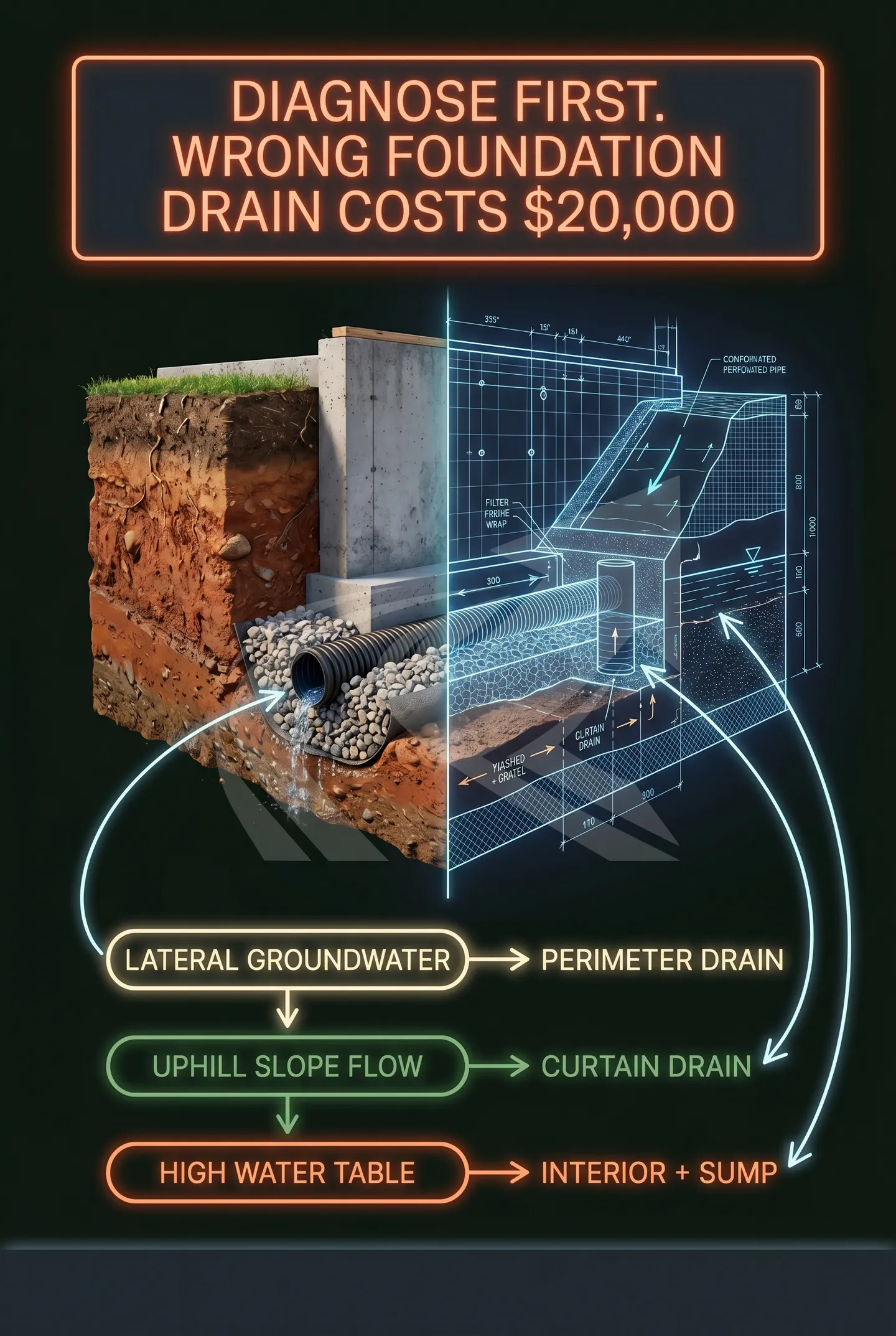
What a Foundation French Drain Actually Does
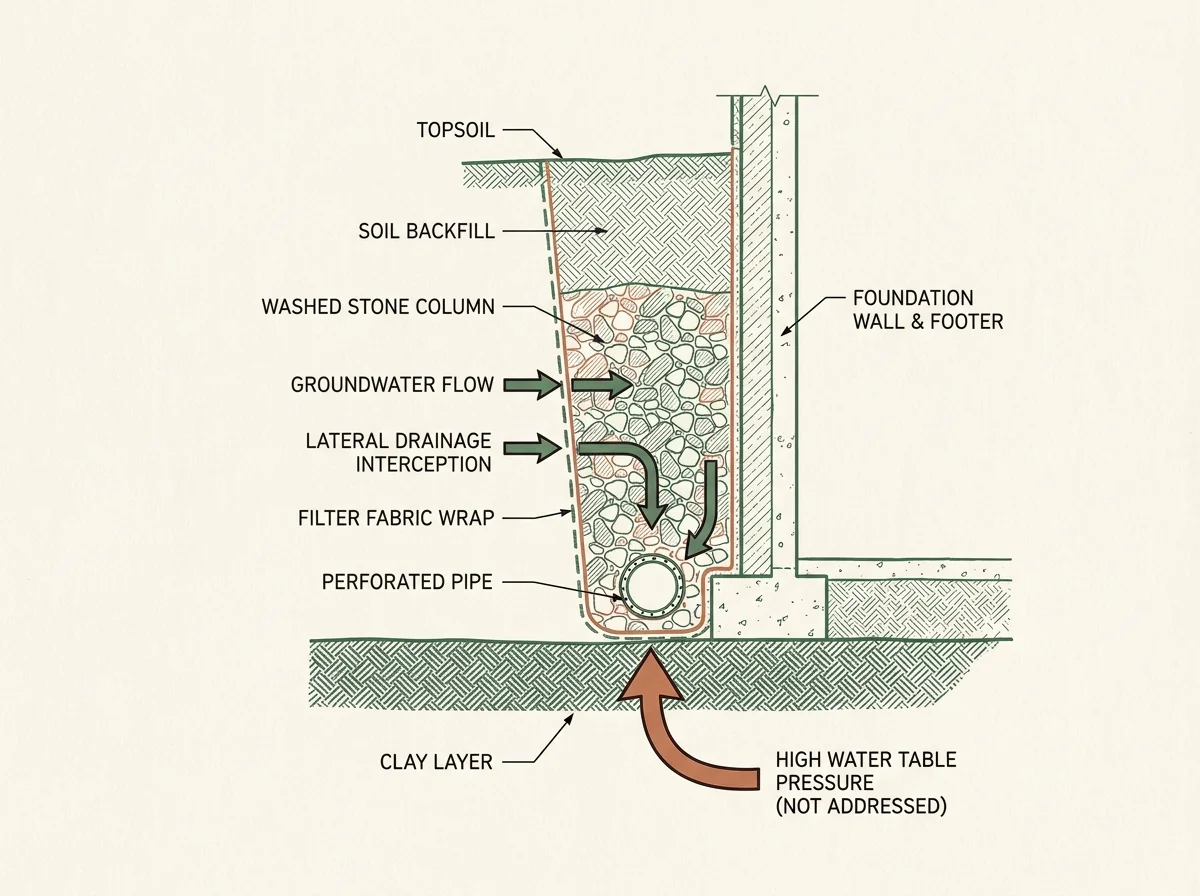
An exterior foundation French drain intercepts surface runoff and shallow lateral groundwater before it reaches the wall — it does not depressurize a high water table.
The pipe sits at or near footing depth — the French drain burial depth by application varies by purpose and soil conditions — along the exterior of the foundation. Perforated on top, wrapped in filter fabric, bedded in #67 washed stone. Water flowing through the soil toward your wall hits the stone trench first, drops into the pipe, and routes away from the house.
That is the job. It intercepts water in transit. It cannot lower a water table that is rising from below. If the pressure behind your wall is coming from a saturated aquifer, no exterior perimeter French drain eliminates that pressure.
This distinction — water moving laterally through soil versus water rising from below — is the diagnostic question every foundation drainage contractor should answer before quoting. If they skip it, that’s a signal.
Perimeter Drain vs Curtain Drain — Which Problem Is Which
A perimeter drain wraps the foundation to collect water that has already reached the footing. A curtain drain intercepts water flowing toward the house from a slope or neighboring property uphill.
These solve different problems. Confusing them is common. Here’s the diagnostic cue:
- Perimeter drain: water is migrating through the foundation wall or footing uniformly. The source is diffuse — saturated soil pressing against the wall from multiple directions. The fix is to wrap the footing and collect before it enters.
- Curtain drain: water is consistently coming from one direction — a slope above the house, a neighboring lot that drains toward yours, a natural drainage path crossing your property. The fix is to intercept the flow before it reaches the house, not at the wall itself.
A curtain drain installed 10-20 feet uphill from the foundation can eliminate the problem before the water ever becomes a foundation issue. For many NC Piedmont lots with grade running toward the house, a curtain drain is cheaper and more effective than a perimeter system — the same directional-flow problem that drives standing water in yard NC solutions when no drainage system exists.
Foundation water in NC: diagnosis-first vs the wrong fix
Comparison. Right tool, right problem: Water source identified before any quote; Directional uphill flow -- a curtain drain intercepts it; Curtain drain set 10-20 ft uphill of the house; Water redirected before it ever reaches the wall. Perimeter drain misapplied: No diagnosis -- the standard install gets quoted; Real problem is hydrostatic pressure from a high water table; A footing-depth trench can't lower a water table; Water still enters; $6,000 spent, problem unsolved.
- Water source identified before any quote
- Directional uphill flow -- a curtain drain intercepts it
- Curtain drain set 10-20 ft uphill of the house
- Water redirected before it ever reaches the wall
- No diagnosis -- the standard install gets quoted
- Real problem is hydrostatic pressure from a high water table
- A footing-depth trench can't lower a water table
- Water still enters; $6,000 spent, problem unsolved
In the NC Piedmont, the water source -- not the contractor's default -- decides whether a French drain is even the right fix.
When a French Drain Is Not the Right Foundation Fix
If your water problem is hydrostatic pressure from a high seasonal water table, no exterior French drain will fix it — you need interior drainage and a sump pump.
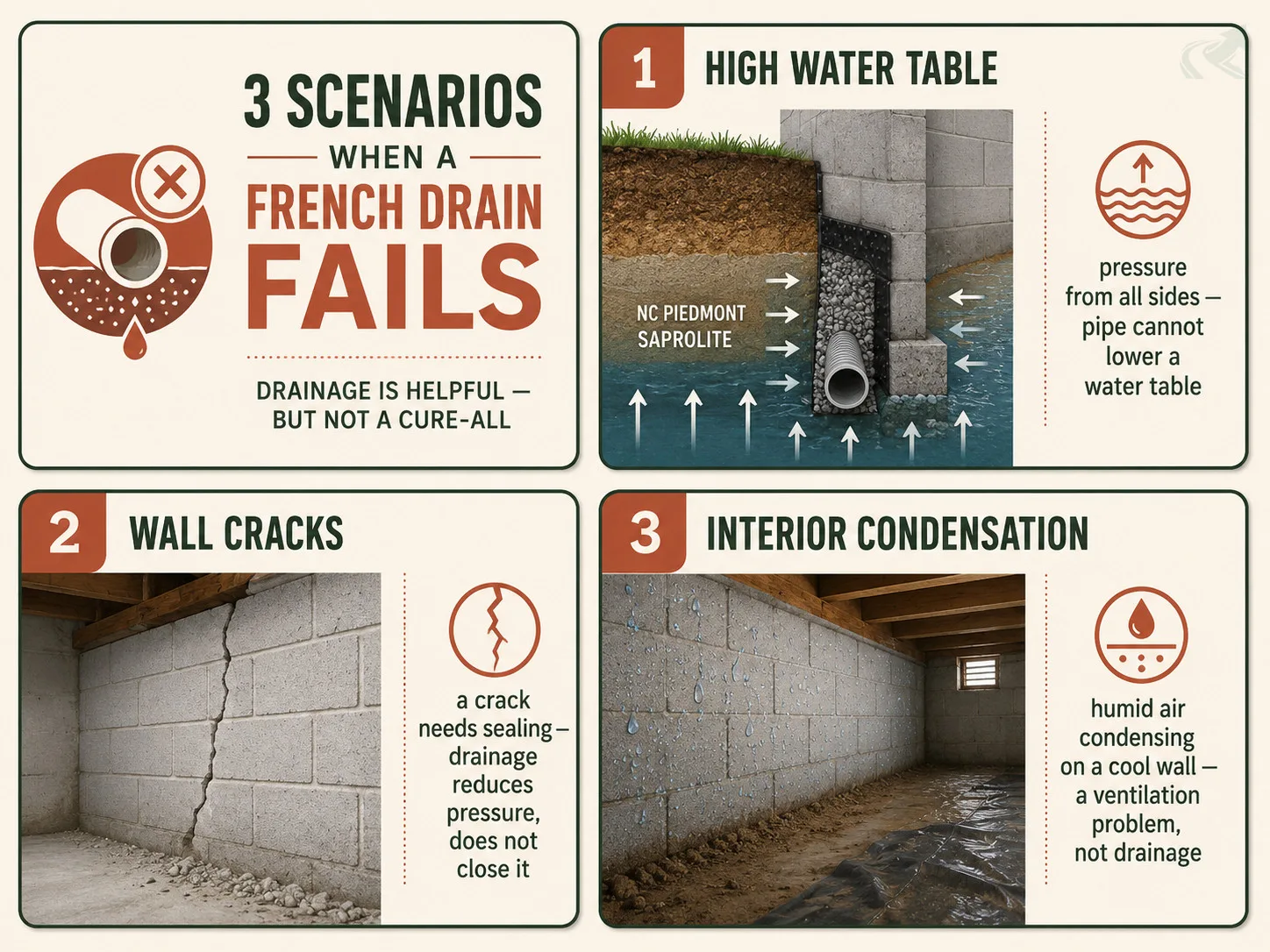
Three situations where an exterior French drain fails as a foundation fix:
1. High water table in the NC Piedmont. Seasonal water tables in the Piedmont — sitting in the saprolite layer above crystalline bedrock — can rise significantly during wet winters and spring, sometimes within a few feet of the surface depending on local geology and soil depth. When the water table itself is elevated, the pressure against your foundation wall comes from below and from all sides simultaneously. A perimeter trench at footing depth may actually intercept some lateral flow, but it cannot lower a water table. The water will find another path.
2. Wall cracks or deteriorating foundation. A French drain manages water in the soil. It does not seal a crack in a block or poured wall. If water is entering through a structural crack, the crack needs to be addressed first. Drainage reduces the volume of water pressing against that crack — but it doesn’t close it.
3. Interior condensation from humidity. Crawl space and basement moisture that originates from interior humidity is not a drainage problem at all. Installing a French drain won’t stop warm humid air from condensing on a cool foundation wall. This is a vapor barrier and ventilation problem.
An honest contractor should identify which of these three scenarios applies before recommending any solution — hire a yard drainage contractor NC who leads with the diagnostic, not the install. If they lead with the solution, ask them first: is this a drainage problem or a hydrostatic pressure problem?
Interior vs Exterior — The NC Retrofit Reality
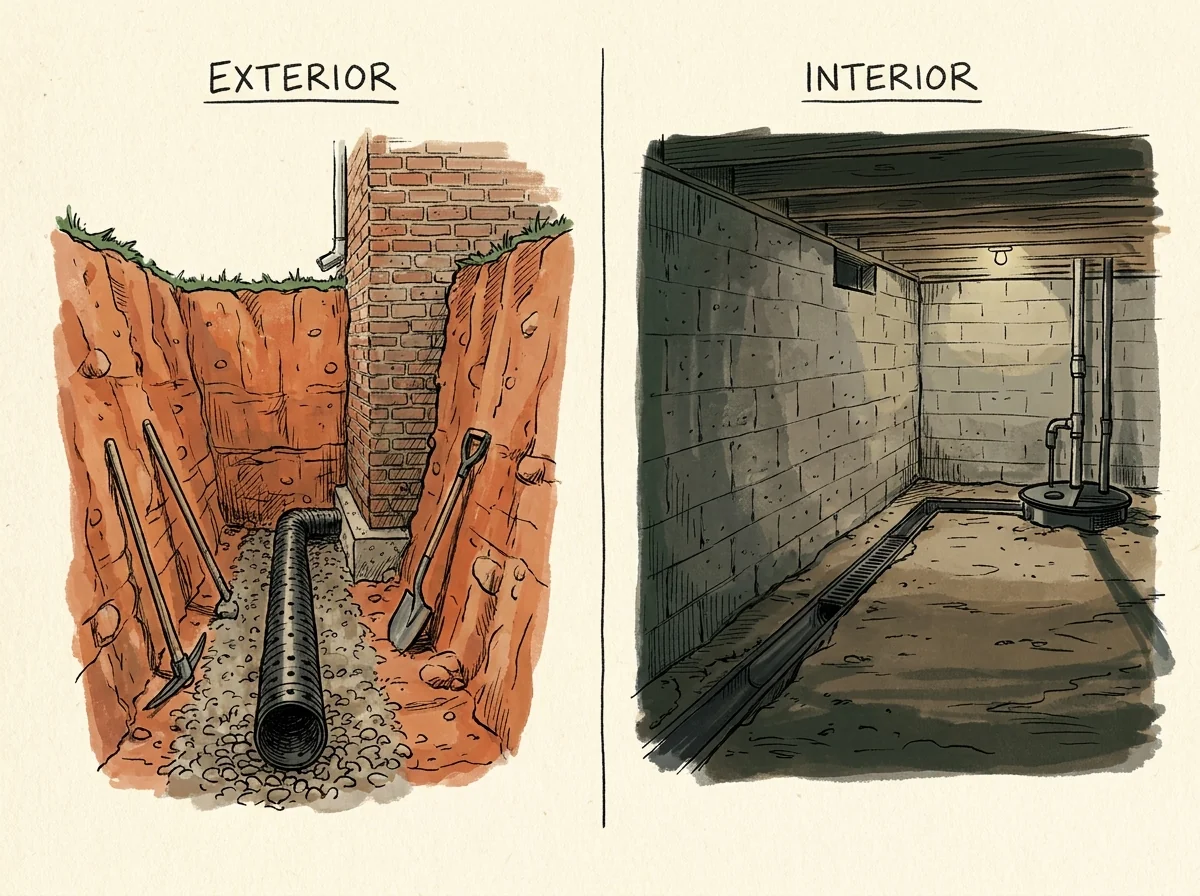
Exterior foundation drainage is the right-first answer but requires excavation to footing depth — often $8,000-$20,000 for a full North Carolina perimeter. Interior systems are less invasive but address symptoms, not source.
Exterior systems intercept water before it enters the foundation. That’s the engineering-correct approach. But getting to footing depth means excavating the full perimeter of the house, backfilling with washed stone, and restoring landscaping. For a typical NC home on a crawl space, that’s significant work.
Interior systems — a drain tile running around the inside perimeter of a crawl space or basement, routing to a sump pump — don’t stop water from entering the wall. They collect it after it enters and pump it away. The water still wets the wall, still creates humidity, still exerts pressure. Interior systems manage the problem. They don’t eliminate the source.
For a high water table situation where exterior excavation is cost-prohibitive, an interior system with a properly sized sump pump is the realistic path. That’s a legitimate choice. But it should be a choice made with clear eyes about what the system does and doesn’t do.
See the full interior vs exterior foundation drain comparison for the side-by-side cost and effectiveness breakdown. For North Carolina homes where a sump pump is the terminus, see sump pump for NC foundation drainage.
The Three-System Comparison
Perimeter drain vs curtain drain vs interior system -- at a glance
| Factor | Perimeter Drain | Curtain Drain | Interior System |
|---|---|---|---|
| Where installed | Exterior, at footing depth, wrapping the foundation | Exterior, 10-30 ft uphill from the house | Inside the crawl space or basement perimeter |
| What it fixes | Lateral groundwater reaching the footing from all sides | Directional groundwater flowing toward the house from uphill | Manages water after it enters; pairs with sump pump for high water table |
| NC cost range | $8,000-$20,000 full perimeter (excavation + stone + pipe) | $2,500-$8,000 depending on trench length and slope | $3,000-$10,000 depending on system size and sump pump spec |
| Best for | Diffuse wall seepage, uniform foundation wetness after rain | One-direction water source, sloped lot draining toward the house | High water table where exterior excavation is cost-prohibitive; symptom management |
Where installed
- Perimeter Drain
- Exterior, at footing depth, wrapping the foundation
- Curtain Drain
- Exterior, 10-30 ft uphill from the house
- Interior System
- Inside the crawl space or basement perimeter
What it fixes
- Perimeter Drain
- Lateral groundwater reaching the footing from all sides
- Curtain Drain
- Directional groundwater flowing toward the house from uphill
- Interior System
- Manages water after it enters; pairs with sump pump for high water table
NC cost range
- Perimeter Drain
- $8,000-$20,000 full perimeter (excavation + stone + pipe)
- Curtain Drain
- $2,500-$8,000 depending on trench length and slope
- Interior System
- $3,000-$10,000 depending on system size and sump pump spec
Best for
- Perimeter Drain
- Diffuse wall seepage, uniform foundation wetness after rain
- Curtain Drain
- One-direction water source, sloped lot draining toward the house
- Interior System
- High water table where exterior excavation is cost-prohibitive; symptom management
Diagnostic Questions to Ask Before Getting a Quote
Before any contractor tells you what you need, ask: where is the water entering, and have they confirmed whether this is a drainage problem or a hydrostatic pressure problem?
Three specific questions to put to every contractor before they quote:
Question 1: “Is this a surface drainage problem, a lateral groundwater problem, or a hydrostatic pressure problem?” These require different systems. A contractor who gives the same answer regardless of which type your problem is has not diagnosed your situation — they’ve defaulted to their standard install.
Question 2: “Are you recommending exterior or interior drainage, and why?” If the answer is “interior because it’s easier,” that’s a symptom-management recommendation, not a source-fix. Understand the tradeoff before you sign.
Question 3: “What happens if this system doesn’t resolve the water intrusion?” A contractor who can’t answer this question — or who says “it always works” — hasn’t thought through your specific hydrology. Get the answer in writing.
Find a grading contractor in North Carolina who can diagnose before they quote. An itemized quote that breaks out the diagnostic finding, the system spec, and the cost per component is what you’re looking for — not a round number.
Copy this question when you call:
“Before you give me a quote, can you tell me: is this a surface drainage problem, a lateral groundwater problem, or a hydrostatic pressure problem? The fix is different for each.”
Diagnostic question to ask any contractor before they quote foundation drainage.
See also: curtain drain vs footing drain vs French drain for the terminology deep-dive, the foundation drainage NC for the full foundation water context, and NC French drain installation guide for the French drain cluster hub.
For homes where grading is the first-line fix, the NC foundation slope code requirement covers the 6-inch-in-10-foot positive drainage rule and why most NC lots fail it.