
Maria put #67 stone on her driveway two summers ago. The contractor said it was “driveway gravel.” After the first hard rain, the gravel was in the ditch. After the second, it was in the creek. She has refilled the same bare clay patches four times.
The gravel is not defective. It’s drainage aggregate — performing drainage aggregate behavior on a surface where it has no business being.
#67 stone is washed, open-graded, and intentionally free of fines. That design makes it excellent for French drain trenches and drainage layers. It makes it a problem on a driveway surface where every vehicle pass and every rain event will move it somewhere else.
This page explains what #67 is, why it migrates, when it’s specified correctly in North Carolina driveway construction, and what the correct layering sequence looks like for a wet-area driveway.
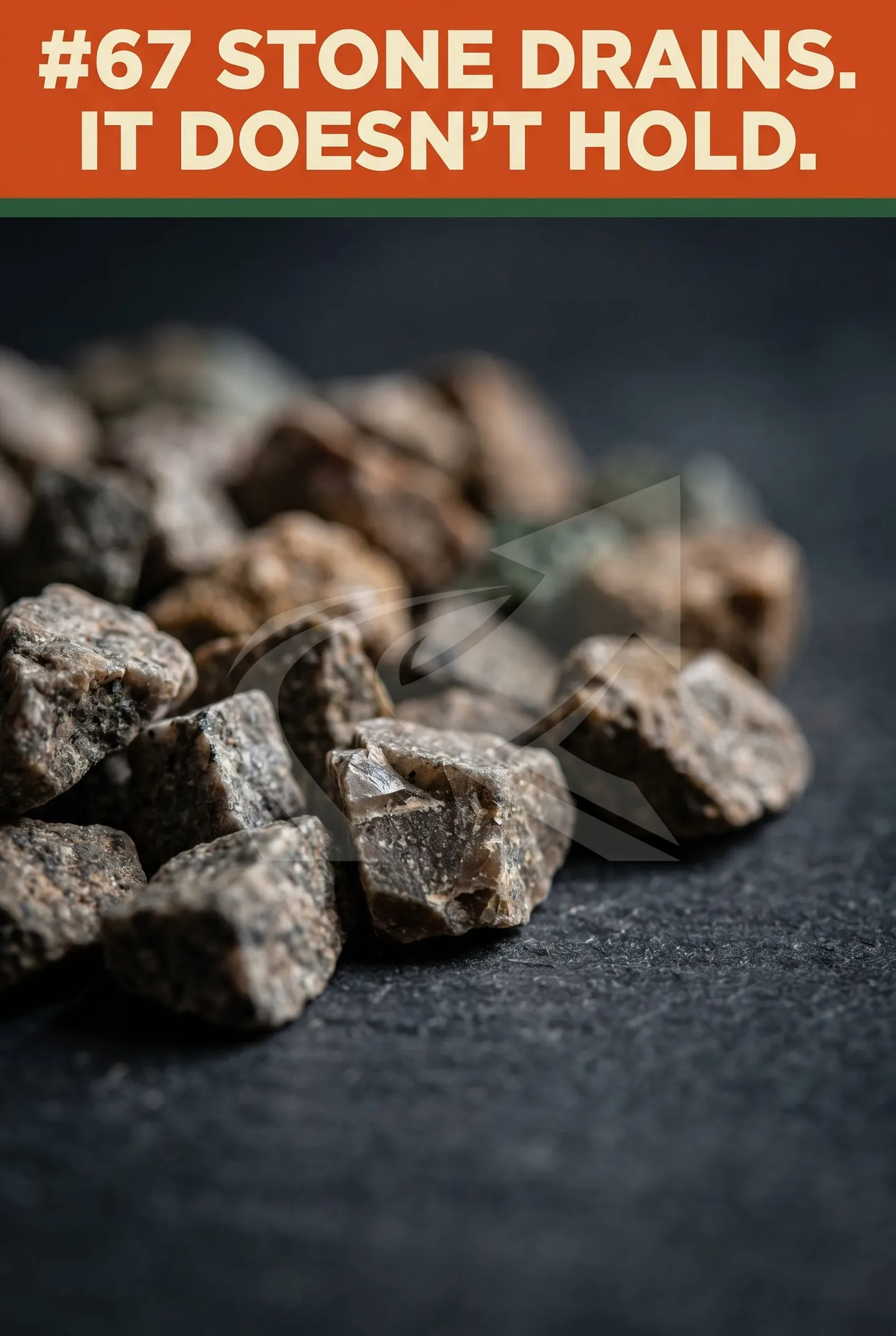
What #67 Stone Is
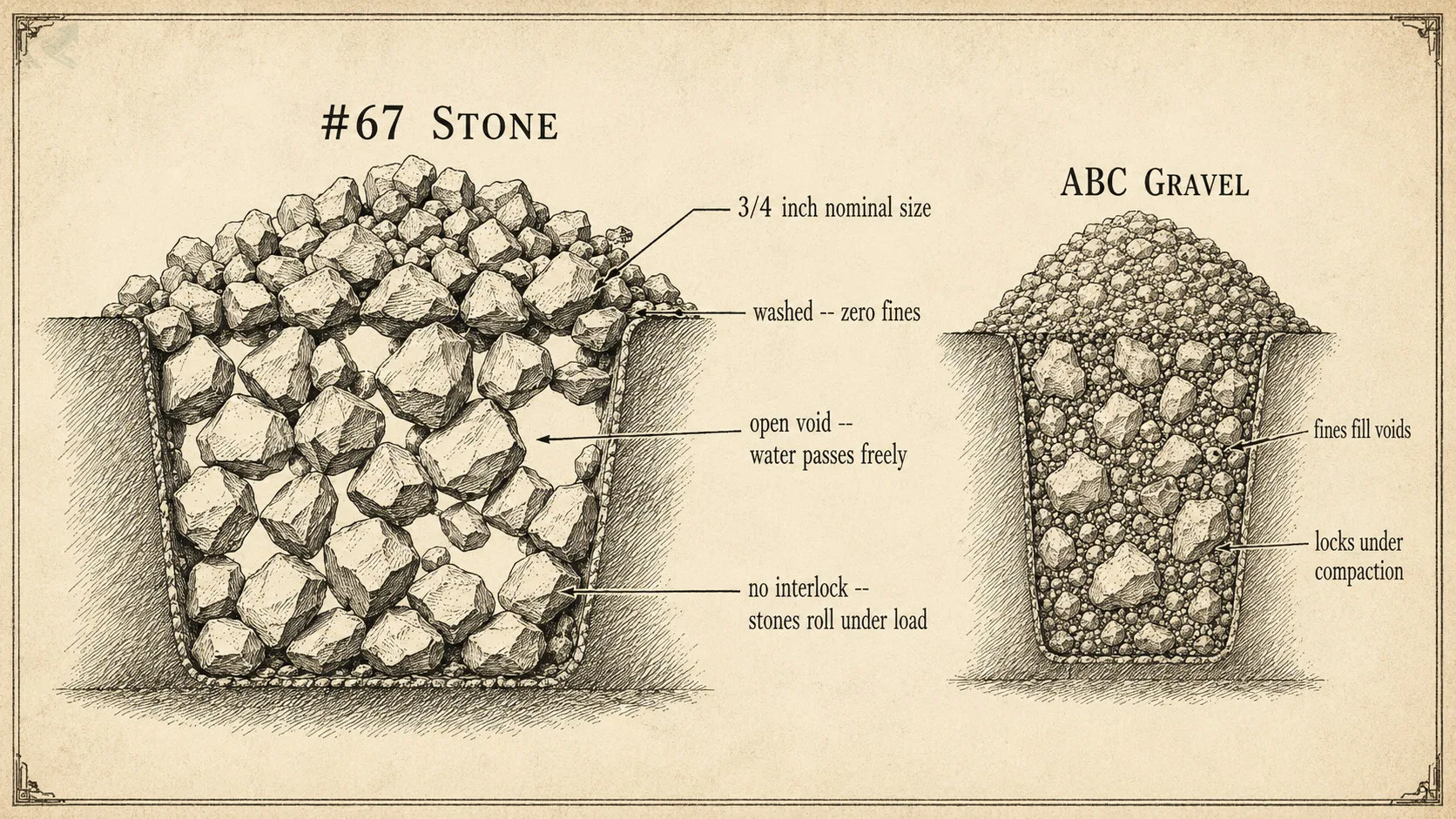
#67 stone is a washed, open-graded aggregate with a nominal size of 3/4 inch — no fines, no interlock, designed to let water pass through it freely.
The key properties:
- Nominal size: 3/4 inch. Most of the stone is retained on a 1/2 inch sieve and passes a 1 inch sieve, per Section 1010 gradation requirements.
- Washed: fine material — dust, clay particles, silt — is removed during processing. What remains is uniformly sized stone.
- Open-graded: because the gradation is uniform and fines are absent, large void spaces exist between stones. Water moves freely through those voids.
- No interlock: without fines filling the voids, individual stones cannot pack against each other. A load applied to the surface causes stones to roll and shift rather than bear together.
That last property is the one that matters for driveways. Interlock is what makes a driveway surface stable. has fines that fill voids and lock particles together under compaction — which is why grading a gravel driveway involves compaction passes that a simple stone dump-and-spread skips. #67 does not.
The NCDOT uses numbered designations for aggregates by sieve gradation. #67 is the standard 3/4 inch open-graded designation. #57 stone is slightly coarser (nominal 1 inch) with a similar open-graded structure and the same migration problem when placed on a driveway surface.
The reason #67 is called drainage aggregate: the open void structure and washed gradation are engineered for water flow, not load bearing. That’s the right behavior for a French drain trench. It’s the wrong behavior for a driveway.
Why #67 Migrates on a Driveway
#67 migrates because there’s nothing holding the stones in place — no fines means no interlock, so each vehicle pass shifts individual stones and each rain event carries them to the low point.
Three forces work together on a #67 surface:
- Vehicle load: a tire contact patch on #67 stone applies point load to individual stones. Without interlock, stones displace laterally and concentrate at the edges of the tire path or at low areas adjacent to the wheel track.
- Rain and water flow: water enters the void spaces between stones — by design. As it passes through, it picks up finer particles from the clay subgrade below and carries them upward through the voids. This clay pumping gradually destabilizes the stone layer from underneath.
- Slope: on any grade, gravitational and water forces combine. Over time, all of the stone migrates toward the downhill end or the low edge.
What this looks like after two or three seasons: gravel piled in the ditch, bare clay showing in wheel tracks, stones accumulated at the low end of the driveway or along one edge. The refill cycle never ends because the underlying mechanism — no interlock, open voids, clay pumping below — is unchanged.
This is not a contractor quality problem with the stone itself. #67 is performing correctly. The problem is a material specification error: drainage aggregate specified for a structural surface application. When you hire a grading contractor in NC who itemizes materials by type and role, that specification error doesn’t happen — the quote distinguishes drainage aggregate from structural base from surface material.
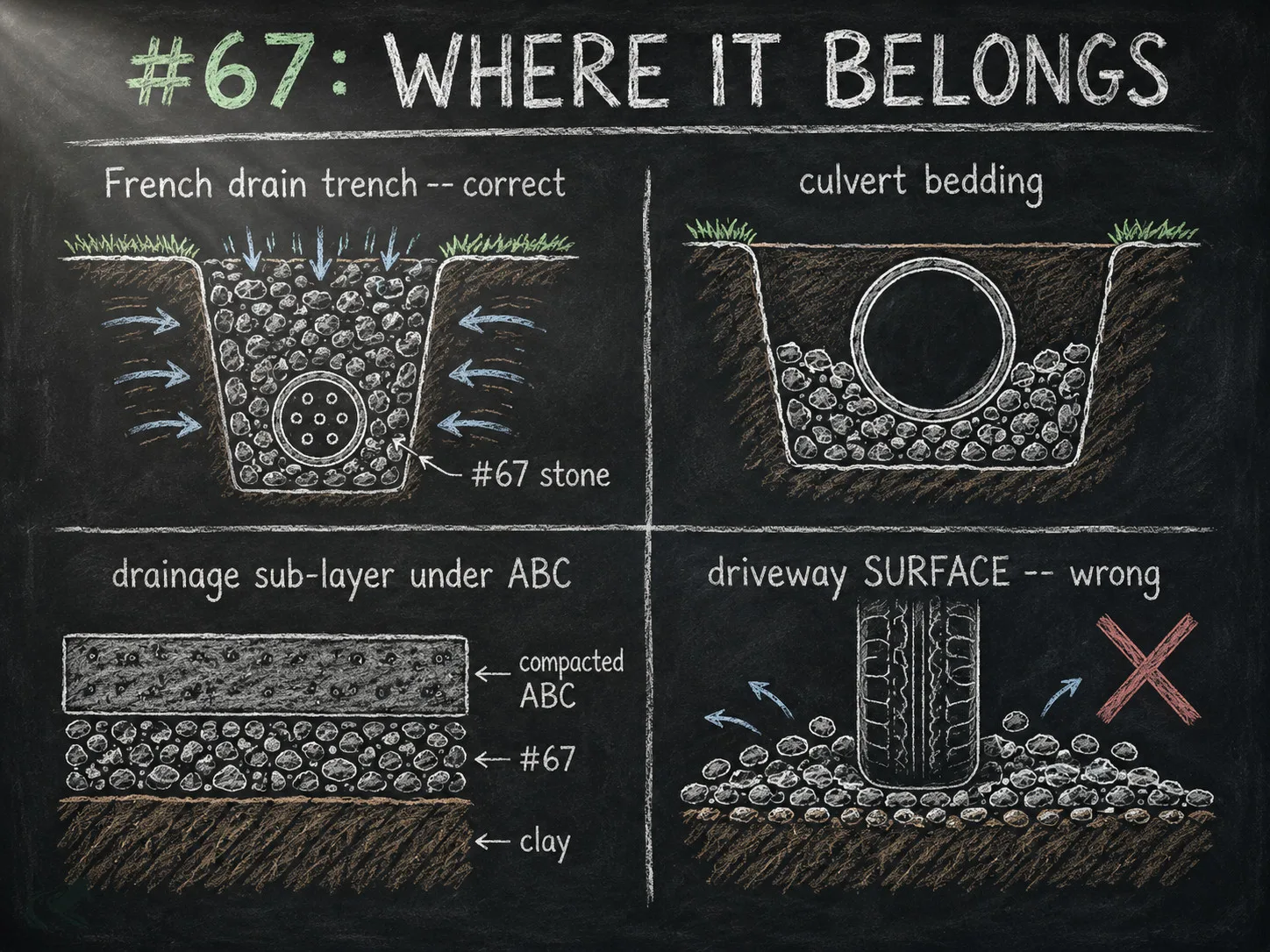
#67 stone in a French drain vs on a driveway surface
Comparison. Correct -- French drain aggregate: Open voids let water pass freely into perforated pipe; Geotextile wrap keeps clay out of the trench; Washed, fines-free gradation is exactly the right spec; Stays put because no vehicle load crosses it. Wrong -- driveway surface: No fines means no interlock under vehicle load; Stones displace laterally with every tire pass; Clay pumps up through the open voids from below; Bare red clay shows in the wheel tracks within seasons.
- Open voids let water pass freely into perforated pipe
- Geotextile wrap keeps clay out of the trench
- Washed, fines-free gradation is exactly the right spec
- Stays put because no vehicle load crosses it
- No fines means no interlock under vehicle load
- Stones displace laterally with every tire pass
- Clay pumps up through the open voids from below
- Bare red clay shows in the wheel tracks within seasons
#67 is drainage aggregate -- the open void structure that makes it ideal in a French drain trench is exactly why it migrates off a driveway surface.
When #67 Stone Is the Right Material
#67 is the correct material for French drain aggregate, culvert bedding, drainage layers under ABC in wet areas, and any application where water needs to move freely through the aggregate.
Correct applications in North Carolina construction:
- French drain aggregate: the open gradation allows water to enter the perforated pipe and flow along the trench without clogging. This is the primary designed use of #67, and it’s central to how French drain systems NC are built — #67 or #57 fills the trench around the perforated pipe. The void space that makes it a bad driveway surface makes it an excellent drainage trench fill.
- Drainage layer under ABC in saturated areas: in locations with a high water table or chronic saturation — the kind that produces standing water in yard NC solutions problems at the driveway edge — a 4 to 6 inch layer of #67 over geotextile below the ABC base allows water to move laterally and drain away from the subgrade. This addresses the ABC-fines saturation problem — where ABC’s fines can become saturated and lose bearing capacity when drainage is inadequate.
- Culvert bedding: the culvert pipe needs to be bedded in open-graded material that does not shift. #67 provides stable bedding while allowing drainage around the pipe barrel.
- Under concrete slabs: concrete slabs in North Carolina are often placed over a 4 inch layer of #57 or #67 stone for drainage and frost-heave mitigation — the same principle applies.
What separates correct and incorrect contractor practice: a contractor who specifies #67 as a driveway surface material on North Carolina clay is either confusing drainage aggregate with base aggregate, or substituting a drainage product for structural work to reduce material costs. Both produce the same result — migration and repeated refill calls.
Some North Carolina quarries and suppliers use “#67” and “#57” somewhat loosely, and some homeowners are told both stones are appropriate for driveways without the surface-vs-drainage distinction being explained. That’s the source of most misapplication.
What to Use Instead of #67 for a Driveway
For the driveway surface, use ABC or CABC. For a drainage layer under ABC in a wet location, #67 over geotextile can be part of the sub-base — but it stays below the ABC, never on the surface.
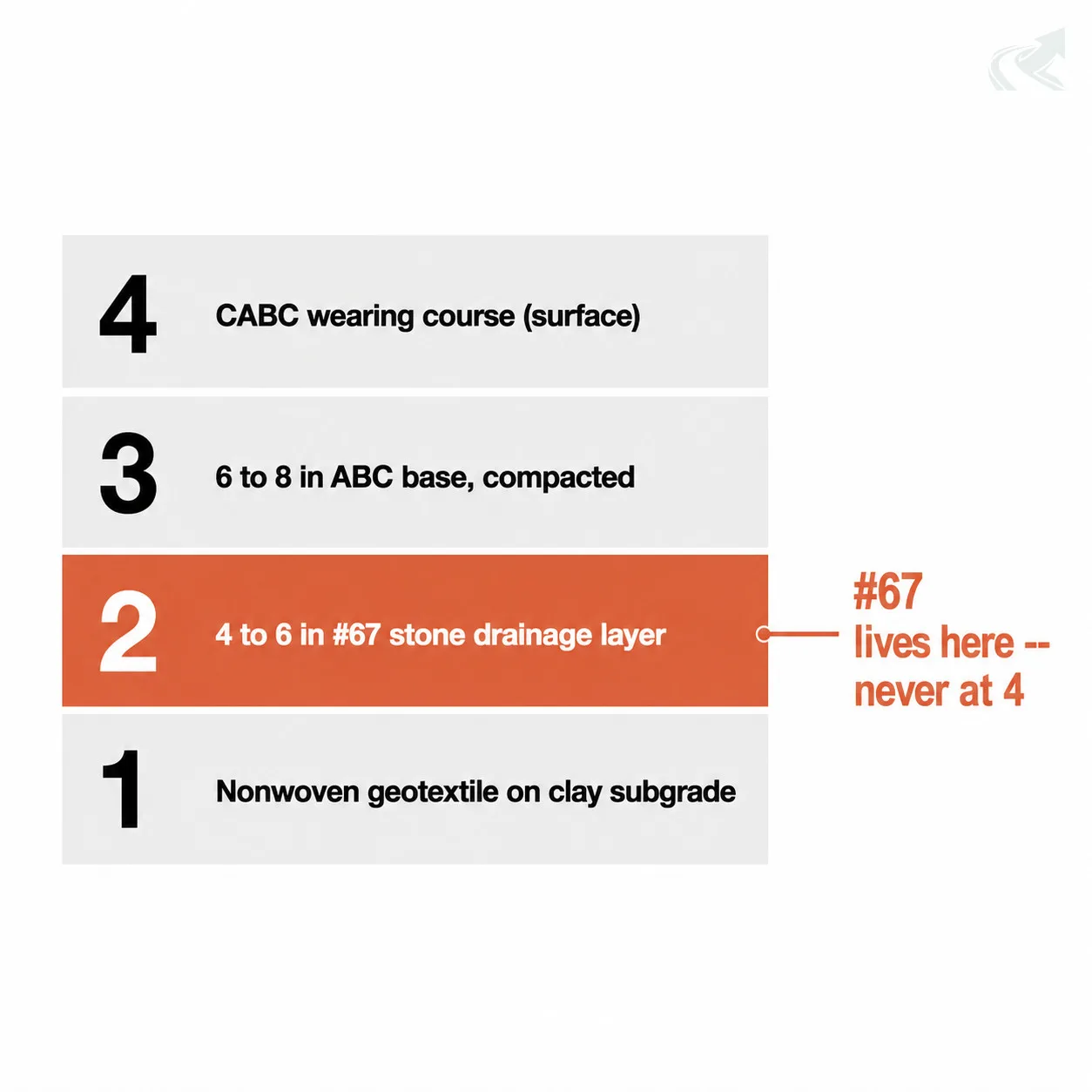
The correct layering sequence for a wet-area North Carolina driveway:
- Geotextile separation fabric (nonwoven) laid directly on the clay subgrade. Prevents clay from migrating upward into the drainage layer over time.
- 4 to 6 inch #67 stone drainage layer over the geotextile. Allows lateral drainage, addresses saturation in subgrades with high water-table conditions.
- 6 to 8 inch ABC base layer, spread and compacted. This is the structural layer. fines lock under compaction against Piedmont clay.
- Surface material — CABC or specified surface gravel as the wearing course.
#67 appears in step 2, below the structural base. It never appears in step 4. That’s the distinction.
If #67 is currently on the surface of your driveway, the fix is not to add ABC on top of it. Adding a structural layer over an unbound drainage aggregate without addressing the layer interaction can produce instability — the drainage layer beneath may shift under load and undermine the ABC above.
Get a grading operator’s assessment before mixing materials. In most cases, removal and a proper build-up from the clay is the correct sequence.
Before You Order Material
A quote that says “gravel and grade” without naming the material by type and application is not a real quote — the material spec determines whether the surface holds.
If your driveway contractor quoted “5 tons of gravel, spread and grade” without naming the material by spec, you don’t have a real quote. The material type determines whether the surface holds.
Get it itemized before agreeing to any scope:
- Material: named by type and application — “ABC base, 6 inches, compacted” and “CABC wearing course, 2 inches” — not just “gravel, spread”
- #67 if specified: for drainage layer only, noted as sub-base application with geotextile below
- Surface material: separate line from any drainage or base work
A contractor who put #67 on your surface and called it “driveway gravel” gave you the wrong spec. The solution is to find a verified North Carolina grading contractor who will give you an itemized breakdown that distinguishes drainage aggregate from structural base from surface material.
For a look at all NC driveway aggregate types including #67, the gravel hub covers the full material comparison. For #67 stone for French drain pipe bedding and #67 stone in French drain installation, see the drainage spokes. For #67 stone delivery NC logistics and tonnage estimation, see the hauling spoke. For ABC gravel for NC driveways specs by quarry and compaction requirements, see the ABC material spoke.