
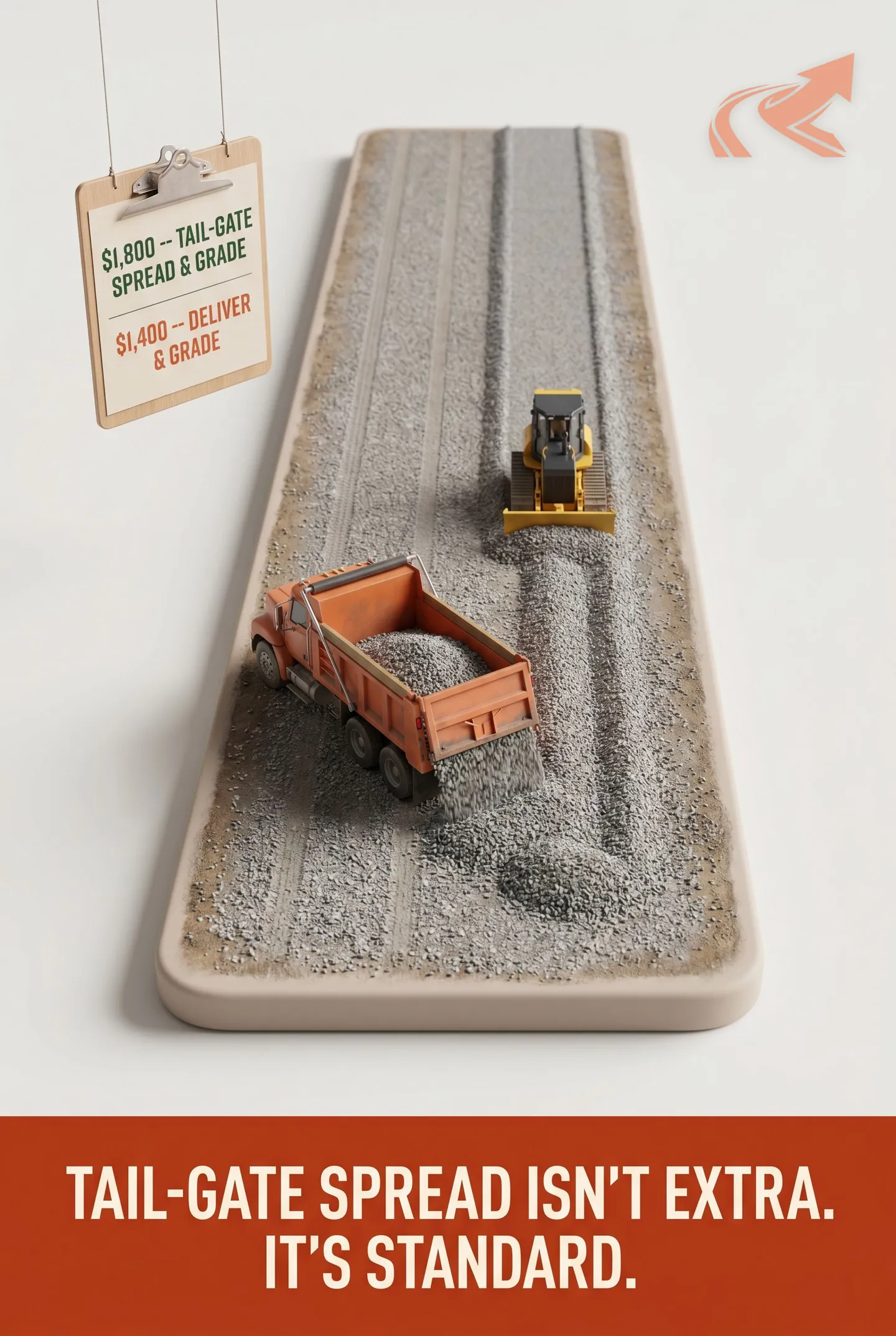
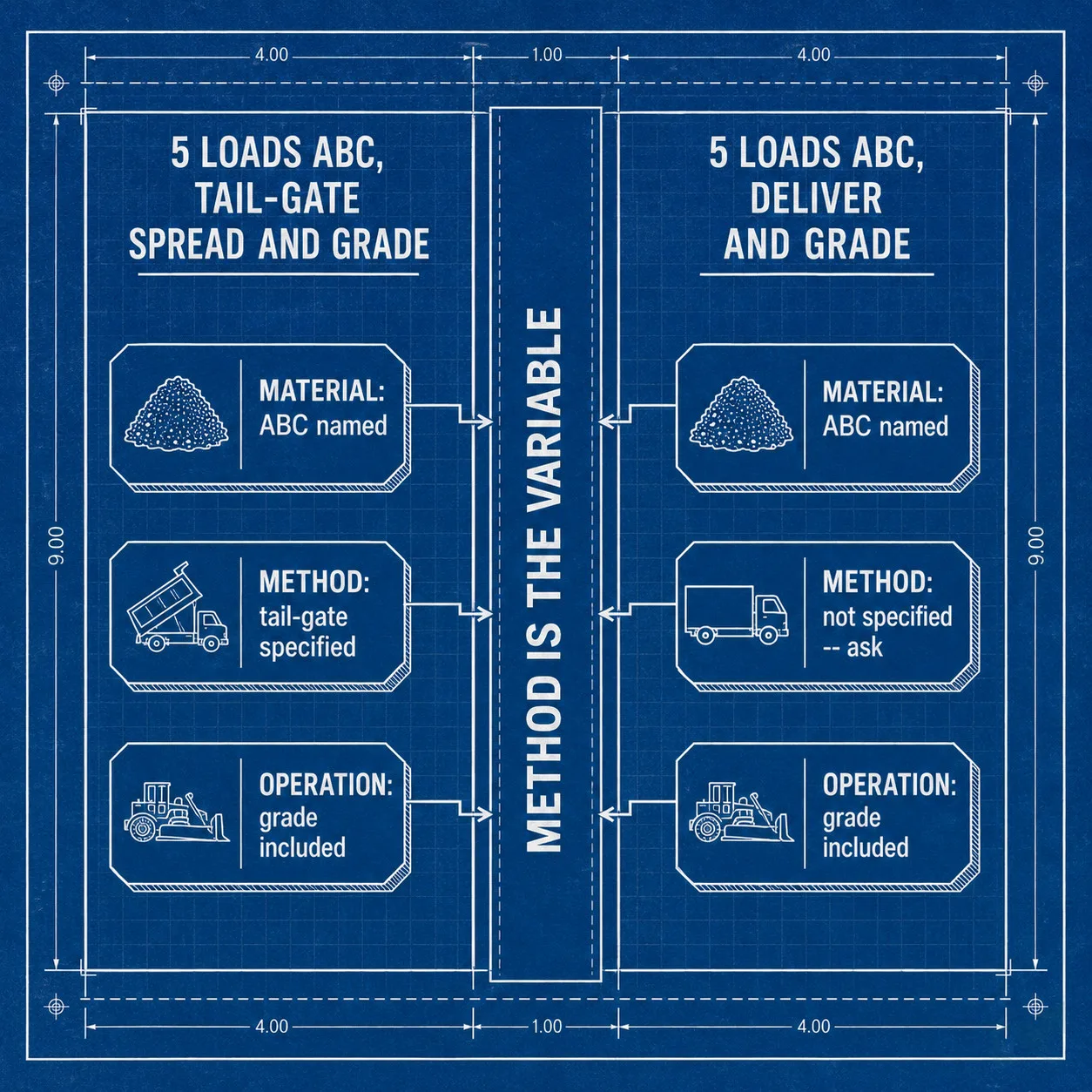
Tonya is looking at two quotes side by side. One says: “5 loads , tail-gate spread and grade, $1,800.” The other says: “5 loads ABC, deliver and grade, $1,400.”
She doesn’t know whether “tail-gate spread” is a specialty service she’s paying $400 extra for — or whether one contractor is just describing their work more precisely than the other.
This page explains what tail-gating actually means, when it matters, and what question to ask before accepting either quote.
How Tail-Gating Works
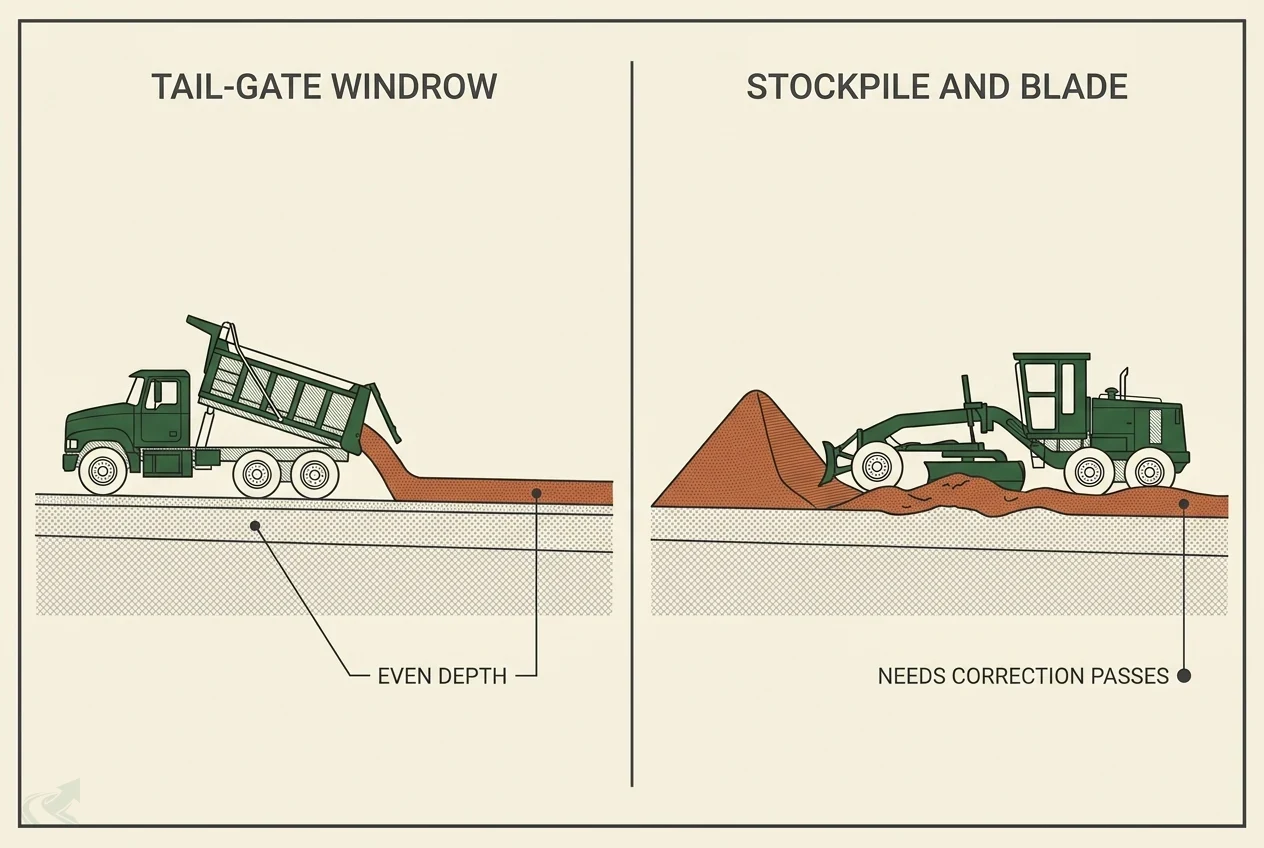
The dump truck’s tailgate opens partially and the truck drives slowly forward, releasing gravel in a controlled stream called a windrow.
Here’s what happens in sequence:
- The tailgate opens to a partial aperture — not a full dump, not fully closed
- The truck moves forward at walking speed or slower
- Gravel falls in a consistent ridge behind the truck — the windrow
- The grading operator follows immediately with the blade, shaping that windrow to the target depth and crown geometry
The windrow approach matters because it puts material approximately where it needs to be before the blade touches it. Consistent depth across the full driveway width follows naturally. The driveway crowning technique — cutting the crown geometry in the same pass as spreading — means no separate correction pass after the fact.
The alternative is stockpile-and-blade: gravel dumped in a pile at one end (or several spots) and pushed the full length of the driveway with the blade. It works. But it requires more passes to achieve even depth, and the material has already lost the placement accuracy that a windrow provides.
When Tail-Gating Is the Right Method
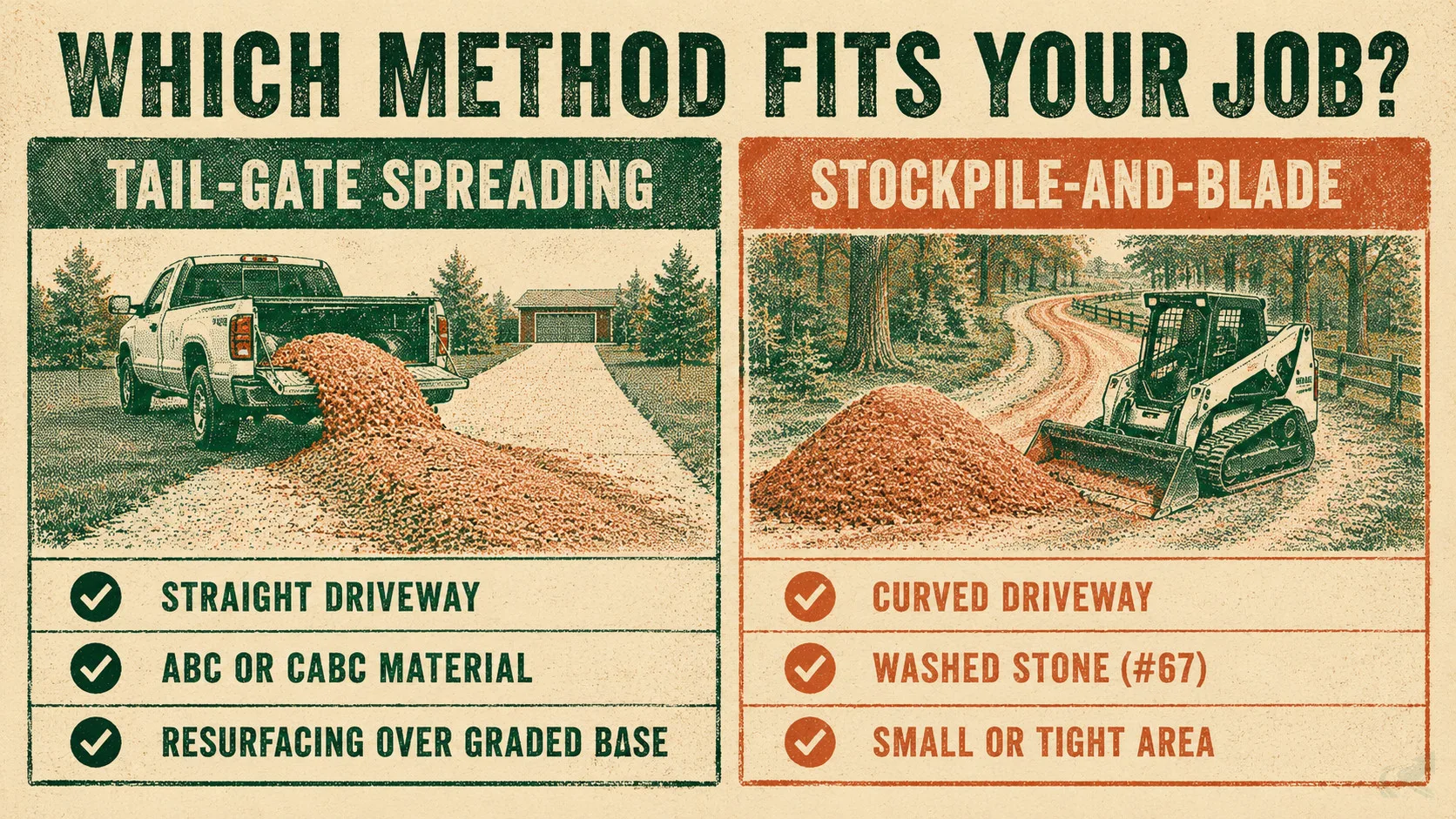
Tail-gating is the correct method for any driveway gravel spread where consistent coverage and proper crown geometry matter — which is most North Carolina residential driveways.
When it works best:
- Straight driveways — the truck makes one continuous pass; the windrow is uniform end to end
- Resurfacing over a graded base — the windrow lands directly on the prepared surface, minimizing disturbance to the crown geometry that was just cut
- and material — the fines in these mixes keep the windrow from flowing or spreading unevenly after it lands
When stockpile-and-blade makes more sense:
- Curved driveways where truck maneuvering is limited
- Small areas where the tail-gate pass is shorter than the truck itself
- Material that’s being blended into an existing surface rather than spread fresh
NC homeowner takeaway: on an 80-to-100-foot suburban driveway, both methods produce comparable results in the hands of a verified NC driveway grading operator. The difference in outcome grows on longer rural driveways — Ray Pettiford’s quarter-mile Guilford County drive is where spreading method choice shows up in the finished surface.
One note on material: tail-gating works because ABC and CABC hold their windrow shape after landing. #67 washed stone and clean gravel flow too freely — they spread sideways on impact and the windrow loses consistency. If a quote calls for washed stone as the top course, stockpile-and-blade with close blade control is often the better fit.
Contractor Evaluation — What to Ask
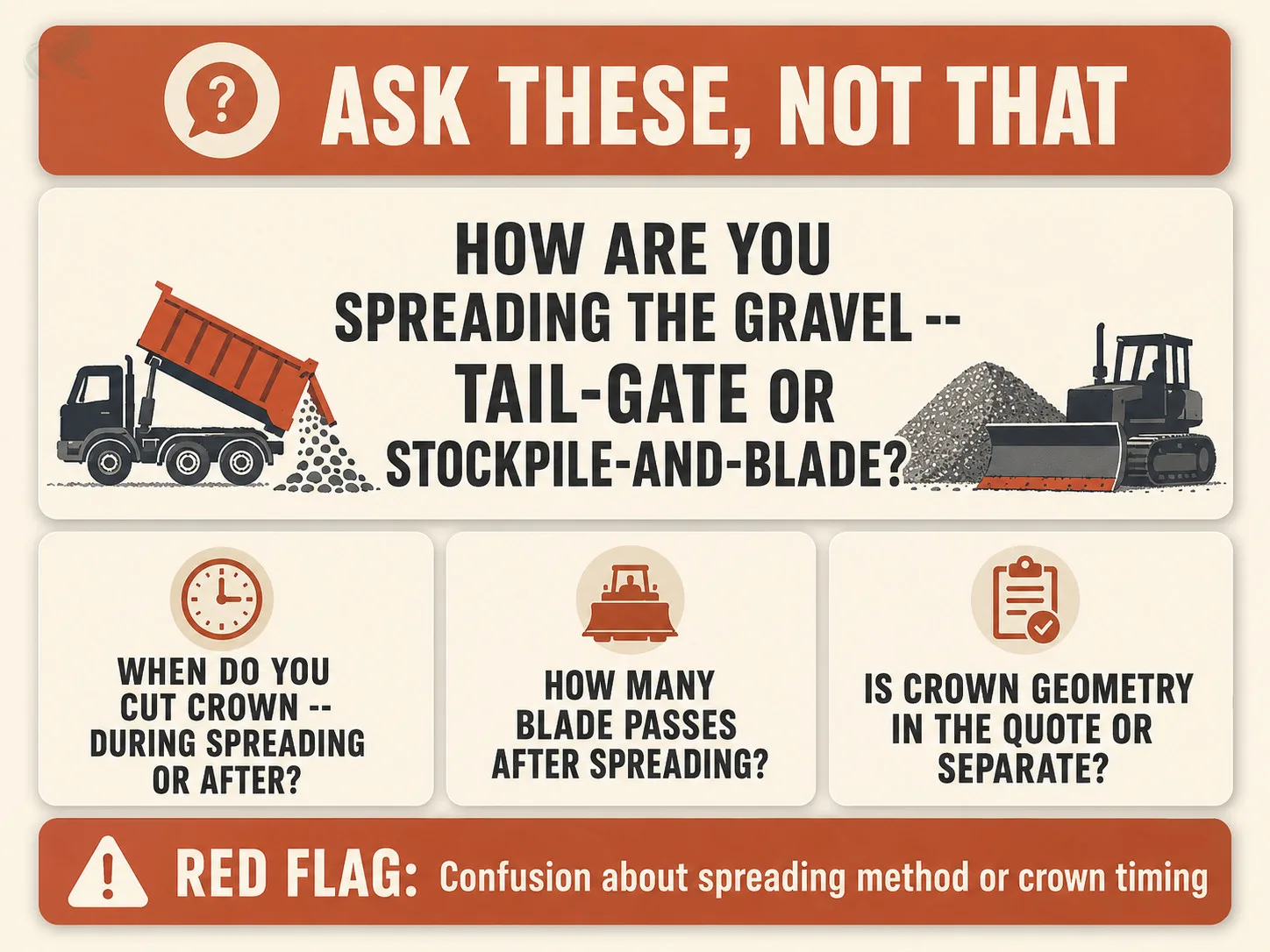
The question isn’t “will you tail-gate?” — it’s “how are you spreading the material, and will you cut crown in the same pass?”
Most competent North Carolina operators don’t think of tail-gating as a feature they offer. It’s just how they spread gravel on a straight drive. If you ask “are you tail-gating?” you may get a blank look from someone who’s been doing it their whole career without using the term.
Ask it this way instead:
“How are you spreading the gravel — tail-gate or stockpile-and-blade? And when do you cut the crown geometry — during spreading or after?”
That’s a question any operator who knows what they’re doing can answer in one sentence. If the response is confusion, that’s a signal.
Additional questions that surface method detail:
- “How many blade passes do you plan for finishing?” — 2 to 3 passes after spreading is standard; 5 or more suggests the spreading approach is creating extra correction work
- “Will crown shaping be included in the spreading pass or as a separate operation?” — combined is more efficient, but either is acceptable if specified
The goal is an itemized quote where spreading method, material type, and crown specification are each visible as separate line items — that’s what reading a driveway grading bid correctly looks like, not a single round number that leaves all three unspecified.
Tail-Gating vs “Deliver and Grade” — Reading the Quote
“Deliver and grade” tells you gravel is coming and the blade is coming. It does not tell you the spreading method. Ask before assuming the quotes are equivalent.
Breaking down Tonya’s two quotes:
- “5 loads ABC, tail-gate spread and grade, $1,800” — method is specified. The contractor has named how the material lands before the blade touches it. You know what to expect.
- “5 loads ABC, deliver and grade, $1,400” — method is not specified. The contractor may use tail-gate spreading. They may stockpile and blade. The scope is real; the process is opaque.
- “5 loads, spread” — no grading pass specified at all. Is crown being cut? Is positive drainage addressed? Ask.
The $400 gap between Tonya’s two quotes reflects how much driveway grading cost in NC varies by what’s actually included — a detailed scope vs. shorthand. Neither quote is automatically the better deal. Ask the second contractor the method question above and evaluate from there.
One detail on material choice: tail-gating works specifically because ABC holds its windrow shape. If either quote substitutes a clean washed stone as the primary base course, ask whether the spreading method is adjusted accordingly.
To see how gravel delivery and spreading fit into the full driveway grading sequence, read how driveway grading works in NC. For material selection, see gravel driveway grading and spreading technique.
Itemized Quote — What to Ask For
A quote that covers tail-gating correctly names four things:
- Material — ABC, CABC, or another spec. Named, not “gravel.”
- Volume or tonnage — in both units if possible. See yards vs tons when ordering driveway gravel if the quote uses one and you want to verify the other.
- Spreading method — tail-gate or stockpile-and-blade. Either is fine if named.
- Crown specification — is positive drainage built into the grade, and is it shaped in the spreading pass or after?
That’s the scope of the job, written down. A single line that reads “5 loads gravel, grade and spread” covers none of those four items.
If you’re comparing North Carolina contractors and want help reading quotes, hire an NC grading operator in the NCGH directory — every listing links directly to the contractor’s NCLBGC license record so you can verify their credentials before the first call.
For more terms from this page, see the NC grading operator glossary and gravel delivery and tail-gating for NC driveways.