
The two questions Renee asks before ordering
Is crusher run the same as ABC gravel?
At most NC Piedmont quarries, yes -- both are mixed-gradation aggregate with fines, suitable for driveway base. At some quarries they differ in gradation. The safe check is to ask for the spec sheet, not go by the name.
Which material stabilizes better on NC clay -- crusher run or ABC?
Either product, correctly specified and compacted, works on a standard Piedmont clay driveway. Ask whether the product meets NCDOT Type ABC specification and has fines included. If yes, order it regardless of what the quarry calls it.
Your contractor said to order crusher run. You called the quarry and they list both crusher run and at different prices. They sound like two different products. They might be. At some North Carolina quarries, crusher run is a coarser gradation and ABC is the specification product. At other quarries, they are identical material sold under two names.
This page resolves the naming confusion and gives you the question to ask before placing the order. The name is not the information you need — the gradation spec is.
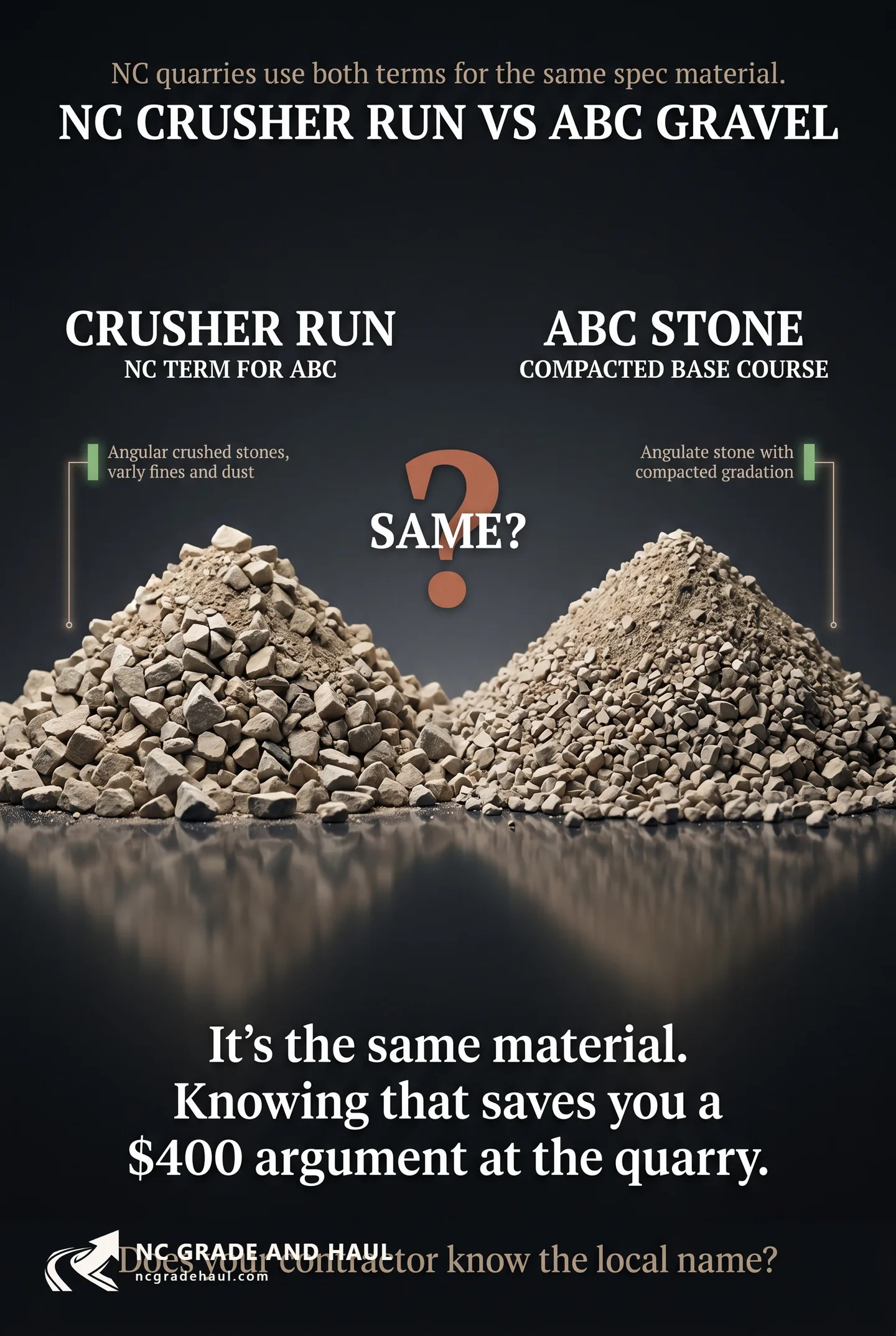
The NC Quarry Naming Problem
NC quarries use different names for the same material because aggregate naming is not standardized across quarries — only NCDOT has a published standard, and not every quarry sale is for an NCDOT job.
Why the naming varies across North Carolina:
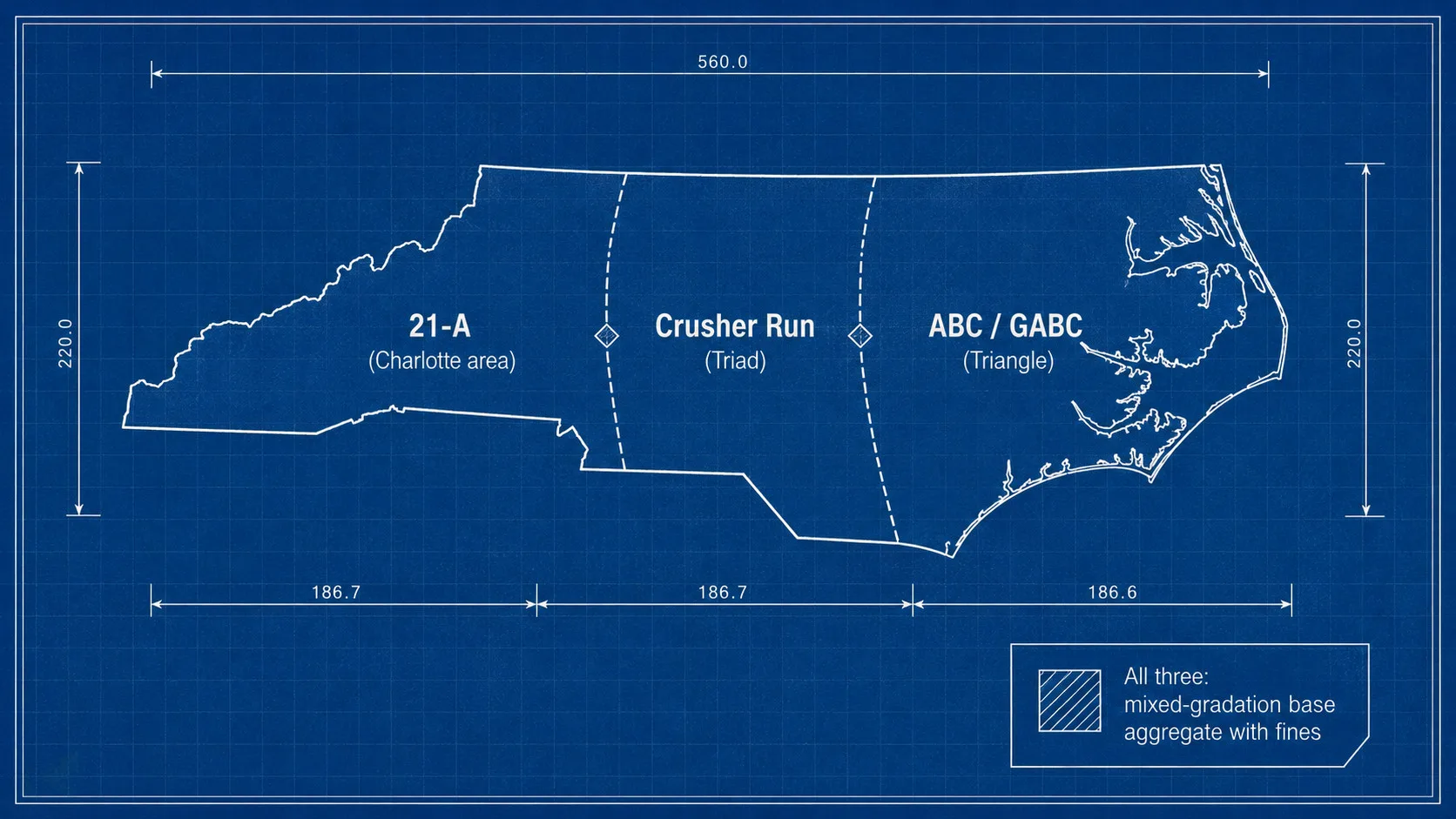
- Historical regional naming: different parts of NC developed different terms for mixed-gradation base aggregate. Quarries near Charlotte may call it “21-A.” Triad quarries often say “crusher run.” Triangle-area quarries may say “ABC” or “GABC.” Same general material category, different commercial names depending on where the quarry is and who their historical customer base was.
- Spec vs. commercial product: “ABC” in an NCDOT context has a specific gradation requirement documented in NCDOT Standard Specifications Section 1010. The same quarry may sell a product they label “crusher run” that meets that spec but does not carry the NCDOT label — because it was not produced under NCDOT quality control protocols for a road contract.
- Gradation variation at quarries that distinguish them: at quarries where crusher run and ABC are separate products, crusher run is sometimes a coarser gradation — more large stone, fewer fines — than the ABC product. Both materials have fines, but the ABC product meets a tighter gradation range.
The practical implication: ordering by name at an unfamiliar quarry can get you the wrong product. Ordering by gradation spec gets you what your project needs — and the spec also determines how the material behaves through the full NC driveway grading process from crown to compaction.
When Crusher Run and ABC Actually Differ
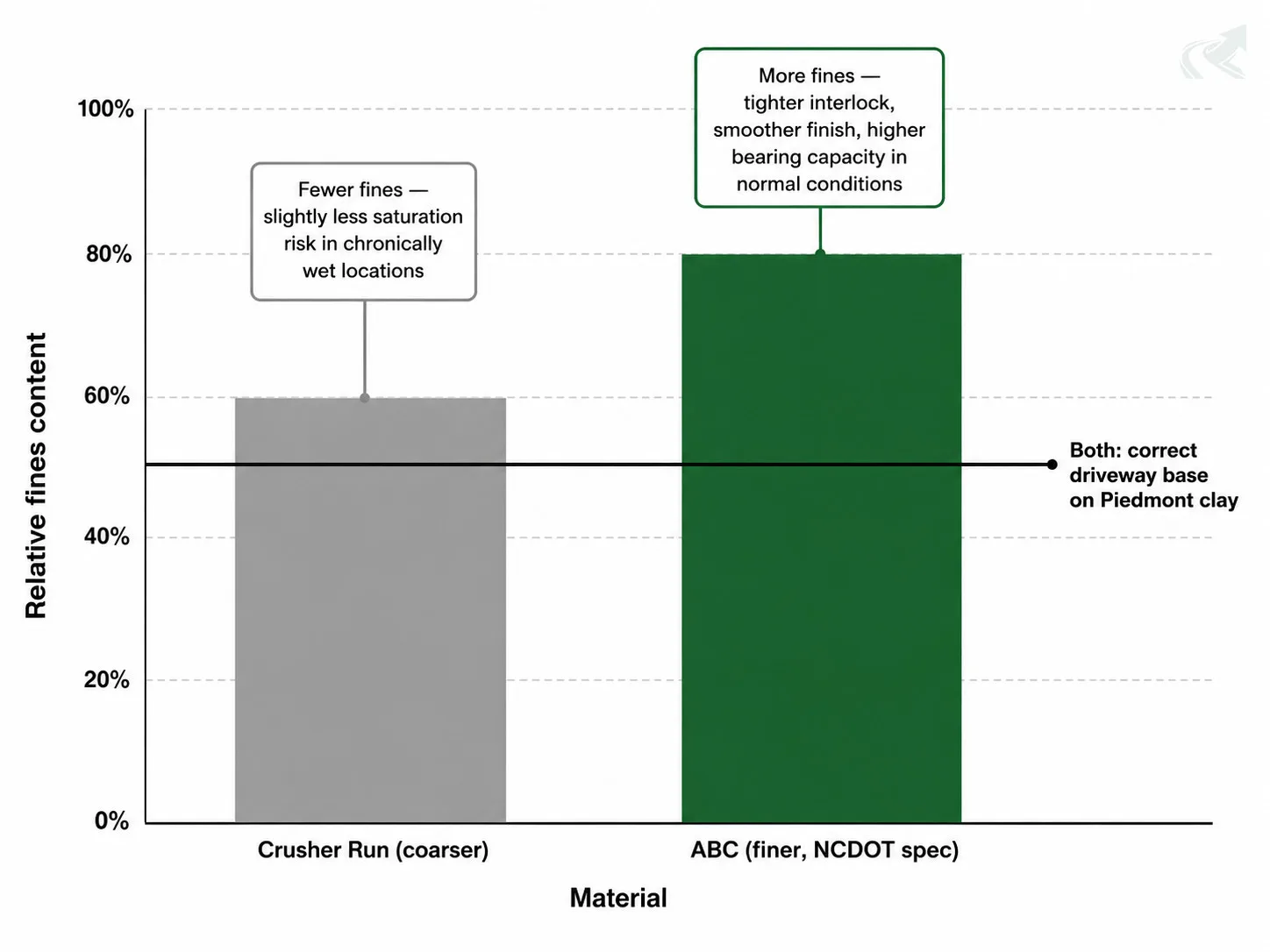
When a quarry distinguishes crusher run from ABC, crusher run typically has a coarser gradation — more large stone, fewer fines — and the two products compact differently under load.
Performance difference when the quarry treats them as distinct products:
- Crusher run (coarser gradation): more large aggregate in the mix, fewer fines. Compacts to a coarser surface texture. Provides good bearing capacity but may have slightly less particle interlock on compaction because the fines content is lower. In saturated conditions, fewer fines means less risk of fine-particle migration into mud at the surface.
- ABC (finer gradation, NCDOT spec): more fines, tighter interlock on compaction. Slightly smoother finished surface. Better interlock in NC Piedmont clay conditions, though slightly more susceptible to fines saturation in poorly drained locations.
For North Carolina clay driveways, the practical difference between them:
- Most conditions: equivalent performance. Both compact correctly on Piedmont clay with the right moisture content and adequate roller passes.
- Very wet or low-drainage areas: coarser crusher run may perform better because fewer fines means less fines-saturation risk during extended wet periods. Surface drainage from a proper driveway crown in NC matters more than the material difference in most cases.
- Heavy traffic driveways: more fines (ABC) compacts tighter, providing slightly higher bearing capacity under repeated heavy loads.
The answer for a standard NC Piedmont driveway: either product, correctly specified and compacted, works. The spec matters; the name does not.
Crusher run vs ABC -- normal conditions vs saturated
Comparison. Compacted in normal conditions: Crusher run sets to a slightly coarser surface texture; ABC's extra fines lock to a finer, tighter surface; Both interlock against the Piedmont clay subgrade; Performance is effectively equivalent for a driveway. Under extended saturation: ABC's higher fines content turns plastic in a mud zone; Crusher run, with fewer fines, softens slightly less; Coarser gradation has lower fines-saturation risk; Either way, fix the drainage before the gravel.
- Crusher run sets to a slightly coarser surface texture
- ABC's extra fines lock to a finer, tighter surface
- Both interlock against the Piedmont clay subgrade
- Performance is effectively equivalent for a driveway
- ABC's higher fines content turns plastic in a mud zone
- Crusher run, with fewer fines, softens slightly less
- Coarser gradation has lower fines-saturation risk
- Either way, fix the drainage before the gravel
The crusher-run vs ABC difference is small -- both work on Piedmont clay; the gap only shows up in chronically wet ground, where coarser holds slightly better.
How to Order the Right Material
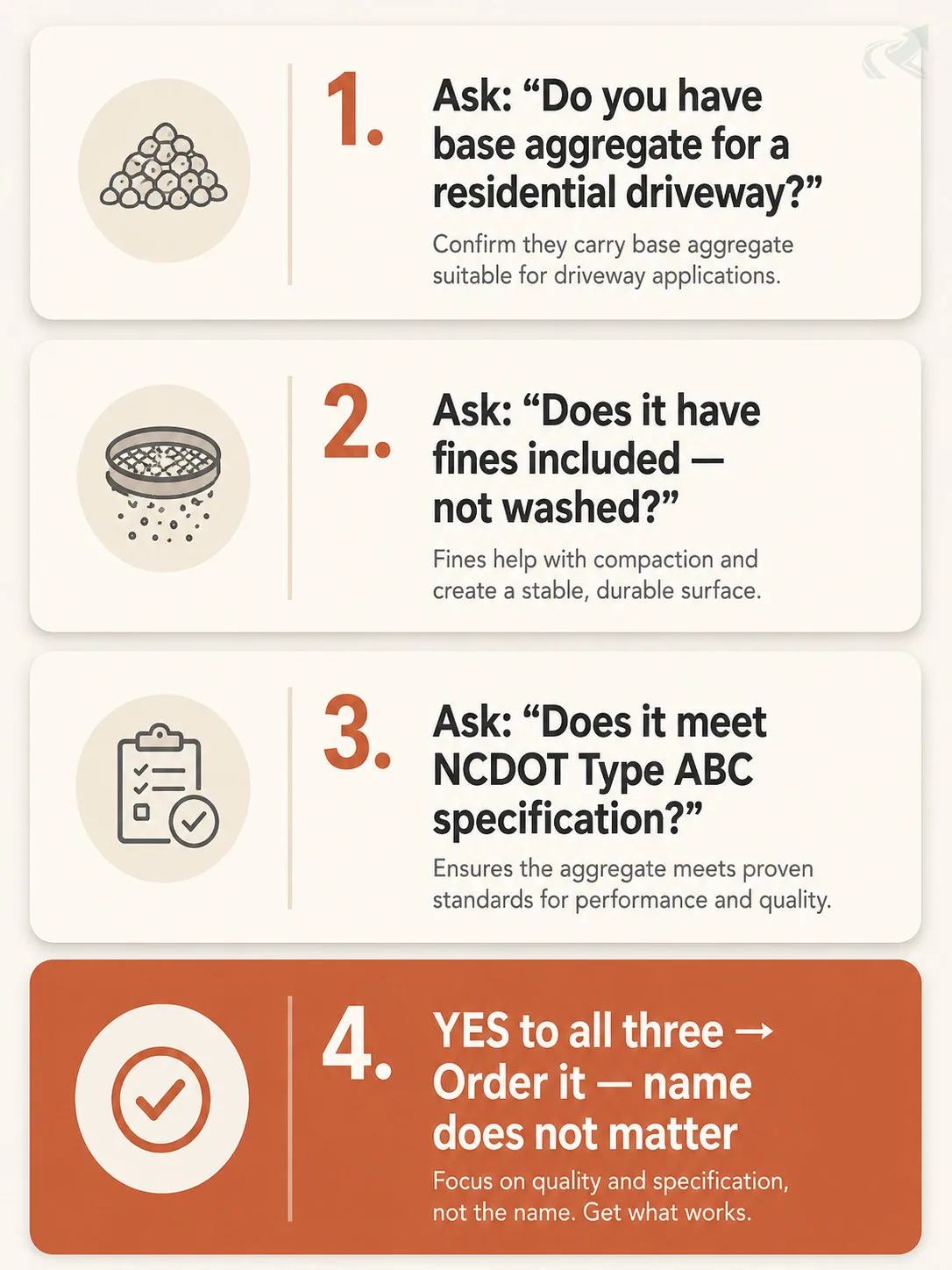
Ask for the gradation spec sheet, not the product name. If the material meets NCDOT Type ABC specification, it works for a driveway base — regardless of what the quarry calls it.
The ordering conversation:
- “Do you have aggregate base course for a residential driveway?”
- “Does it have fines included — not washed?”
- “Does it meet NCDOT Type ABC specification?” (A quarry that says yes to this question is selling you equivalent material even if they call it crusher run, 21-A, GABC, or anything else.)
- “What are the minimum and maximum stone sizes in the gradation?”
If the quarry says the product has fines and meets NCDOT Type spec: order it regardless of what they call it.
If the quarry says their crusher run has larger max stone and fewer fines than their ABC product: for a standard suburban driveway in North Carolina, either works. For a poorly drained or very wet driveway location, specify the product with more fines — but only after addressing the underlying drainage problem first. A verified driveway grading operator in NC can assess the drainage situation before the material order is placed.
Copy this ordering question when you call the quarry:
“Does your crusher run — or your ABC — meet the NCDOT Type ABC specification? And are they the same product with different names, or do they differ in gradation?”
Compaction Behavior in NC Clay — The Practical Comparison
Both crusher run and ABC compact correctly on Piedmont clay when the right moisture conditions exist. The difference in compaction behavior between them is smaller than the difference between either of them and a washed aggregate.
Compaction notes for NC Piedmont conditions:
- Crusher run (coarser): the larger aggregate skeleton provides more resistance to roller load, which means slightly more roller passes may be needed for equivalent density. In practice, this is not a meaningful issue on residential driveways — it is a consideration on road subbase where density spec is checked by nuclear gauge.
- ABC (finer): the fines fill under roller pressure more quickly, producing a smooth, tight surface in fewer passes. This is why ABC is the standard for a smooth-finish driveway surface in North Carolina.
- Both vs. washed stone: #57 or #67 washed stone does not compact in the same sense — there are no fines to interlock the aggregate skeleton. Any comparison of crusher run vs ABC on NC Piedmont clay should start from this baseline: both are correct driveway base materials; washed stone as a base layer is not.
Before You Order
When your itemized quote arrives, the material line should name the product by spec — not just “gravel.” Get the gradation type on the quote, and confirm the same gradation type appears on the delivery ticket when the truck shows up. That is the information that lets you verify what you received.
A contractor who calls either product “ABC-equivalent” or “crusher run” without specifying whether fines are included has not given you a real material spec. The question to ask on the quote is simple: does this material have fines, and does it meet NCDOT Type ABC specification?
For more on ABC gravel specification vs crusher run and how quarry products are graded, see the ABC gravel spoke. For a side-by-side look at all NC driveway gravel types, see the gravel hub. For logistics on ordering crusher run or ABC for delivery in NC and verifying your gravel delivery ticket when the truck arrives, see the hauling spokes. To hire an NC grading operator who can specify and place the right material, see the directory. For help understanding gravel driveway grading in NC and how the base layer fits into the full crown-compaction-top-up sequence, see the driveway grading spoke.