
Two questions about 3/4 minus for driveways
Is 3/4 minus gravel good for a driveway?
Yes -- with a caveat. 3/4 minus has fines and compacts, making it suitable for driveway use. On North Carolina Piedmont clay, it works as a surface or topdress layer. For base construction, confirm whether your quarry's 3/4 minus meets the NCDOT ABC gradation -- some do, some don't. It is not as fine as full ABC, so compaction interlock is slightly less tight.
When should I use 3/4 minus instead of ABC?
Use 3/4 minus for light-traffic residential driveways, pedestrian paths, and surface topdress when there are no NCDOT permit requirements. Use ABC when spec compliance is required or when heavy vehicles -- delivery trucks, concrete trucks, contractor equipment -- regularly use the driveway.
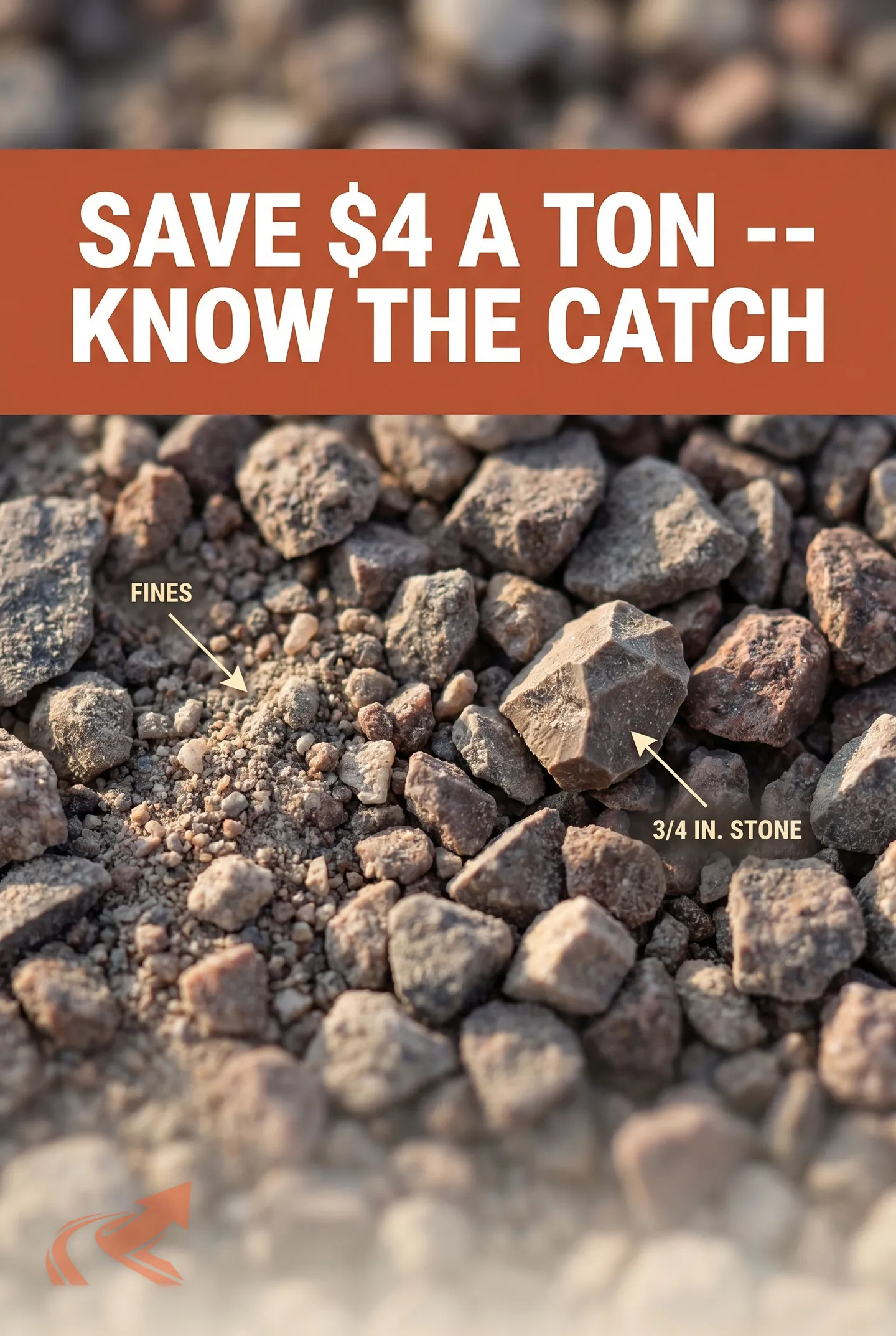
You saw 3/4 minus listed at $18 per ton at the landscape supply. ABC was $22. Both looked similar in the bin. Before assuming you can swap one for the other and pocket the difference, it helps to know what the $4-per-ton gap actually buys — and whether it matters for your specific driveway.
This page answers that. It is written for a NC residential driveway situation: Piedmont clay subgrade, passenger vehicle traffic, and a homeowner pricing materials before calling a contractor.
What 3/4 Minus Actually Is
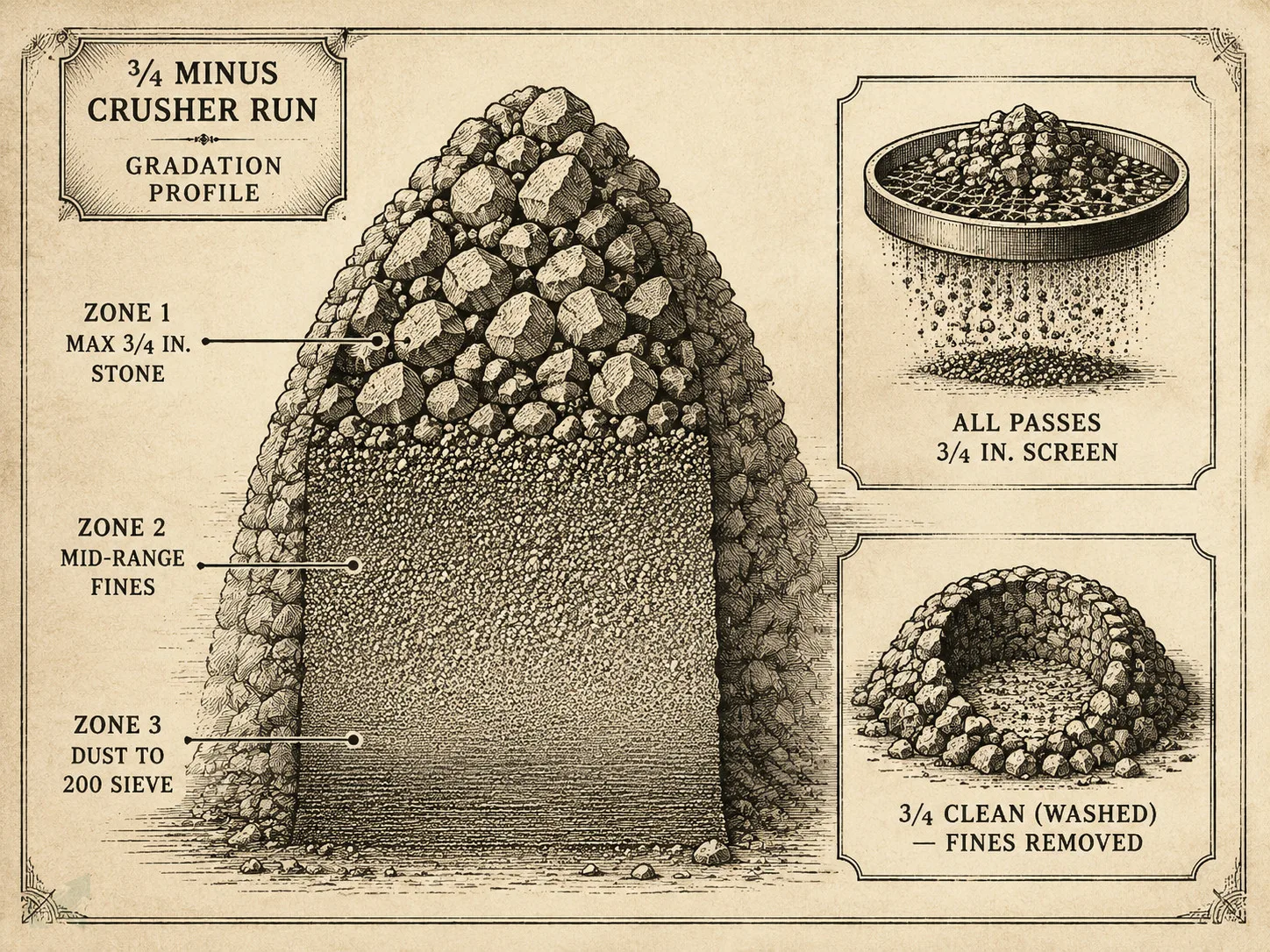
3/4 minus means all stone passes through a 3/4 inch screen — maximum stone size is 3/4 inch, with fines included down to dust. It is not washed. It has fines.
The “minus” designation is the key: stone is retained by a screen at the named size, so “3/4 minus” means everything that passes through a 3/4 inch opening. That includes material down to the 200 sieve — fine dust and clay-sized particles are present.
NC quarries sell this product under several names:
- 3/4 crusher run
- 3/4 minus crusher run
- 3/4 minus (the most common term at Piedmont supply yards)
Do not confuse it with “3/4 clean” or “3/4 washed stone.” Those are washed products with the fines removed — they behave completely differently (drainage aggregate, not base aggregate). The quarry naming confusion for NC driveway gravel runs deeper than most homeowners expect — what one quarry calls “crusher run” another may label “3/4 minus,” and knowing the distinction matters before you order.
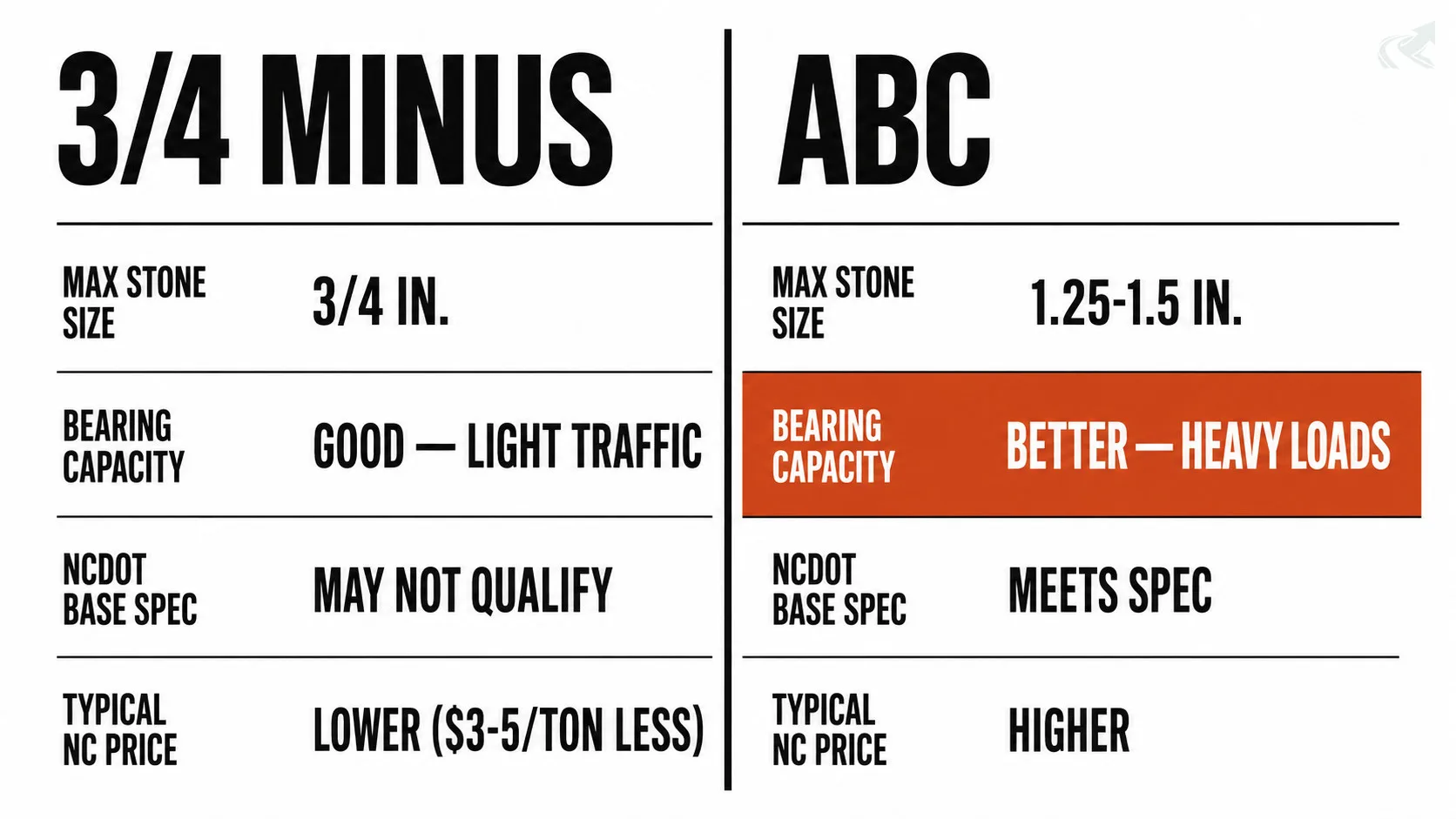
How 3/4 minus differs from ABC gravel: ABC typically carries a maximum stone of 1.25 to 1.5 inches with a wider gradation spectrum. 3/4 minus is essentially the finer end of the ABC gradation family — without the large coarse fraction that gives ABC its structural skeleton.
At most Piedmont quarries, 3/4 minus is a standard product used for pathways, light-traffic parking areas, and residential driveways. It is not an unusual or specialty material.
3/4 Minus on NC Piedmont Clay — How It Performs
On North Carolina Piedmont clay, 3/4 minus compacts adequately for light-traffic driveways and surface topdress — but its smaller max stone means slightly less bearing capacity than ABC under heavy loads.
The performance difference comes down to the structural skeleton. ABC’s coarser aggregate (up to 1.5 inch) creates a more interlocked matrix after compaction. 3/4 minus compacts well but produces a finer, less rigid layer. For passenger vehicles, that difference is marginal. For heavy vehicles, it matters.
| Factor | 3/4 Minus | ABC | Notes |
|---|---|---|---|
| Max stone size | 3/4 inch | 1.25-1.5 inch | ABC has more structural skeleton |
| Fines content | Present | Present | Both interlock on compaction |
| Bearing capacity | Good — light traffic | Better — heavy/medium traffic | ABC for contractor trucks |
| Surface texture | Finer, smoother | Coarser | Personal preference |
| Typical NC price | Lower (~$3-5/ton less) | Higher | Differential varies by quarry |
| NCDOT base spec | May not meet full spec | Meets | Matters for permitted work |
For a standard North Carolina residential driveway with passenger vehicle traffic, 3/4 minus performs adequately. The compaction interlock is slightly less tight than ABC, but on a residential scale with proper gravel driveway compaction NC that gap is not a failure mode.
The situation changes when the driveway also carries heavy trucks, delivery vehicles, or contractor equipment on a regular basis. ABC’s coarser skeleton handles repeated heavy load better. For how NC red clay affects gravel driveway performance, the subgrade condition — not just the aggregate — is often the deciding factor.
Drainage Behavior vs ABC
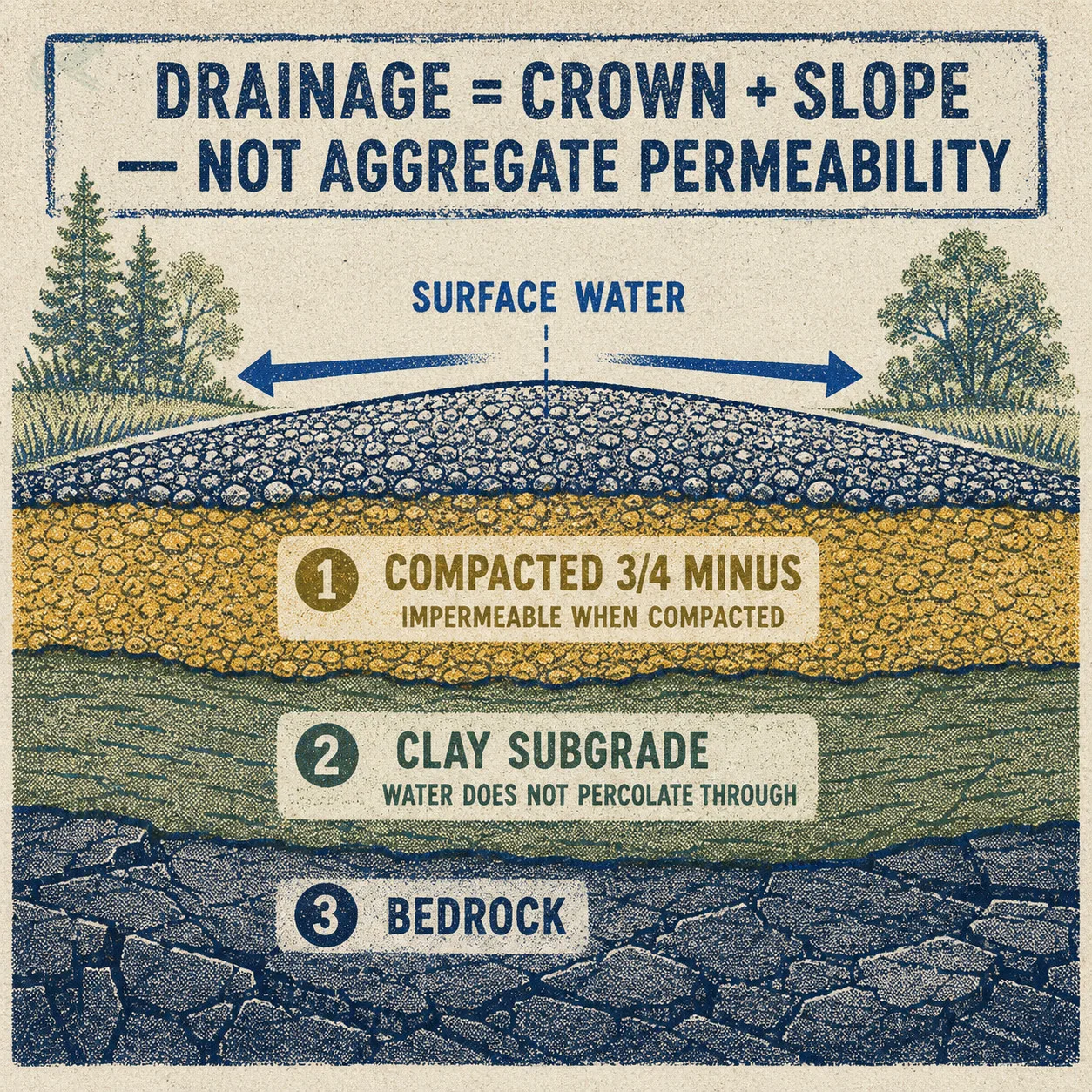
3/4 minus drains similarly to ABC — neither is a drainage aggregate. Both are impermeable base materials on clay subgrade.
This is a common misread: because 3/4 minus has a slightly finer texture, some homeowners assume it drains better. It does not. The fines fill void space. Under compaction, 3/4 minus becomes essentially impermeable — water moves across the surface, not through it.
ABC behaves the same way. Both materials on clay subgrade are surface-drainage-dependent. Water moves off via crown and cross-slope, not by percolating through the aggregate.
The comparison that matters is not “3/4 minus vs ABC for drainage” — it is “either of these base materials vs a washed open-graded stone.” If you have a very wet area, high groundwater, or a drainage problem that requires percolation through the driveway base, neither 3/4 minus nor ABC is the right material. An open-graded aggregate (#57 or #67 washed stone) over geotextile fabric is the right answer for that situation.
For a standard NC Piedmont driveway, driveway crowning in NC controls drainage. The aggregate type is secondary to surface geometry.
When to Specify 3/4 Minus vs ABC
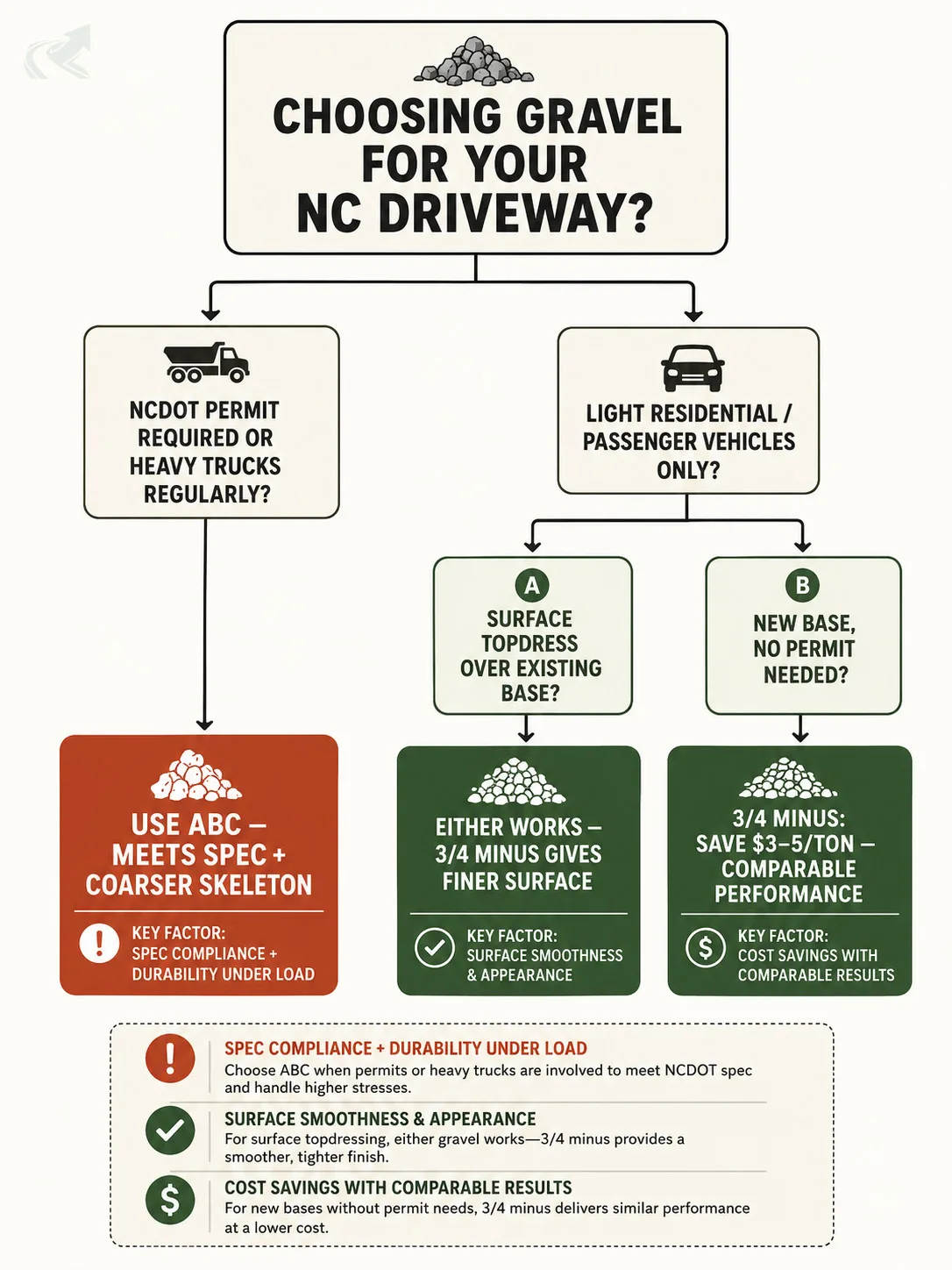
Use 3/4 minus for light-traffic residential drives, pedestrian paths, and surface topdress. Use ABC when NCDOT spec compliance is required or when heavy vehicle loads are expected regularly.
Decision guide for North Carolina conditions:
- NCDOT-permitted work (culvert approach on a state road, permitted entrance): ABC meeting the NCDOT Type ABC gradation specification is required. 3/4 minus may not meet the full spec — confirm with your quarry before ordering. Do not assume they are interchangeable on permitted work; how driveway grading works in NC covers what spec compliance actually requires at each stage of a permitted job.
- Heavy truck traffic (delivery trucks, concrete trucks, contractor equipment): ABC’s coarser skeleton handles repeated load better. Use ABC.
- Passenger vehicle residential driveway, no permit requirements: either works. 3/4 minus is a reasonable choice.
- Surface topdress over an existing ABC base: 3/4 minus or CABC as topdress both work. 3/4 minus gives a slightly finer, smoother surface. This is one of the better use cases for 3/4 minus specifically.
The cost check: if 3/4 minus is $3 to $5 per ton cheaper and you have a light-traffic residential driveway with no permit requirements, those savings are real. On a 100-ton driveway job, that is $300 to $500 back in your pocket for comparable performance.
If your driveway has permit requirements or regular heavy vehicles, the performance gap is real enough that the savings are not worth it. Use ABC.
What to Ask Before Ordering
Ask your contractor which material they plan to use and why. “Is that 3/4 minus or ABC?” is a specific question with a specific answer for your driveway conditions.
An itemized quote lists material type and gradation — not just “5 tons of gravel.” Before signing, confirm the quote specifies the aggregate type, the total tonnage, and whether it includes compaction passes. That one line in a quote tells you whether the contractor has actually matched the material to the job.
See all NC driveway gravel types including 3/4 minus at the gravel hub for a side-by-side of every aggregate used on NC residential driveways. Or find a verified NC grading contractor who can walk the site before recommending material.
For questions about gravel driveway grading in NC — crown geometry, compaction passes, when to regrade vs top-up — that page covers the installation side separate from material selection.