Overlay or replace? Two questions NC homeowners ask
When does an NC asphalt driveway need full replacement instead of overlay?
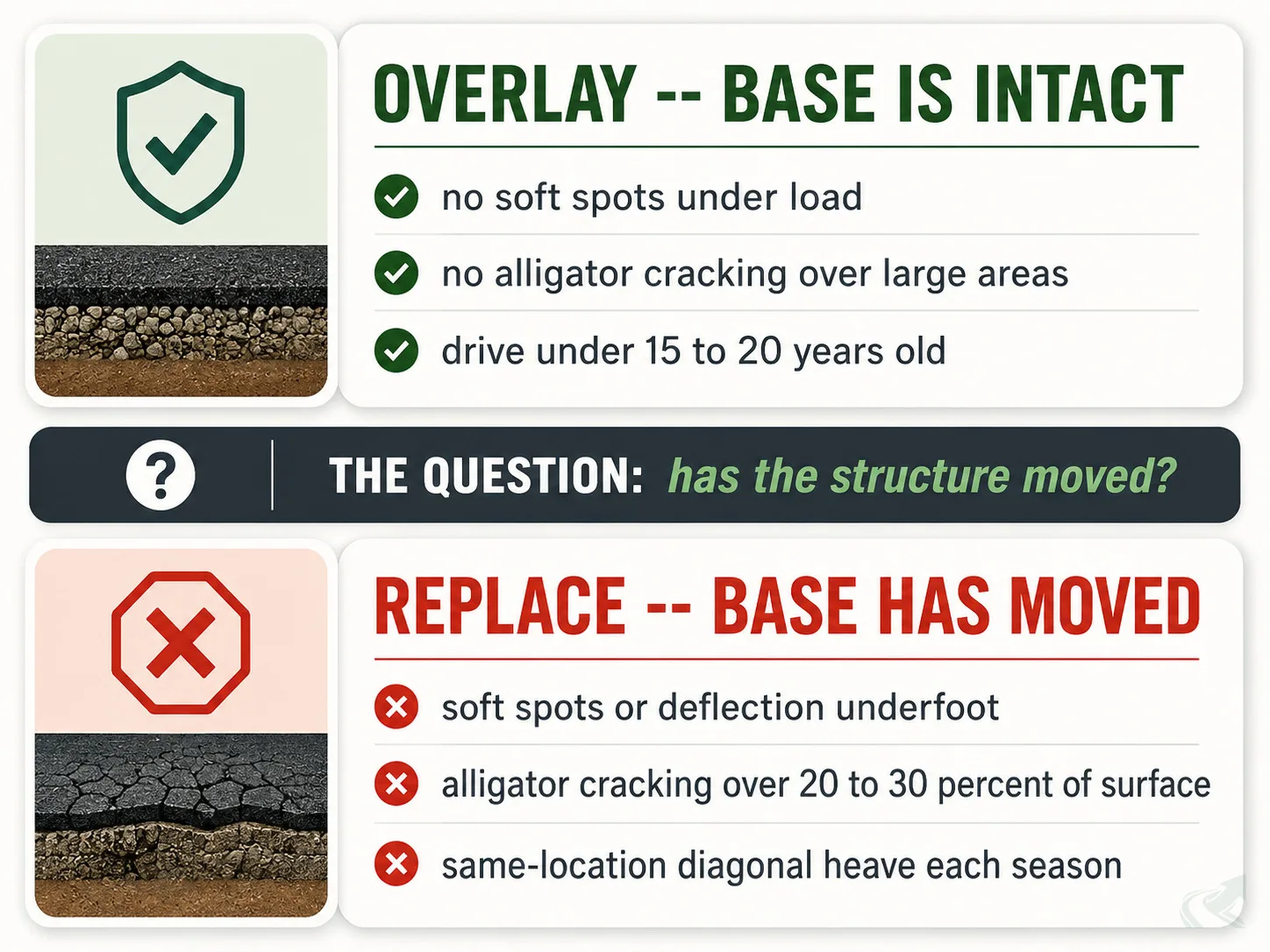
Full removal and replacement is required when the subgrade has failed -- soft spots you can feel underfoot, diagonal or alligator cracking across large areas, heave that returns each winter at the same location. Overlay on failed subgrade in NC Piedmont clay typically lasts 14 to 24 months before the same cracks reappear.
Why do asphalt driveways fail faster in NC Piedmont clay than other regions?
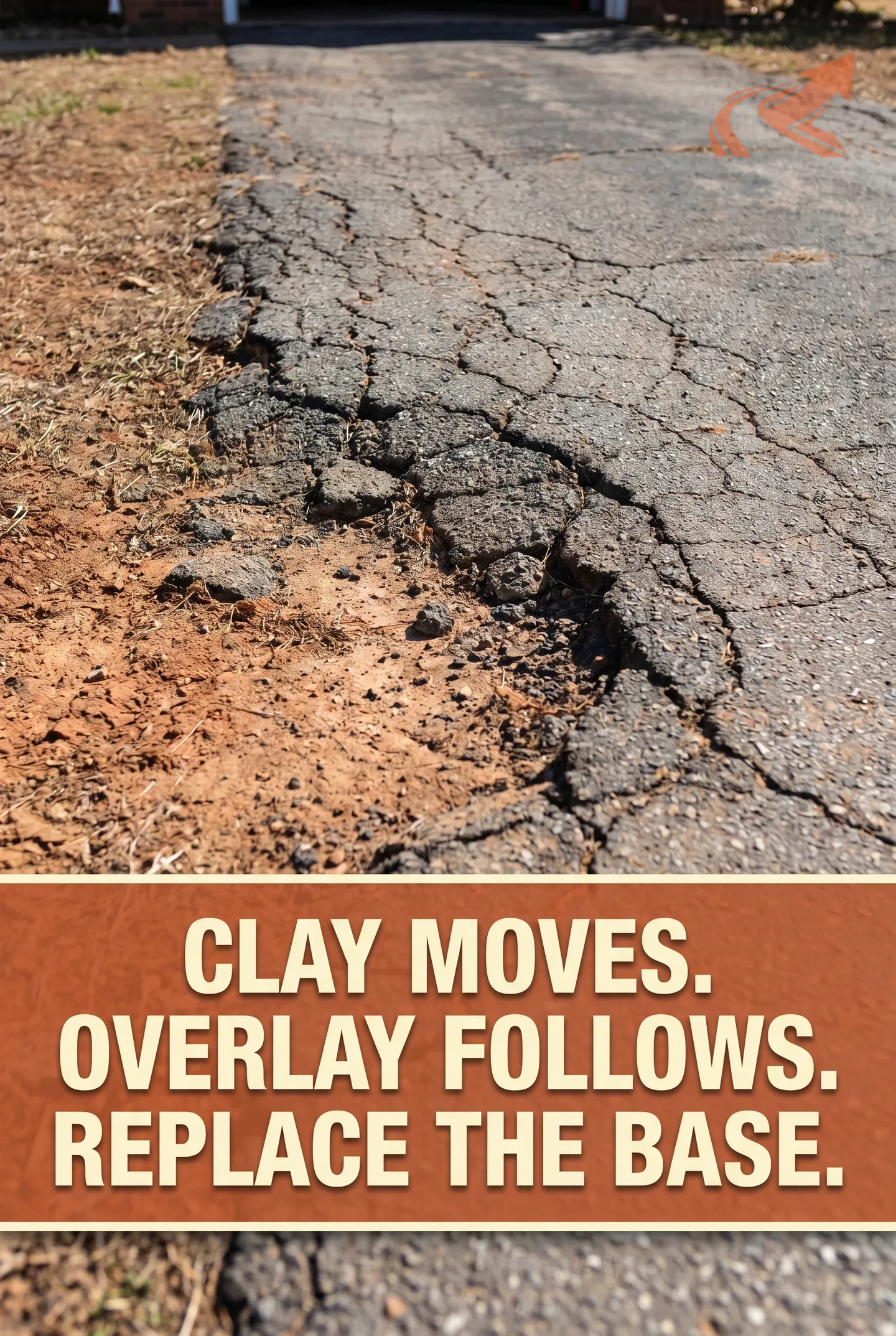
Piedmont red clay swells when wet and contracts when dry. That vertical movement -- sometimes a quarter-inch or more per season -- cracks the asphalt from underneath. Overlay treats the surface. The clay is the problem.
Three years ago, a homeowner in Guilford County paid for an asphalt overlay. Fourteen months later, the same diagonal cracks showed up in the same spots. The contractor’s explanation: “clay movement.” That is not an explanation. That is a description of what failed.
Clay movement means the subgrade was not prepared correctly before the overlay went down. The asphalt is following the subgrade. An overlay on a moving subgrade is a surface treatment applied to a structural problem — and in North Carolina Piedmont clay, structural problems repeat on a predictable schedule.
This page covers what the failure looks like, why asphalt subgrade prep in NC differs from gravel driveway grading, how to decide between overlay and full replacement, and what the correct subgrade sequence looks like before any asphalt work begins.
NC Piedmont Clay Subgrade Failure — What It Looks Like
NC Piedmont red clay behavior is the core problem: it swells when wet and contracts when dry, creating vertical movement the asphalt surface cannot flex with.
The failure pattern is predictable once you know what to look for. Each pattern tells you something different about what failed underneath.
- Alligator cracking over large areas: the base or subgrade has lost bearing capacity across a wide zone. The cracking pattern looks like dried mud — interlocking polygonal cracks. Overlay applied over alligator cracking telegraphs the same pattern through the new surface within 12 to 24 months. The base is the problem, not the asphalt.
- Diagonal heave cracks at the same location each year: same-location, same-angle cracking every winter means geometry-specific subgrade failure at that point. The clay is moving at a specific location — from a drainage concentration, a low spot, or a load-concentrating area. Patching slows the problem; it does not stop it.
- Soft spots you can feel while walking: if you can feel the asphalt deflect under foot — especially after rain — the subgrade has lost bearing. Vehicle loads will continue to accelerate the failure. No surface treatment fixes bearing loss.
- Edge cracking along the driveway perimeter: typically a different cause from interior cracking. Without lateral confinement (concrete curb or compacted shoulder), the edge is the first place load escapes. The pavement unravels outward from the edge.
- Surface cracking that grows the same way every year: not random. If the crack map from last spring looks like the crack map from this spring, the subgrade geometry is driving the failure. The asphalt is mapping the subgrade.
Asphalt subgrade: prepped right vs overlaid on raw clay
Comparison. Prepped right: Active clay assessed, stabilized or replaced before paving; 6-8 inch compacted ABC base at 95% Proctor density; Asphalt surface stays intact -- load distributes evenly. Overlaid on clay: Asphalt laid over untreated Piedmont clay; Clay swells and shrinks with NC's wet-dry cycle; Alligator and diagonal cracks telegraph through in 14-24 months.
- Active clay assessed, stabilized or replaced before paving
- 6-8 inch compacted ABC base at 95% Proctor density
- Asphalt surface stays intact -- load distributes evenly
- Asphalt laid over untreated Piedmont clay
- Clay swells and shrinks with NC's wet-dry cycle
- Alligator and diagonal cracks telegraph through in 14-24 months
Overlay treats the surface; the moving clay underneath is the real problem -- prep is what makes an NC asphalt driveway last.
What Differs About Asphalt Grading vs Gravel Grading
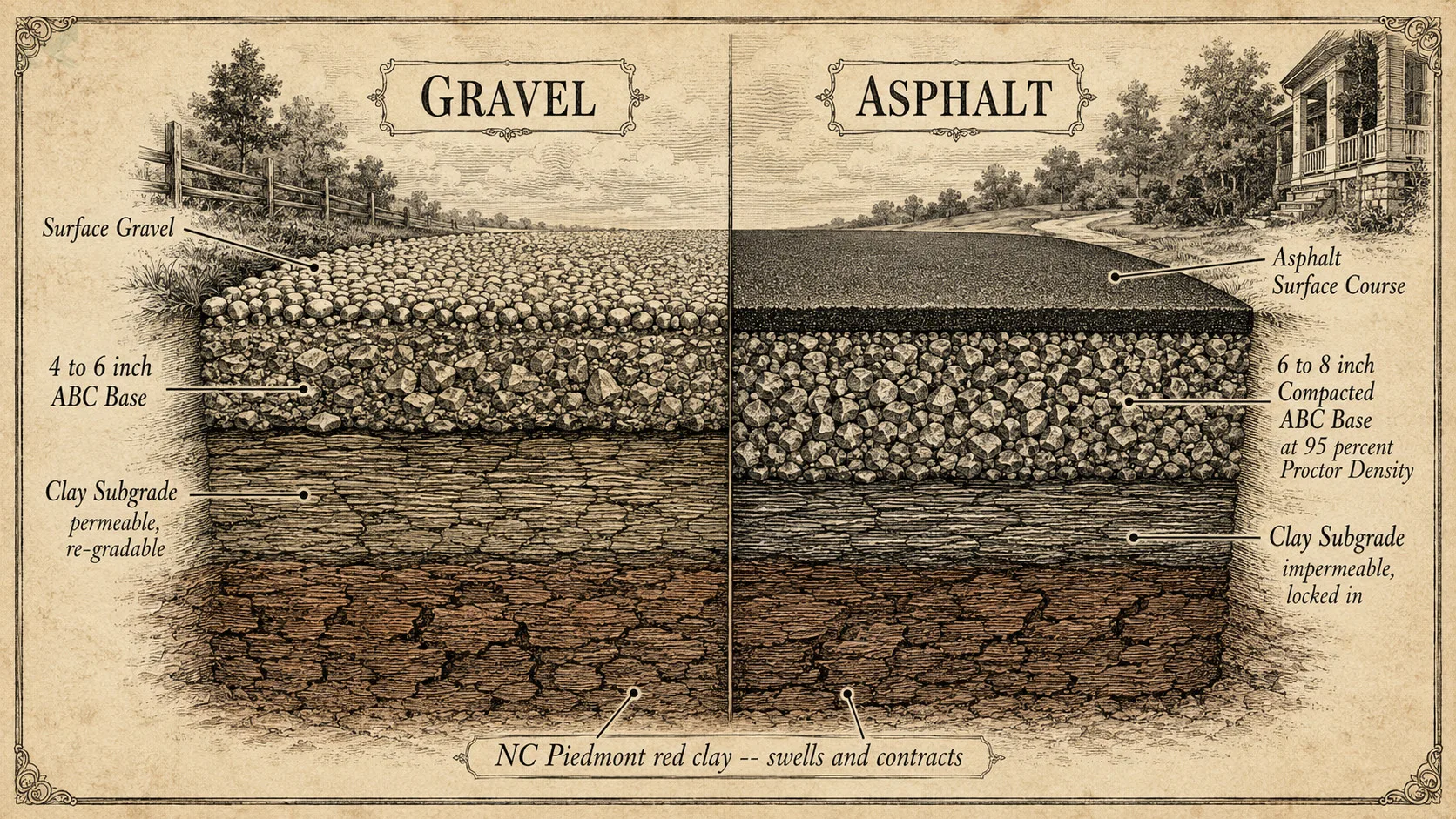
Gravel driveways are maintainable with periodic regrading. Asphalt buries the subgrade under an impermeable surface — prep failures are invisible until they crack through.
A gravel driveway on NC Piedmont clay can work with periodic re-grading because the surface stays permeable and is correctable season to season. Asphalt is a finished surface. Once it is down, the subgrade condition is locked in. The prep standard is higher because the surface does not forgive.
Key differences between asphalt and gravel subgrade requirements:
- Base depth: a gravel driveway on clay can function with 4 to 6 inches of . North Carolina residential asphalt requires a minimum 6 to 8 inch compacted ABC base, because the impermeable asphalt surface concentrates drainage at the edges rather than allowing moisture escape through the surface. NCDOT residential driveway practice and regional paving contractors consistently call for this minimum.
- Compaction spec: specifications for asphalt subbase target 95% Proctor density. Under-compacted subbase under asphalt causes premature settlement — the kind that becomes a pothole or depression after the first full seasonal cycle.
- Edge confinement: asphalt without a concrete curb or compacted gravel shoulder at the perimeter tends to unravel and crack at the edge. Gravel can be patched at the edge with a shovel load. Asphalt edge failure requires saw-cut, removal, and patching.
- Clay stabilization options: some NC Piedmont contractors use lime stabilization on active clay subgrade before asphalt work. Agricultural lime or Type S lime reacts with clay to reduce its plasticity — it compresses the swell-shrink range that cracks asphalt from underneath (how red clay changes with moisture explains the chemistry). Lime stabilization is a commercial road-prep technique more commonly used in NC at the road scale; for residential driveways, contractors more often address active clay by scarifying and replacing it with select fill or ABC. Ask your contractor which approach they are specifying and why.
The Overlay vs Replace Decision — A Framework
Overlay when the base structure is intact. Replace when the base or subgrade has moved.
The operative word is “structure” — not “asphalt.” A structurally intact driveway is one where the ABC base is at proper depth and compaction. The asphalt surface wearing out is not a structural failure. The subgrade shifting is.
Overlay is appropriate when:
- Surface cracking is non-structural: hairline cracks, oxidation, surface delamination from UV, or minor rutting in the wheel path without deflection
- No soft spots under load: probe the surface on foot in wet conditions. No deflection = base is holding
- No alligator cracking over large areas: isolated surface cracking away from the pattern described above
- Core sample or probe shows intact base: a contractor quoting overlay should be able to tell you the base depth. If they can’t, they haven’t checked.
- Drive is under 15 to 20 years old with no history of base failure or flooding
Full removal and rebuild is required when:
- Soft spots or visible deflection under foot or vehicle: bearing is gone
- Alligator cracking covers more than 20 to 30 percent of the surface area: the base has failed across too much area to patch
- Same-location diagonal heave cracks reappear each season: geometry-specific subgrade failure at those points
- Edge delamination with subgrade exposure: the driveway is losing its structural edge — driveway washout repair NC typically follows when this goes unaddressed
- Drive is more than 20 to 25 years old on NC Piedmont clay without prior base replacement — clay driveways in the Triad and Triangle rarely outlast this window without some base work
What a contractor should do before quoting overlay: probe the surface at soft spots, check base depth through a crack or bore, and do a visual deflection test with a loaded truck (proof-roll). A quote that does not involve any base assessment is a surface-only quote. It has no guarantee about the base.
How Subgrade Prep Works for NC Asphalt
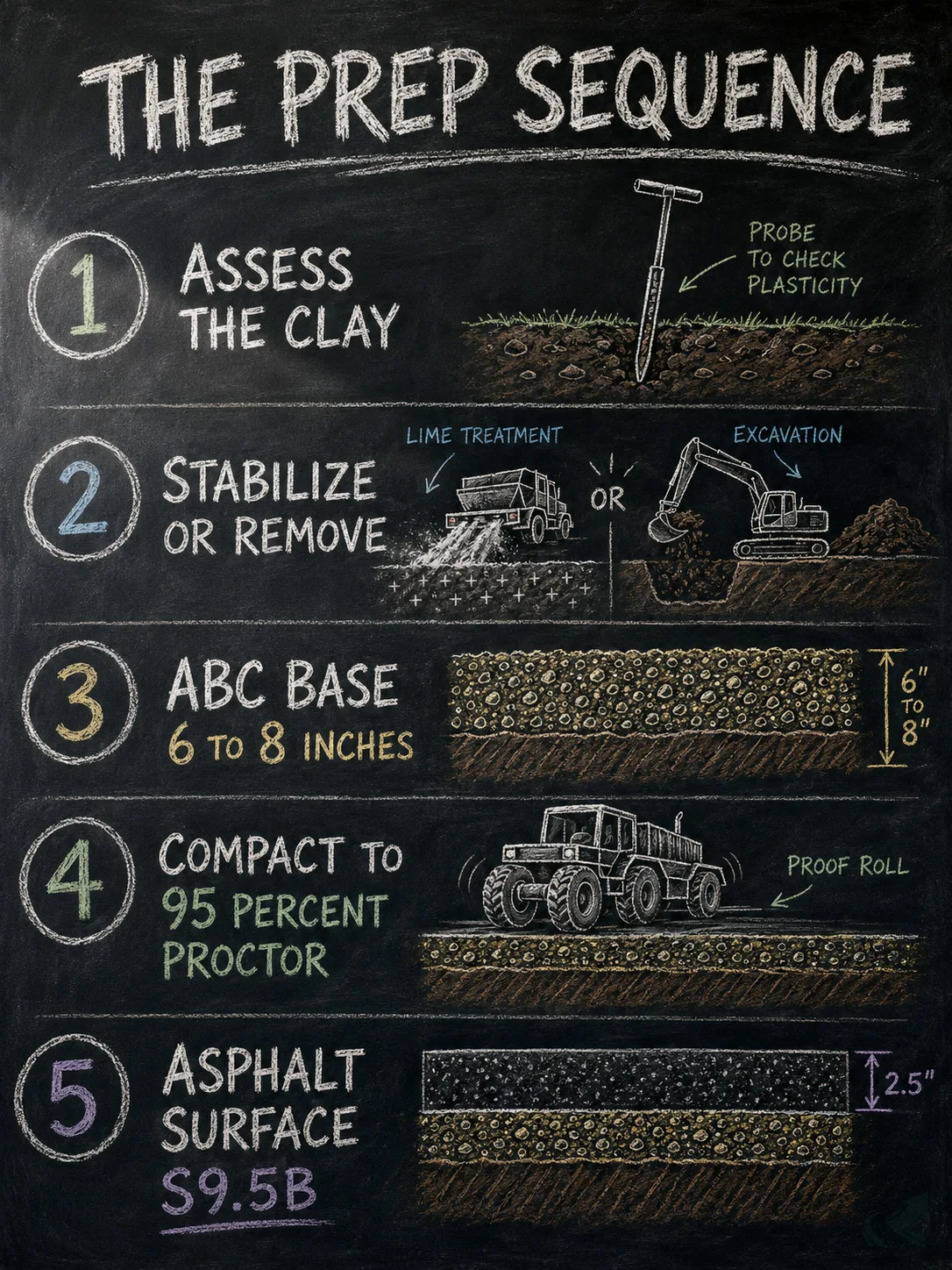
Proper asphalt subgrade prep in North Carolina Piedmont starts with clay assessment or stabilization, then ABC base at correct depth and compaction, then the asphalt surface.
Skipping any step in this sequence is what creates the 14-month overlay failure. The prep sequence for a properly built NC asphalt driveway:
- Assess the clay: probe or core to determine whether the subgrade clay is stable or actively moving. Moisture content and density readings tell the contractor whether the base can be built directly on top or whether the clay needs treatment first.
- Stabilize or remove: for active Piedmont clay, the two options are lime stabilization (lime reacts with clay minerals to reduce swell-shrink behavior, then the treated layer is compacted) or scarify and replace with select fill. Full clay removal down to stable material is sometimes required on driveways with documented flooding or high water tables.
- ABC base at correct depth: minimum 6 to 8 inches of compacted aggregate base course for residential asphalt. Higher for driveways that carry regular truck traffic (deliveries, equipment, heavy vehicles).
- Compaction to spec: 95% Proctor density minimum at the subbase level. The contractor should proof-roll with a loaded dump truck before asphalt placement — how operators test driveway compaction is covered in detail if you want to know what to watch for.
- Asphalt surface: standard NC residential asphalt uses a binder course plus surface course. The NCDOT S9.5B surface mix is the most common specification for residential driveways in the Triad and Triangle; local paving contractors may use equivalent mixes depending on regional plant availability.
What happens when this sequence is skipped: the asphalt surface goes down on insufficiently prepared subgrade. NC seasonal moisture cycles (wet winters, dry summers) cause the clay to move. The asphalt follows. The driveway starts cracking within the first full season.
Before You Sign the Asphalt Quote
An asphalt driveway quote without a base assessment is a surface quote. It may be honest about what it covers — but if the subgrade is the problem, that surface quote is a 14-month fix billed as a driveway repair.
Before you approve any asphalt work, ask the contractor two specific questions:
- What is the base depth under my existing asphalt? A contractor who has assessed the job can answer this in inches. One who hasn’t assessed it cannot.
- What compaction spec are you targeting on the subbase? The right answer is 95% Proctor or higher. “We compact it good” is not a specification.
An itemized quote for asphalt driveway work should show base prep separately from asphalt material and installation. If everything is bundled into a single line item, ask for it broken out. You need to see what the contractor is actually planning to do underneath.
For the full driveway grading process in North Carolina, see how driveway grading works in NC. If cost is the next question, how much does asphalt driveway grading cost in NC walks through the price drivers. And if you want to compare asphalt with a lower-cost surface option first, see asphalt millings as an overlay alternative.
Hire a licensed NC grading contractor who can assess your subgrade and give you an itemized quote — not a round number that bundles surface and base into one line.